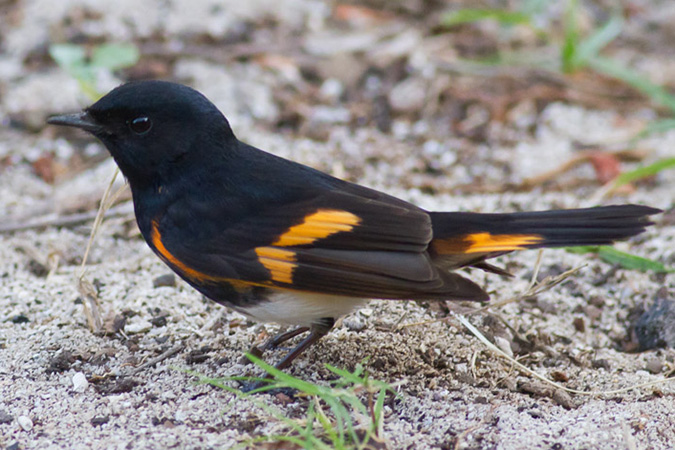
When the male American Redstart (a warbler) arrives, with his distinctive black and orange markings, identification is swift.
Each autumn I’m reminded of why field guides often have a page entitled “confusing fall warblers.” These “butterflies of the bird world” are just plain ‘ole hard to identify! Memorizing their yellows and olives, undertail covert colors, auricular (feathers over the ears) and supercilium (“eyebrow”) colors, wing bar patterns (if any) and breast feather characteristics, all while they’re flitting nonstop, is a challenge.

This sweetly-songed wood warbler is (along with the Black-and-white Warbler) one of the most distinct in the Blue Ridge. They breed here in summer and migrate through the region in fall and spring. For the latter, they often only stay for a day at any one location during the journey, which they make mostly at night.
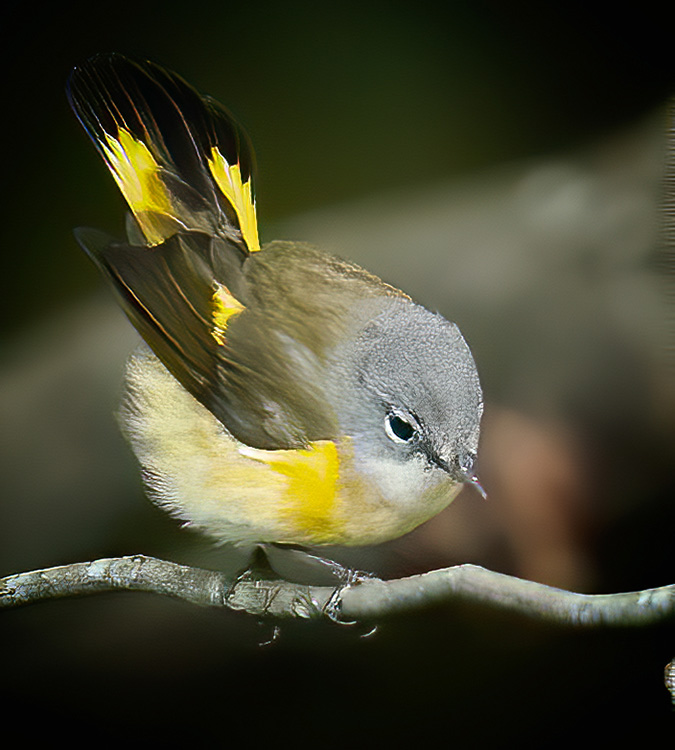
I’m not a person who wants to “golf course” the yard; and Nature’s shrub-line along the back of the property rewards me regularly with visitors like the American Redstart.
Fun Facts
In their winter homes of Central America, the Caribbean and northern South America this species is called candelita, meaning “little torch.”
How to Identify an American Redstart
To identify the female (who also flits amongst the brushes), here’s a tip: She is grayish where he is black; and her yellow markings will roughly coincide with the male’s orange markings.
American Redstart Habitat
The American Redstart prefers second-growth interior woodland habitats with abundant shrubs, saplings and a moist, mixed-deciduous character. They spend winters in shade coffee and citrus plantations, mangroves and wet forest.
Conservation Note
Habitat loss is causing small to significant declines (depending on location) of this widespread and otherwise numerous warbler.
ABOUT THIS SERIES:
“Birds of the Blue Ridge” showcases frequently seen and rare birds across the southern Appalachian region. For over four decades, Angela Minor has traveled with binoculars and field guides across the continental U.S., Alaska, the Caribbean and seven European countries. She is a contributing editor with BRC magazine and a freelance writer, penning travel and nature feature articles for several regional and national print publications. Angela created and authored the state park birding series for Bird Watcher’s Digest.
Read More by Angela Minor: BlueRidgeCountry.com/AngelaMinor