Guest Column: Preserving the Song of the Forest

Todd Fearer

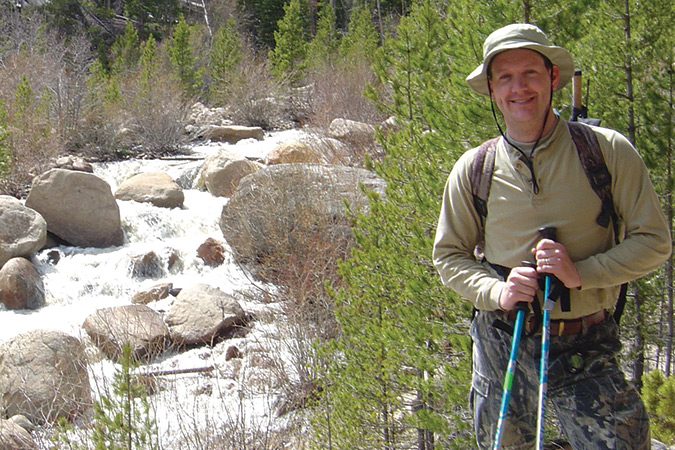
Todd Fearer is a wildlife biologist, avid outdoorsman, and the coordinator of the Appalachian Mountains Joint Venture, one of 21 U.S. Fish and Wildlife Service Migratory Bird Joint Ventures (JVs).  He lives in Christiansburg, Virginia, with his wife, Stephanie, and four children. 

Photo Above: Todd Fearer.

I will never forget the first time I heard the song. It was one of the most melodic, almost ethereal sounds I’d heard. I was young, maybe 11 or 12, and camping with my parents on our 75 acres of forest land couched in the mountains of Preston County in north-central West Virginia. It was a cool morning in early June, and I immediately set out to find the source of this slow, flute-like melody wafting through the forest undergrowth.

My search ended in vain, partly because I didn’t have binoculars at the time, but also because I didn’t know exactly what I was looking for. I know now that I was hearing a wood thrush singing, a forest songbird common in the Appalachians.

Much has changed since that cool June morning, but one thing that hasn’t is my love for the wood thrush’s song. They are my favorite bird, and I pause every time I hear one. The Appalachians are in the core of the wood thrush’s breeding range, but unfortunately their population has declined by over 50% since the late 1960s, and they’re not alone.

According to a study published in the October 2019 issue of the journal Science, we’ve lost 2.9 billion breeding adult birds from the United States and Canada—more than a quarter of our birdlife—since 1970. Even birds common at our feeders, like dark-eyed juncos and blue jays, are declining.
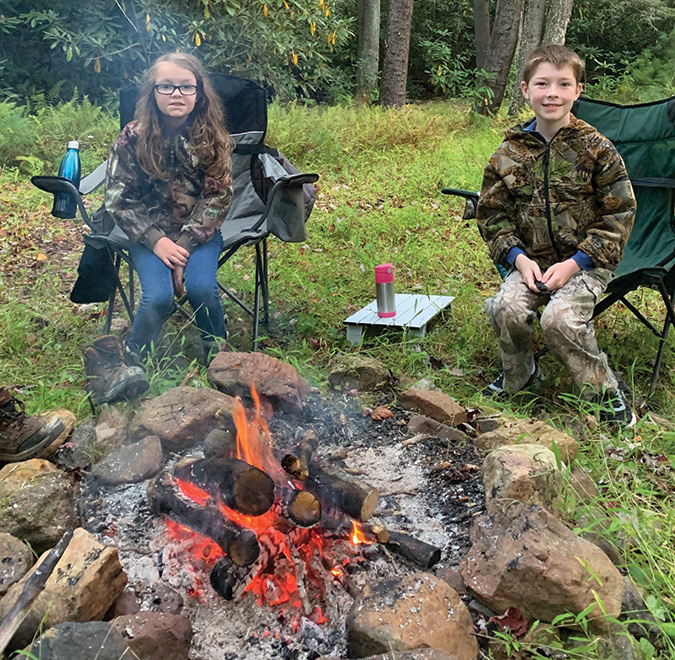
Two of Todd Fearer’s four children—Chloe and Grayson—accompanied dad on a camping trip last fall, a trip that included an encounter with a small flock of wood thrushes.

While a decline of this magnitude is daunting, I believe it should be a call to action. The study points out that some species, such as waterfowl, have increased in abundance thanks to concerted conservation efforts. As coordinator of the Appalachian Mountains Joint Venture—a regional partnership of government agencies, non-profit organizations, corporations and individuals working to conserve habitat for the benefit of birds, other wildlife and people—I’m happy to say that similar conservation efforts are occurring across the Appalachians. But it’s important that we, as individuals, take our own actions, such as planting native flowers in our yard, avoiding pesticide use and drinking bird-friendly coffee, just to name a few. The greatest conservation impact will be realized if actions are taken at all scales—from landscape-level initiatives to individual acts of conservation.

Early last September found me on another camping trip with my two youngest children—this time at one of my favorite spots along the North Fork of Stony Creek in Jefferson National Forest. And again, we were blessed with the presence of wood thrush—a small flock of at least a dozen were taking a brief respite from their trek south, their summer song replaced by sharp eeks and pit-pit-pit calls as they foraged for insects in the trees and shrubs surrounding our campsite. I look forward to their return in the spring, and the chance to share their beautiful melody with my children.   


The story above appears in our March/April 2020 issue.


You Might Also Like:

Mia Hall: Executive Director of Penland School for Craft

The Mountain Q&A – Mia Hall: Executive Director of Penland School for Craft

She came from Sweden to America as an international student, and now leads one of the country’s oldest and most prestigious art schools.
Courtesy of Jeff Eastman

The Mountain Q&A – Jeff Eastman: CEO, Remote Area Medical

Remote Area Medical, with roots in the Southern Appalachians, has provided free health care since 1985 to over 1 million people through mobile pop-up clinics across the nation. “Free Is In Our DNA.”
b8c626fe-9f9c-11f0-88d9-1248ae80e59d-photo-of-Betty-and-Robert-Balentine

The Mountain Q&A – Betty & Robert Balentine: Founders of Southern Highlands Reserve

The 120-acre mountaintop property is the only high-elevation native plant garden in the eastern United States.
09723834-6e21-11f0-ba49-1248ae80e59d-portrait

The Mountain Q&A – Dolly Parton: The Nation’s Sweetheart, Among So Many Other Things

The award-winning songwriter, entertainer, global philanthropist and creator of Imagination Library is also celebrating the 40th anniversary of her theme park Dollywood.
Chattanooga Mayor, Tim Kelly

The Mountain Q&A – Tim Kelly: Mayor of Chattanooga, Tennessee

Mayor since 2021, Kelly led Chattanooga in becoming North America’s first National Park City in 2025 and a global destination. He calls his hometown “a city inside a park.”
Virginia State Parks Director, Dr. Melissa Baker

The Mountain Q&A – Dr. Melissa Baker: Director of Virginia State Parks

She leads Virginia State Parks, the first state in the nation to open a system of parks. “From the mountains to the piedmont, you can get just about anything you want in Virginia.”
Lindsey Gallaher

The Mountain Q&A – Lindsey Gallaher: President of The Museum of Appalachia

This granddaughter of Museum of Appalachia founder John Rice Irwin now leads the 54-year-old East Tennessee museum, keeping the stories alive and showing visitors how people of Southern Appalachia lived in the 1800s.
99cf05e8-cec5-11ef-b165-12163087a831-Blenko-Glass-President-John-Blenko

The Mountain Q&A – John Blenko: President of Blenko Glass in Milton, West Virginia

John Blenko is the fourth generation to lead this 131-year-old company in making hand-blown glass popular throughout the world.
44ca52dc-9879-11ef-9a5f-12163087a831-t

The Mountain Q&A – Tom Bailey: Executive Director of the Southern Highland Craft Guild

Tom Bailey is leading the second-oldest craft organization in America toward its 100th birthday with big dreams for its future in multiple locations.
1e7cab66-7137-11ef-aad4-12163087a831-Kasey-with-Leaf

The Mountain Q&A – Kasey Krouse: Tree Advocate Wears Many Hats

Knoxville’s urban forester since 2012 promotes the benefits of trees while growing the region’s tree canopy. He was educated at Purdue and, with his wife, Beth, is the father of two young daughters.

CALENDAR OF EVENTS