Skip to content

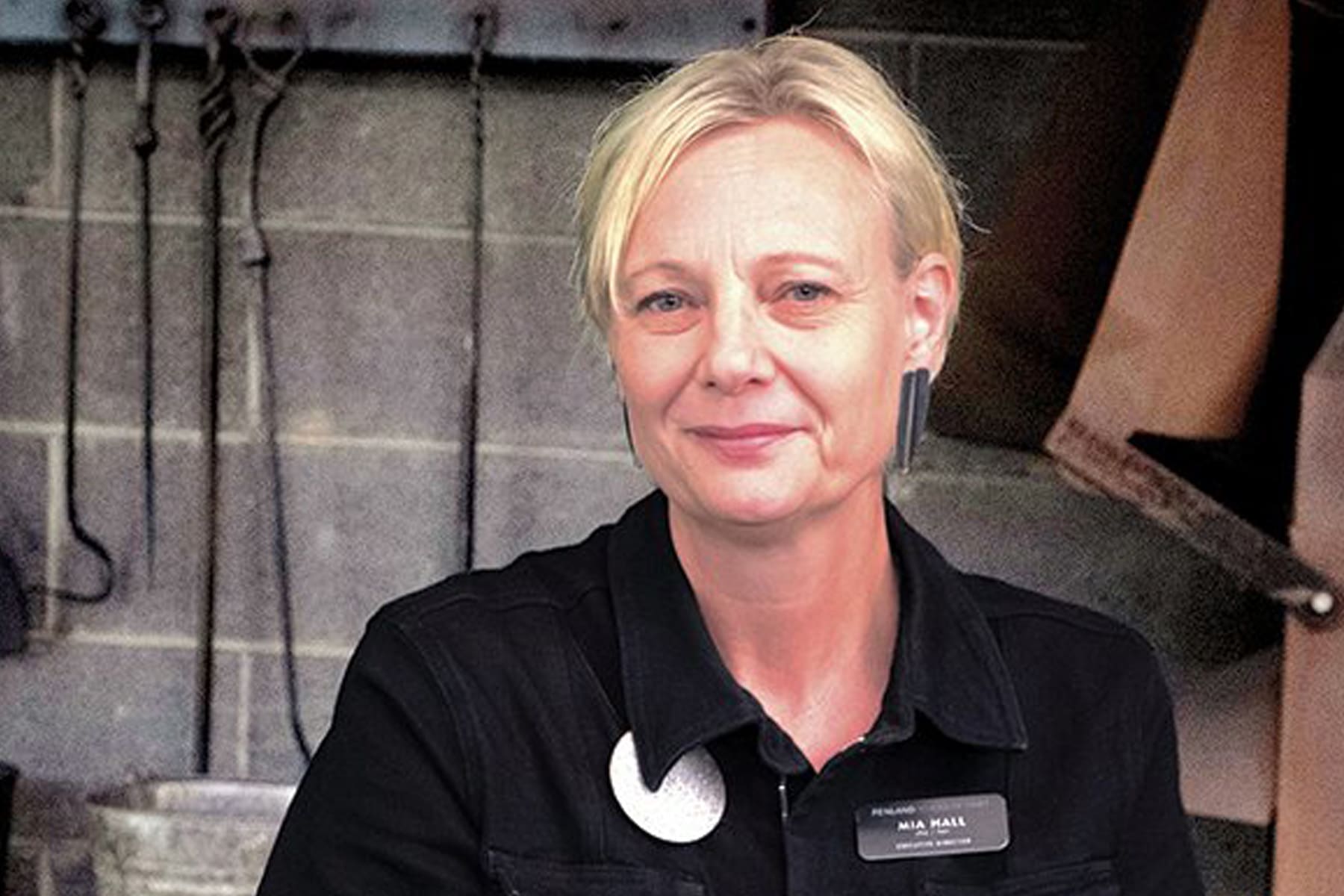
She came from Sweden to America as an international student, and now leads one of the country’s oldest and most prestigious art schools.
Photo Above: Courtesy of Mia Hall.
Tell us about your journey from your native Sweden, crossing the United States and ending up in Bakersville, North Carolina.

My grandfather was born in Minnesota but returned to Sweden as a young child. I always had a strong fascination with everything American and knew from an early age that I wanted to live in the United States.
I came here as an international student and earned my undergraduate and graduate degrees in furniture design from San Diego State University. That path led me into academic teaching and a professor position at the University of Arkansas for nearly 10 years. Then, nine years ago, the Board of Trustees at Penland School of Craft offered me the position of Penland’s seventh executive director. I met my husband, David Clemons, in graduate school. He has a thriving metalsmith studio practice and also works at Penland.
What is Penland School of Craft, and who goes there?
Penland is dedicated to helping people live creative lives. Located in the Blue Ridge Mountains of North Carolina, Penland offers one-, two-, six- and eight-week workshops in books and paper, clay, drawing, glass, iron, metals, photography, printmaking and letterpress, textiles and wood. Students come from every state in the nation and from 15 other countries. They spend time with other makers who are passionate about exploring the wonderful act of making beautiful things by hand.
Penland also offers artists’ residencies and community collaboration programs and is a world-class art gallery and information center. We welcome artists of all experience levels and are unique because of the immersive teaching. Students typically stay on campus and have a singular focus. What we know is that you can teach a chemistry class in an art studio. This is the kind of holistic learning Penland teaches.
You are an enthusiastic fan of Lucy Morgan, who founded Penland in 1929. What has changed since the school’s early days, and what’s stayed the same?
In 1929, a group of weavers from the region traveled to Penland to study with a master weaver from New York. Those artists stayed on campus and for one week had a singular focus — to gain new skills. Today, of course, the operation has grown dramatically. We now offer over 130 classes a year in 16 highly equipped studios. The reasons for attending Penland haven’t changed: a great sense of community, deep curiosity and increased lifelong learning.
What do you and your family enjoy doing together?
Our 18-year-old son Bastien is an avid equestrian and competes in eventing — a competition that consists of dressage, show jumping and cross-country over fixed jumps. Most of my weekends and many evenings are spent at the barn or at horse shows across the southeastern United States. I also have two of Bastien’s retired horses living on campus, and I love caring for and interacting with them several times a day.
What is next for Penland? What does the future look like?
Our 100th anniversary is coming up, and we are planning a year-long celebration. This is a great opportunity to be looking back at our long history as well as forward into the future. We are already the largest such school in the nation, so we are not aiming to grow larger. We are now working on building a more sustainable, resilient, diverse community. We want to make sure Penland School for Craft will be as vibrant and relevant a model in 100 years as it is today!
The story above first appeared in our March / April 2026 issue.