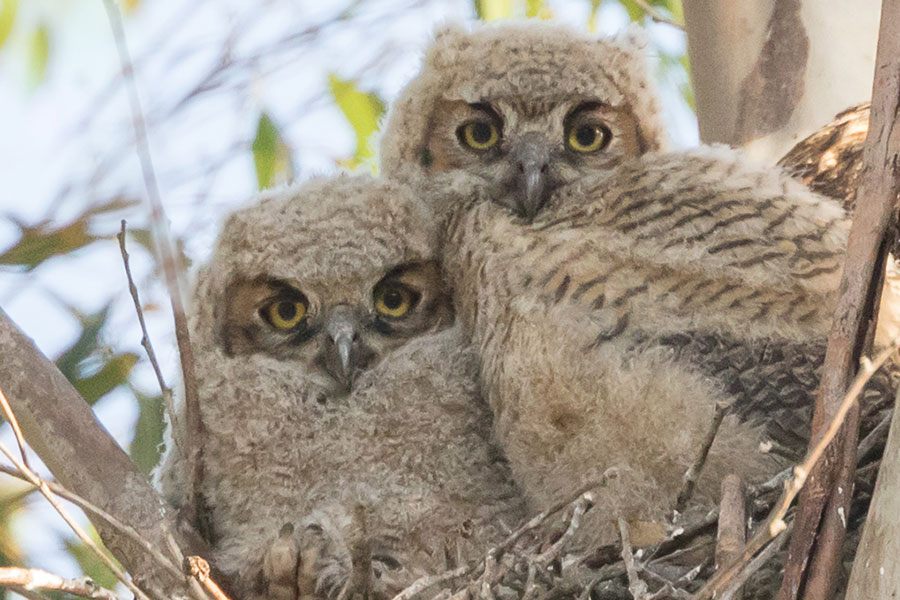
The Great Horned Owl is one of our largest and most common owls.
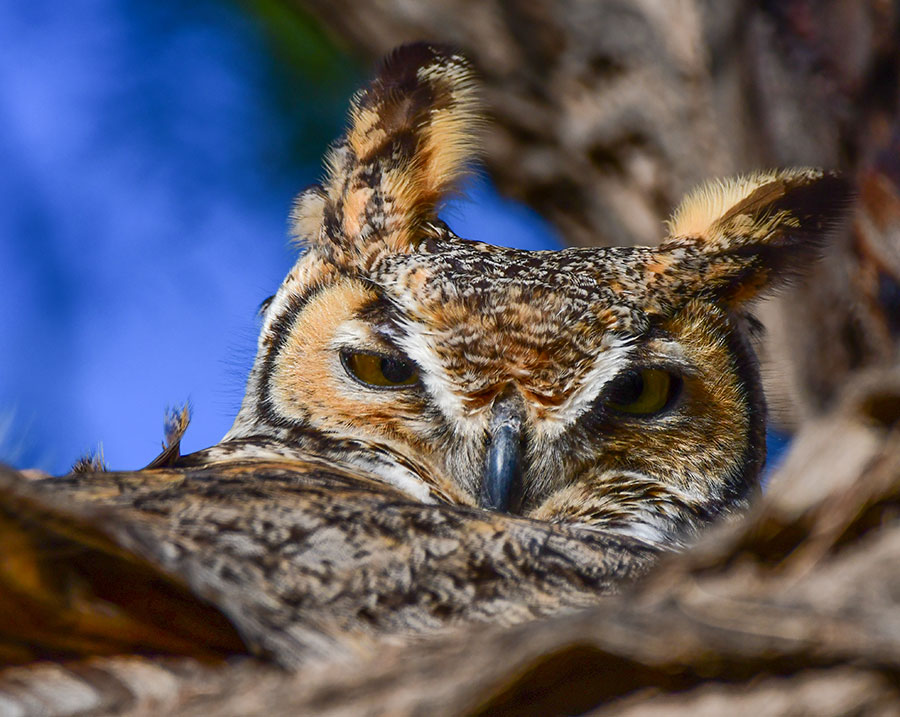
However, this bird, made famous in storybooks, myths and legends, has neither horns nor visible ears. The tufts upon their heads are feathers only. Several theories exist as to their function: blending in with the surroundings, recognition amongst individuals and/or territorial displays.

Great Horned Owls have exceptional vision in low light. Their eyes do not move in the sockets, hence their ability to turn their heads a total of 270 degrees (humans can swivel about 180 degrees). They have sharp hearing due in part to disc-shaped feathers on their faces. It is reported that owls can hear a mouse snap a twig from 75 feet away! And, they fly silently through the air due to special arrangements of feathers on the wings.
Mated pairs are monogamous, fierce defenders of the nest and successfully excellent parents. When hissing, bill-snapping and other noises fail to deter threats, they may strike predators with their talons, which can require 28 pounds of force to open once clamped.
Fun Facts
The female Great Horned Owls are larger than the males and have a higher pitched voice. With a bit of well-timed eavesdropping, we can hear their nighttime conversations.
How to Identify a Great Horned Owl
Our eastern Great Horned Owl colors are rich with tawny orange faces and densely barred feathers below. The females are generally browner with heavier markings. This species can be 19 to 25 inches tall and have a wingspan of more than 4.5 feet!
Great Horned Owl Habitat
Highly adaptable in a wide variety of habitats including forests, swamps, farmland, deserts and urban neighborhoods and parks.
Conservation Note
Populations are stable with numbers rising and falling in relation to prey availability. Susceptible to pesticides/toxins used for rodent control.
ABOUT THIS SERIES:
“Birds of the Blue Ridge” showcases frequently seen and rare birds across the southern Appalachian region. For over four decades, Angela Minor has traveled with binoculars and field guides across the continental U.S., Alaska, the Caribbean and seven European countries. She is a contributing editor with BRC magazine and a freelance writer, penning travel and nature feature articles for several regional and national print publications. Angela created and authored the state park birding series for Bird Watcher’s Digest.
Read More by Angela Minor: BlueRidgeCountry.com/AngelaMinor