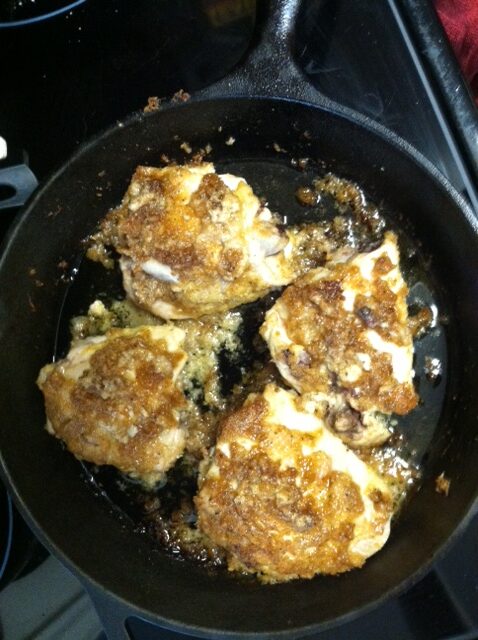
The Wannabe Chef: Lemon Mustard Chicken

My apologies for what seems to be a constant theme for me lately: lemon. But as I hold on to the last bit of summer, it’s a flavor I continue to crave. And as I was browsing for a recipe to try on my first attempt at cooking with chicken thighs, this dish immediately jumped out at me.

I had most of the ingredients on hand, and I had a chance to make use of my cast iron skillet in the oven instead of just on the stovetop. The recipe calls for both lemon and lime juice, but since I only had a lemon, I just doubled the amount of lemon juice. And for an extra tang, I used Dijon mustard instead of yellow mustard. The result is a buttery, lemony goodness that had me almost licking my plate. Even the baby liked it, and she’s been shying away from chicken lately. Success!

Lemon Mustard Chicken

*recipe adapted from Allrecipes.com

  • 5 tablespoons lemon juice
  • 5 tablespoons fresh lime juice
  • 4 tablespoons prepared mustard
  • 6 chicken thighs
  • 3/4 teaspoon salt
  • 1/2 teaspoon ground black pepper
  • 1/4 teaspoon curry powder
  • 1/4 teaspoon dried oregano
  • 1 tablespoon lemon zest
  • 1 cup dried bread crumbs
  • 6 tablespoons butter
  • 1 lemon – sliced, for garnish
  • 1 tablespoon chopped fresh parsley, for garnish

Combine lemon and lime juices with the prepared mustard. Brush over chicken. Set aside.

Combine bread crumbs, salt, pepper, curry powder, oregano, and grated lemon peel. Roll chicken in crumb mix, coating well.

In a heavy baking pan or iron skillet, melt butter or margarine over medium heat. Place chicken in pan, skin side down.

Place in a preheated 350 degree F (175 degree C) oven. Bake, uncovered, for 20 minutes. Turn chicken and bake until tender, about 30 more minutes. Serve on a warm platter with sliced lemons and chopped parsley, if desired.
You Might Also Like:

e1b70596-05c8-11f1-92e0-1248ae80e59d-3-2026rueanemone--credit-Joe-Cook

March’s Mountain Wildflower: Rue Anemone

A member of the buttercup family and found in the open woodlands, rue anemone (Thalictrum thalictroides) has long, thin stems that tremble in the slightest of winds—prompting its other common name, windflower.
Pokeweed growing in Floyd County, Virginia.

January’s Wild Edible: Pokeweed

Pokeweed is one of the wild plants that is most associated with the Blue Ridge Region.
A purple-spored puffball growing in a field in Botetourt County, VA.

December’s Wild Edible: Purple-Spored Puffball

The purple-spored typically grows in this region’s fields, often appearing from October through December and into early January.
d289022c-696f-11f0-a179-1248ae80e59d-CGZ_0845-011

Ride the Rails, Explore Rockbridge County: Make a Weekend of the 611 in Goshen!

This fall, one of America’s most iconic steam locomotives is making tracks and memories.
The compound, lancelike leaflets of the bitternut are a good identifier.

November’s Wild Edible: Bitternut Hickory

Frankly, this native species to the Blue Ridge mountains comes by its name honestly.
Mullein growing in Ingram's backyard.

October’s Wild Edible: Mullein

Earlier, this year, a lone mullein plant appeared along the fence that encloses my garden, which made me curious about this plant.
An indigo milk cap growing in Botetourt County, Virginia.

September’s Wild Edible: Indigo Milk Caps

When young, indigo milk caps are one of the most stunningly beautiful mushrooms in the Blue Ridge Mountains.
ec3b964c-5201-11f0-968d-1248ae80e59d-9-2025spottedjewelweed--credit-Joe-Cook-and-Monica-Sheppard

September’s Mountain Wildflower: Spotted Jewelweed

Seek out spotted jewelweed growing beside a stream or along a moist area and you will have a good chance of getting to watch one or more ruby-throated hummingbirds flit from flower to flower.
A black staining polypore growing in Botetourt County, VA.

August’s Wild Edible: Black-Staining Polypore

The black-staining polypore is certainly one of the more fascinating wild edible mushrooms.
Northern Dewberry growing in Botetourt County, Virginia.

July’s Wild Edible: Northern Dewberry

For several reasons, the northern dewberry is often overlooked as a summer berry in the Blue Ridge.

CALENDAR OF EVENTS