March’s Mountain Wildflower: Bloodroot

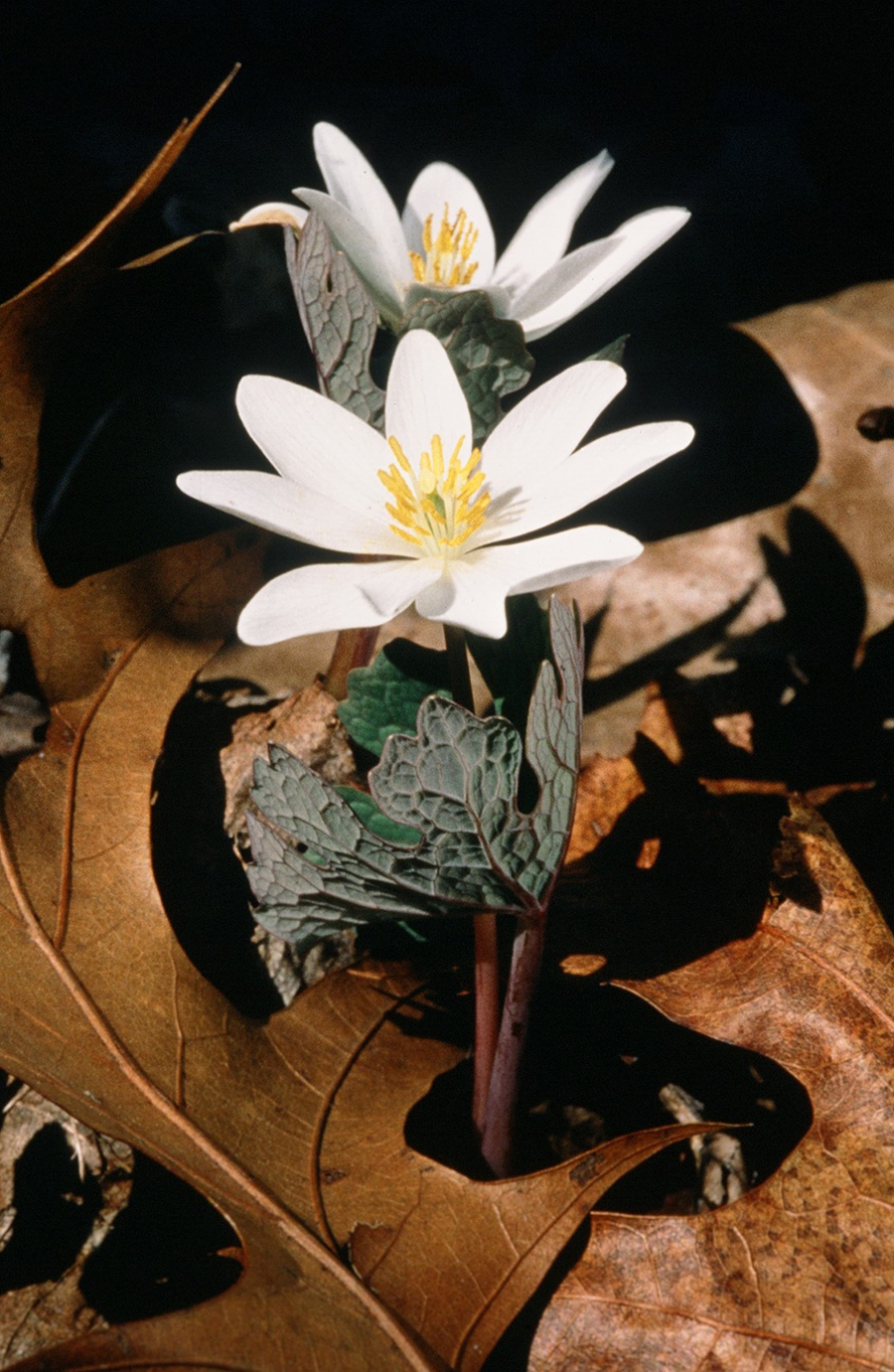
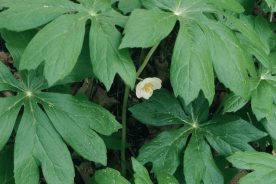
One of the pleasures of a late winter/early spring walk in the woods is spying the tightly-wound green leaf of a bloodroot (Sanguinaria Canadensis) plant pushing its way through the frost-encrusted soil.

It must endure the cold temperatures of this time of year so the leaves stay curled around the stems to conserve warmth and do not fully expand until pollination occurs. Because insects so vital to the pollination process are scarce at this time of year, the bloodroot flower—which usually only lasts two to four day—has developed the ability to produce copious amounts of pollen. This helps ensure self-pollination if no insects happen by. To protect its reproductive parts, the flower closes up at night until pollination does occur. Within two to three weeks of that event, light green pods appear, which eventually split open and release the seeds for dispersal.

Bloodroot’s name comes from the red or orange sap which flows freely whenever its stem or root is cut or broken. Native American used the sap as an insect repellent, a treatment for rheumatism and ringworm, and a dye for clothing, baskets and facial paint. Today, several companies market toothpaste and mouthwash that incorporate ingredients from the plant to help fight plaque buildup and gingivitis, or gum disease. Several studies bear out this claim, but some have shown that it is effective only if users employ both the toothpaste and the mouthwash.

Flower Fast Facts

FLOWER: The one- to two-inch blossom has eight or more white to pinkish petals around a cluster of many sepals.

LEAVES AND STEM: A single, five- to nine-lobed leaf enfolds the stem when it first appears, but opens fully after the flower has bloomed. Persists into late summer.

BLOOM SEASON: March to May


About This Series

“Mountain Wildflowers” features a wildflower from the Blue Ridge region each month from March to October. Leonard M. Adkins has written for Blue Ridge Country for more than two decades and is the author of 20 books about travel, hiking and nature. His Wildflowers of the Appalachian Trail, which received the prestigious National Outdoor Book Award, provides the photographs and some of the information he writes about in each “Mountain Wildflowers.” It and his other works may be obtained through his website.

You Might Also Like:

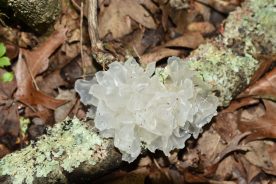
White jelly snow fungus growing in the author’s Botetourt County, Virginia woodlot.

May’s Wild Edible: White Jelly Snow Fungus

“Pass the fungus,” is not common dinnertime conversation in the Blue Ridge Mountains region, but that’s because folks perhaps have not heard of the white jelly snow fungus.
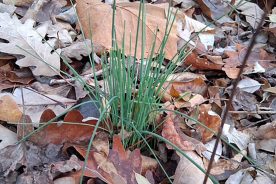
Wild garlic growing in Fayette County, West Virginia.

April’s Wild Edible: Wild Garlic

Fayette County, West Virginia’s Mitchell Dech is one of my foraging mentors, and when he wants me to try an edible new to me … I’m ready to learn about it.
Trout Lilly. Credit Joe Cook and Monica Sheppard

April’s Mountain Wildflower: Trout Lily

Like its western relative the glacier lily (Erythronium grandiflorum), trout lily (Erythronium americanum) is often found pushing its way through a blanket of snow in early spring.
A May apple in bloom in Southwest Virginia.

March’s Wild Edible: May Apple

Sometime this month in the Blue Ridge Mountains, one of these highlands’ signature spring plants will ease from the soil … the May apple (Podophyllum peltatum).
e1b70596-05c8-11f1-92e0-1248ae80e59d-3-2026rueanemone--credit-Joe-Cook

March’s Mountain Wildflower: Rue Anemone

A member of the buttercup family and found in the open woodlands, rue anemone (Thalictrum thalictroides) has long, thin stems that tremble in the slightest of winds—prompting its other common name, windflower.
Pokeweed growing in Floyd County, Virginia.

January’s Wild Edible: Pokeweed

Pokeweed is one of the wild plants that is most associated with the Blue Ridge Region.
A purple-spored puffball growing in a field in Botetourt County, VA.

December’s Wild Edible: Purple-Spored Puffball

The purple-spored typically grows in this region’s fields, often appearing from October through December and into early January.
d289022c-696f-11f0-a179-1248ae80e59d-CGZ_0845-011

Ride the Rails, Explore Rockbridge County: Make a Weekend of the 611 in Goshen!

This fall, one of America’s most iconic steam locomotives is making tracks and memories.
The compound, lancelike leaflets of the bitternut are a good identifier.

November’s Wild Edible: Bitternut Hickory

Frankly, this native species to the Blue Ridge mountains comes by its name honestly.
Mullein growing in Ingram's backyard.

October’s Wild Edible: Mullein

Earlier, this year, a lone mullein plant appeared along the fence that encloses my garden, which made me curious about this plant.

CALENDAR OF EVENTS