Skip to content


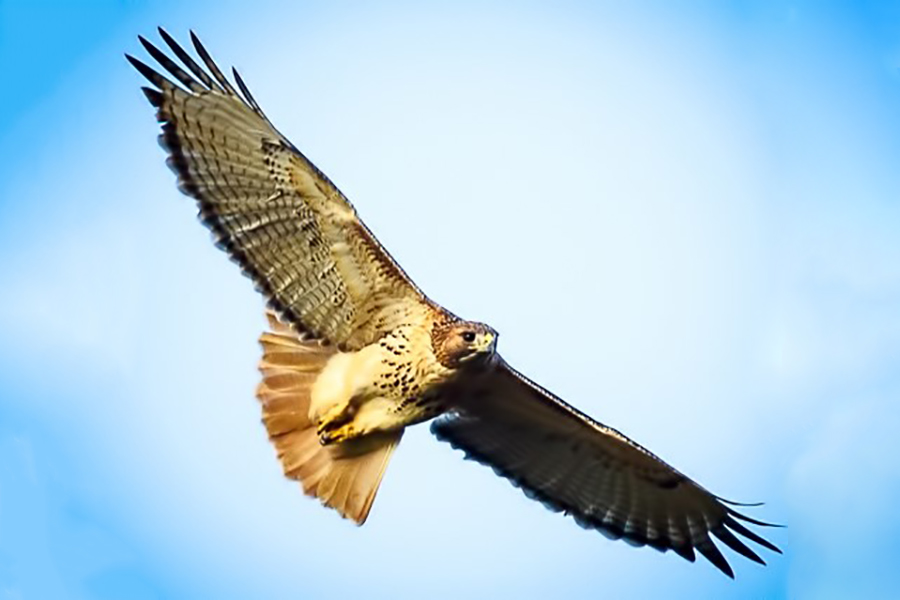
Of all the avians belonging to the genus Buteo, the red-tailed hawk is the most familiar to anyone who glances about for birds. When I was but a fledgling birder, the red-tail was THE bird we counted on vacation trips, scanning the utility poles, fences and trees along the highways. Its chunky frame, short tail and long wingspan (up to 52.4 inches) made this one an “easy spot.” When perched, they are patiently waiting and watching for the next meal.
Red-tailed hawks are also famous for the ability to soar – either hovering with their face into the wind or making “lazy circles in the sky.” It is also in these great heights that the (frankly terrifying!) courtship display occurs. The female and male fly wide circles and “talk.” Then the male dives and returns skyward at sharp angles. The ritual may then involve (here’s the scary part…) locking talons and plummeting in spirals toward the ground, which surprisingly ends with a graceful midair return to flight.

They are monogamous, and only take another mate if one of the pair dies. Both sexes build the nest and incubate the eggs; and the female stays with the young while the male brings the food. After leaving the nest, the juveniles can’t fly well for two to three weeks; and may stay with either parent for up to six months.
Bird Bits
Fun Facts: The red-tailed hawk is a voice-over movie star! When you see those landscape scenes during a film and hear a high, raspy call in the background, that’s our hawk…even if the movie company shows us an eagle.
Known as the “red eagle” to some First Nation peoples, this particular hawk’s energies are believed to assist in rain and healing ceremonies.
With an average lifespan of 21 years, one wild individual (banded and recovered in Michigan) lived for 30 years and eight months.
Habitat: Hawk territory includes open spaces and/or high perches, preferably both. Grasslands, woodlands, mountains and plains are all populated by this bird. They have even figured out how to navigate cityscapes and will nest on the ledges of tall buildings.
The 14 recognized subspecies of the red-tailed hawk (with great variation in plumage colors across regions) reside in North America, Central America and the West Indies. The northernmost birds migrate.
Conservation Note: Mistakenly called a “chicken hawk” (their diet is mostly small mammals, snakes and small birds), indiscriminate hunting was one reason for decreased populations in the past. Today, collisions with tall human-made structures, lead poisoning and rodenticides (particularly for urban red-tails) continue to endanger individuals. However, their numbers are stable and increasing (population estimate is 2.6 million) due largely to the hawk’s ability to adapt.
ABOUT THIS SERIES:
“Birds of the Blue Ridge” showcases frequently seen and rare birds across the southern Appalachian region. For over three decades, Angela Minor has traveled with binoculars and field guides across the continental U.S., Alaska, the Caribbean, and seven European countries. She is a travel and nature freelance writer for several regional and national print magazines, and also created and authored the state park birding series for Bird Watcher’s Digest.
Read More by Angela Minor: BlueRidgeCountry.com/AngelaMinor