Skip to content



The expertise and work of the Civilian Conservation Corps is abundantly evident in walking this 4,058-acre park.
Photo Above: The Cool Springs Overlook looks onto the Holly Creek Valley.
Photo Courtesy of Explore Georgia | Ralph Daniel.
It has been more than eight decades since President Franklin Roosevelt’s nationwide Great Depression-era Civilian Conservation Corps (CCC) program came to an end. Although the corps lasted just a little more than nine years (1933-1942), you and I are still reaping the rewards of the hard work that the young men enrolled in this program performed. I was vividly reminded of this when Laurie and I visited 4,058-acre Fort Mountain State Park in the mountains of northern Georgia. Just about everything we did that day had the corps’ mark on it.

We wouldn’t have even been able to enter the park or take a walk if not for the corps. The road that we drove to the trailhead on was originally constructed by the CCC and, even though the treadway has now become somewhat rocky and bisected with roots from the thousands of feet that have worn away the soil since it was constructed, the trail system that winds around and to the summit of Fort Mountain bears the unmistakable characteristics of the corps’ excellent trail-building expertise: The pathways gradually ascend along the contours of the land or incorporate stone steps to negotiate spots with a slightly steeper terrain.
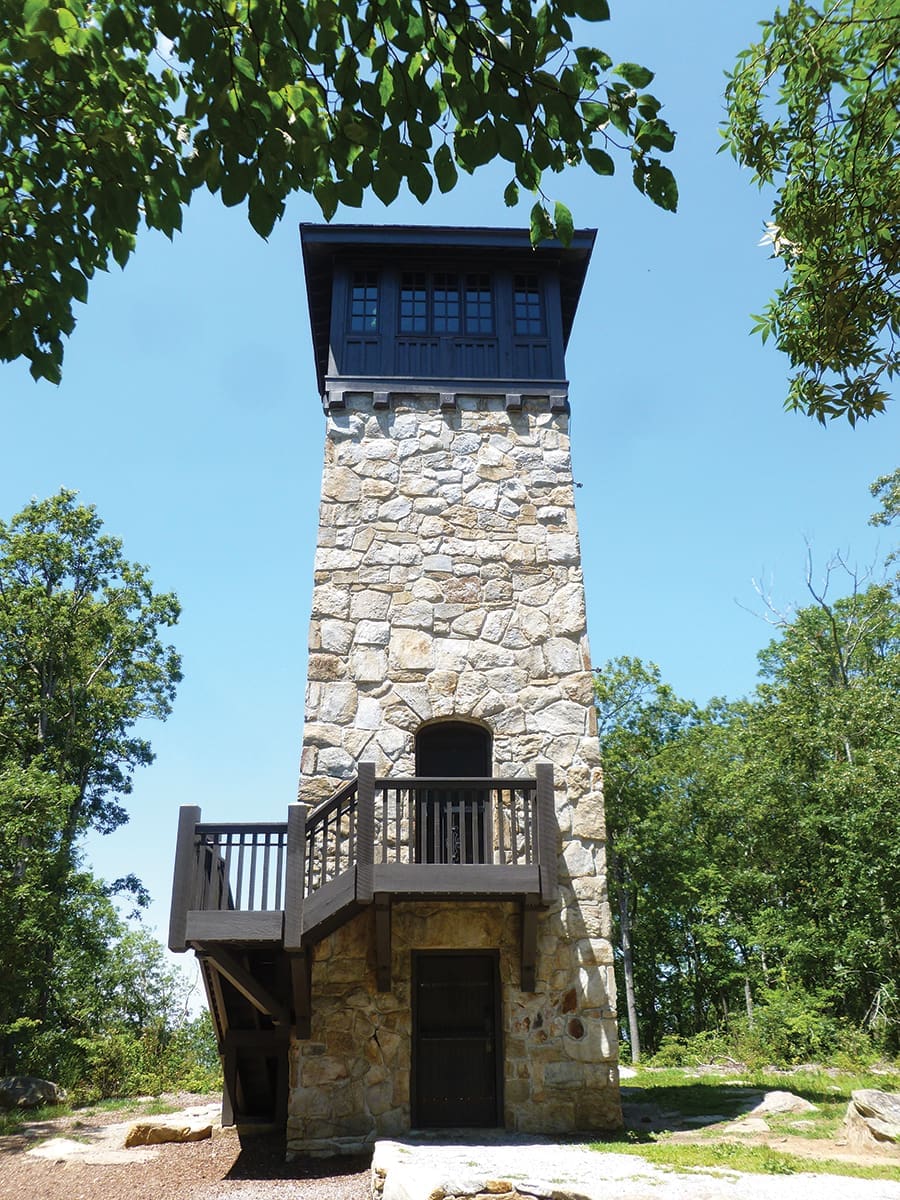
The sweeping vista of the Cohutta Mountains and a wide expansive valley that is visible from the West Overlook was well worth the very few minutes of easy walking it took to reach it, but Laurie and I were just as impressed by the fire tower that capped the mountain’s peak. Led by local stone mason Arnold Bailey, the four-story structure was built by the CCC in the 1930s (look for the heart-shaped stone Bailey carved for his beloved Mildred to whom he was married for 59 years) and restored in 2015.
Fort Mountain is named for a stone wall (not built by the CCC!) that the trail system goes by and snakes below the summit for more than 800 feet and ranges in size from two to six feet tall. Archeologists estimate it was constructed somewhere between 600 and 1,600 years ago, but it seems that no one knows who created it or why.
Down from the mountain, we take the 1.2-mile Lake Trail around 17-acre Fort Mountain Lake. Both features were, of course, created by the CCC. It’s an easy loop walk, passing through a lush forest whose greenery is reflected by the lake’s glassy surface. Along the way, it goes by the sandy beach swimming area, the campground (with cottage rentals), picnic area and a dock with paddleboat, kayak and various other boat rentals. Adding to the appeal is an abundance of interpretive signs providing information about Bowman’s root, heal all, jewelweed, deer berry and numerous other understory plants.
And, in a coincidence that seemed to reinforce the theme of the day, we found that the picnic pavilion in which we decided to have lunch was built by the CCC.
When You Go

© Explore Georgia | Ralph Daniel
The Walks: A 1.6-mile moderate loop that includes a historic fire tower, a mysterious stone wall and a sweeping vista, along with an easy 1.2-mile circumambulation of a scenic lake.
Getting There: Follow GA 52 eastward for 7.2 miles from the intersection of US 411 and GA 52 in Chatsworth. Turn left onto Fort Mountain Park Road and continue to the Stone Tower Trailhead parking area. There is a $5 parking fee.
More Information: Information about the park and its approximately 60 miles of trails may be found on gastateparks.org/FortMountain.
Leonard Adkins has written 20 books on the outdoors and travel. Find out more at habitualhiker.com. He is also the author of Mountain Wildflowers on blueridgecountry.com.
The story above first appeared in our September / October 2024 issue.