Skip to content


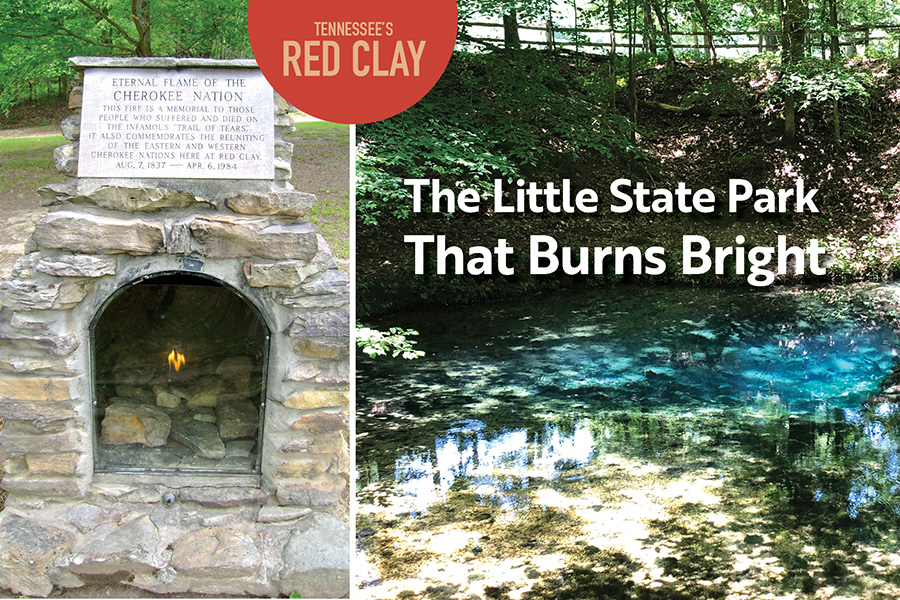
Blue Hole Spring (right) was used by the Cherokee for their water supply. The Eternal Flame (left) was lit in 1984.
The 263-acre east Tennessee park has a history that goes back to 1830, and which, in 1984, completed a re-linking of Cherokee history.

On a small hillside amongst 263 acres of park land in the valleys and mountains of southeastern Tennessee burns an Eternal Flame—a testament to strength in the face of adversity, the indominable will to survive and honor for those who perished. It is also a sacred reminder of the respect owed to every human culture, specifically the Cherokee People.
One hundred and ninety years ago, the Indian Removal Act of 1830 set in motion the forced relocation of thousands of First Nation peoples.
“While the Cherokee were fighting in courts to remain in their homelands, the Choctaw, Chickasaw, Creek, Seminoles and other native people were also dealing with their Removals,” says Danielle Shelton, former doctoral resident at Red Clay State Historic Park. “Life would have been chaotic during these years.”
Shelton, who is completing her Ph.D. dissertation on the events at this location, says that “by 1835 approximately two-thirds of the Cherokee were homeless and had fled to lands in Tennessee, Alabama and North Carolina. [At Red Clay] we know that by 1836 there were 91 log buildings on the grounds [where these refugees had built a new community].”
“Red Clay was called Ela-wodi-yi, which translates into Red Earth Place,” says Erin Medley, park manager. “Many general council meetings were held here over the years with 3,000 to 4,000 Cherokee in attendance. This location had become the new capital in exile for the Cherokee people.”
Elsewhere in the region state governments of that time were legislating anti-sovereignty laws for the purposes of land grabs for white settlers. These actions came before the U.S. Supreme Court in the famous Worcester v. Georgia (1832) case with a surprisingly favorable ruling for the Native Americans. However, this decision that recognized native nations as sovereign “in which the laws of Georgia and other states can have no force” was egregiously ignored. President Andrew Jackson, with an existing history of brutal “Indian removal” campaigns in his past, was among those who refused to honor that decision of the highest court.
In addition to external pressures, there existed a fundamental and deep divide among the Cherokee about the best way forward for their people. Some wished to stand and fight the efforts of forced removal; and others thought the offers of compensation and land west of the Mississippi in “Indian territory” (present-day Oklahoma) should be accepted.
As internal negotiations on this divide continued, a group of unofficial representatives signed an agreement with the federal government named the Treaty of New Echota. It exchanged every acre of Cherokee land east of the Mississippi for money and assistance—with, of course, the requirement that all native people would leave. The principal chief at the time, John Ross, sent a letter of protest to Washington signed by 16,000 Cherokees stating in part, “[this treaty] has not received the sanction of our people.” Much like the Supreme Court decision, it simply did not matter to the federal government. In their opinion, the deal was done.
By 1838 the economic, political and ethnocentric pressures sealed the fate of the Cherokee Nation. Under the orders of President van Buren, 7,000 troops descended on the southern states and Red Clay with weapons drawn. Women, men, children and the elderly were stockaded and their possessions looted. The forced march on foot to unknown lands some 1,200 miles away, the Cherokee Trail of Tears, had begun.
“This unimaginable struggle,” says Shelton, “cost the lives of a quarter (approximately 4,000 to 5,000) of their citizens due to disease, starvation and exposure. Also, what is less well known is that there were also Creek and approximately 1,500 enslaved people of African descent who traveled the Cherokee Trail of Tears.”
The group that walked west is called the Cherokee Nation.
“The group that remained behind was comprised of those allowed to stay under the Treaty of 1819,” says Medley. “These were those who married into white families and refugees from the Removal who hid in the mountains of North Carolina. This latter group is known today as the Eastern Band of Cherokee Indians.
“When the Cherokee [at Red Clay] learned of the impending move west to Indian Territory, they wanted to take their council fire with them,” says Medley. “They loaded coals into iron pots and carried them through the journey. When they arrived, they re-lit their council fire. It still burns in Oklahoma today. However,” she continues, “there remained a lot of animosity toward the Cherokee who decided to remain in their homeland [in the east].”
To bridge this divide that spanned a century, dignitaries from the Eastern Band traveled in a pickup truck to Tahlequah, Oklahoma in the 1950s with the hopes of bringing back some of the original fire, according to Medley. “When they arrived, they got permission from a Fire Keeper to retrieve embers and take them back to North Carolina. The result—Council Fires burning in the East and the West from the original Red Clay coals.”
“In 1984,” continues Medley, “the two groups decided to come back together as one Nation in their homeland with the first council meeting at Red Clay since their departure in 1838. To commemorate this reunion, they lit torches in Cherokee, North Carolina from the original fire; and seven runners brought them on foot back to Red Clay. Upon arrival, Chief Swimmer of the Cherokee Nation (Oklahoma) and Chief Youngdeer of the Eastern Band of Cherokee Indians (North Carolina) accepted the torches and lit the Eternal Flame.”
Today this little park with great significance symbolizes, memorializes and celebrates much more than a location.
“We must protect places with difficult histories, such as Red Clay, so that we can avoid repeating the atrocities,” says Shelton. “The Cherokee Nation now comes here to meet in council, educate their children, share their culture with park visitors and to pray.”
Medley concludes: “The sacred fire of the Eternal Flame now represents the spirit of the Cherokee People and affirms that it will always remain here at Red Clay.”
To Learn More
To learn about upcoming events and activities, explore the museum, watch a documentary film and speak with rangers at Red Clay State Historic Park. tnstateparks.com/parks/red-clay.
The National Park Service has established the Trail of Tears National Historic Trail, which covers 5,043 miles across nine states. nps.gov/trte
The story above first appeared in our March/April 2021 issue.