Skip to content

Celebrating the Tastes and Sounds of the Black Forest
This Shenandoah Valley restaurant relies on family recipes that go back well over 100 years.
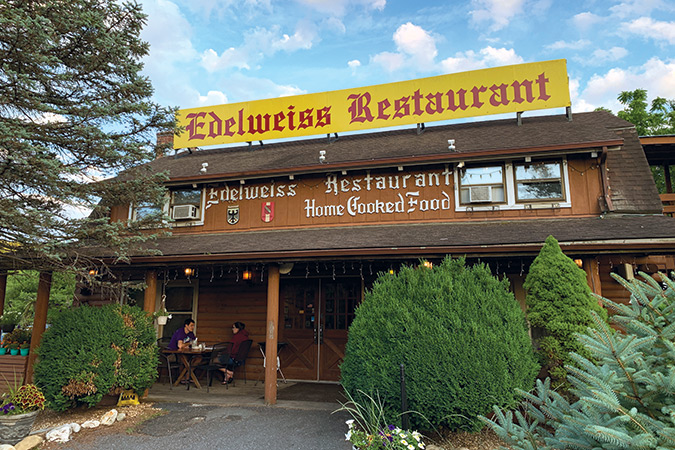
If you walked past Edelweiss German Restaurant in Staunton, Virginia, early in the morning, you might think remodeling was going on. But the banging sound doesn’t come from a hammer. It’s Ingrid Moore tenderizing pork.

She calls it one of the “morning jobs,” pounding the thinly sliced pork fillets for that day’s schnitzel dishes. Ingrid arrives at the restaurant at five o’clock in the morning, six days a week. She says she doesn’t ever set an alarm clock.
Ingrid Moore is almost 80 years old.
A native of Karlsruhe, Germany, she came to the United States when she was 23, first to Queens, New York.
“I had five houses to clean, but that’s how I learned English,” she tells us. “Because I didn’t speak any English at that point.”
She ended up settling in Virginia because it reminded her of the Black Forest region of Germany where she had lived. In 1981, she and her husband opened Edelweiss. After their divorce, she married Walter Moore in 1990 and began training Walter’s son John in the restaurant business.
“I started out washing dishes and watching her cook in the mornings,” John Moore says. “I did meat-cutting, waited on tables, cooked, and did janitorial work.”
Ingrid says she relies on John to handle the business end of things now, leaving her time to do what she loves best—cooking the dishes that her mother and grandmother taught her back in Germany. Talk to any Edelweiss regular, and usually the first word mentioned is “authentic.”
“I use the recipes from my mother and grandmother. That’s exactly what I use,” Ingrid says.
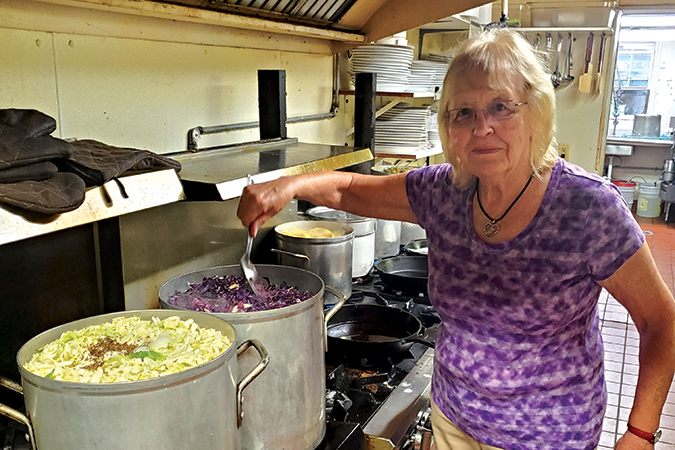
At first, that involved some mathematical calculations. Instead of feeding one family, she had to figure out, for example, how to cook five gallons of “Rotkohl,” German red cabbage.
It’s one of those long-cooking morning dishes, too. The morning we visited with Ingrid, she had just finished making what she calls “the gravies,” including a mushroom and onion one that tops her Jägerschnitzel, “hunter’s cutlet.”
Cutting and tenderizing meat come natural to her. Both her grandfather, Gustav, and her brother, Heinrich (anglicized in America to Henry), were butchers back in Germany.
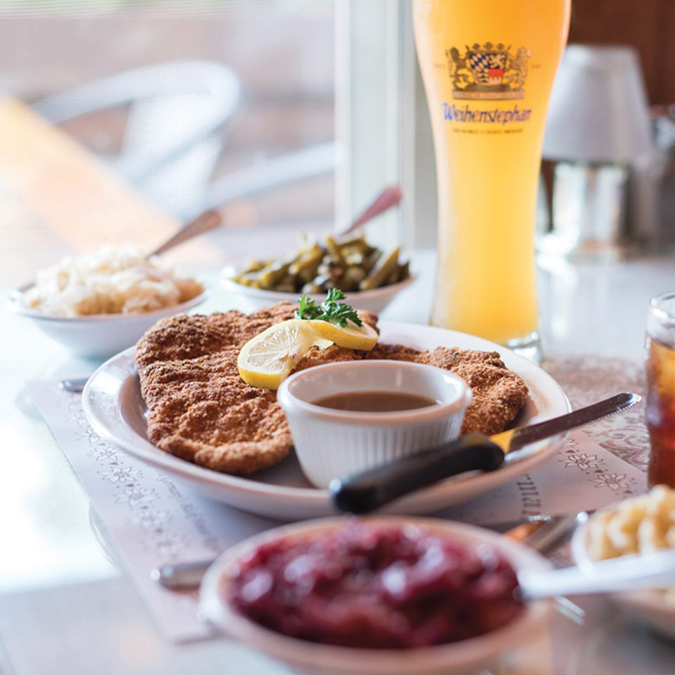
When it comes time to finish the schnitzel, Ingrid and the Edelweiss cooks salt it and pepper it and put a little oil on it, then dip it in flour, an egg wash, and breadcrumbs. All the schnitzel dishes at Edelweiss are pan-fried.
“We use old-fashioned cast-iron skillets,” says Ingrid. “They make such a difference. Cast-iron works best for schnitzel.”
For birthdays and holidays back in Germany, Ingrid’s mother, Anna Rudolph, prepared beef rouladen—rolls of meat stuffed with pickles, carrots, and bacon and seasoned with mustard. That recipe also lives on at Edelweiss, along with a version using pork.
All entrées come with family-style side dishes: red cabbage, Bavarian cabbage, green beans, and Ingrid’s house-made German noodles, called spätzle, that go perfectly with her gravies.
On our first visit to Edelweiss, we had the most tempting table in the house, next to the dessert case. It held a huge “Schwarzwälder Kirschtorte,” Black Forest cherry cake, flavored with cherry brandy and typical of the region where Ingrid grew up. That’s a recipe, though, that she had to acquire. Every bakery in her hometown made them, so her mother rarely did.
Jim Harrington says his favorite dish at Edelweiss is “number four,” the Wienerschnitzel. We met Jim in the parking lot as we were walking to the restaurant. He’s a retired education professor from nearby Mary Baldwin University. He visits Edelweiss not just to eat but also to play the accordion. Some nights Willie Hayes brings a full brass band, but on other nights, it’s just Jim and his accordion.
“I have a clear recollection of when I first saw and heard an accordion,” Harrington tells us. “We lived in London, where my dad, an army officer, was stationed. Some carolers came to the house one Christmas when I was five, and there was a woman accompanying the singers on a small accordion. I was mesmerized by the look and sound of the instrument and even more so when she let me play some notes on the piano side while she worked the bellows.”
Harrington plays almost entirely by ear, and his repertoire is extensive. He never looks at a piece of music.
John Moore says the clientele at Edelweiss is a good mix of locals and travelers. “One couple who lives in New York, every time they make the trip to visit relatives in Georgia, they call ahead for ham hocks and then stop again on their way back.”
John and Ingrid have designed the restaurant to look like a rustic German lodge.
“The atmosphere there is very much a part of the total experience,” adds Jim Harrington. “The rustic architecture, the plantings on the grounds, the lovely front porch for dining in the warm months, and the cozy fireplace in the wintertime all contribute to the overall ambiance of the place.”
But the most endearing feature is undoubtedly Ingrid herself, the first person there every morning. By 10 o’clock in the morning, she has finished her day’s work and is ready for water aerobics at the Staunton-Augusta Family YMCA.
The cycle begins again the next day, long before daylight, as Ingrid joyfully brings the flavors of the Black Forest to the Shenandoah Valley.
Edelweiss German Restaurant
19 Edelweiss Lane, Staunton, Virginia
540-337-1203; edelweissvirginia.com
Tuesday through Sunday from 9 a.m. to 9 p.m.
Fred and Jill Sauceman celebrate the foodways of Appalachia and beyond from their home base in Johnson City, Tennessee.
The story above appears in our September/October 2019 issue. For more subscribe today or log in to the digital edition with your active digital subscription. Thank you for your support!