Skip to content

The story below is an excerpt from our July/August 2017 issue. For the rest of this story and more like it subscribe today, log in to read our digital edition or download our FREE iOS app. Thank you!
Ready for the sun to disappear on an August afternoon? And especially so in eastern Tennessee, western North Carolina, the northeastern corner of Georgia and Upcountry South Carolina (and much of the rest of that state.)
Being an avid skywatcher since I was a young boy, I had waited years for the morning of February 26, 1979. After recently graduating from college, I found myself sitting in a car with friends, driving across Washington’s Cascade Mountains to an undetermined location along Interstate 90. It was 6:45 a.m., the skies were clearing, the sun was rising, and we had only 90 minutes to get to our destination. It was going to be close.

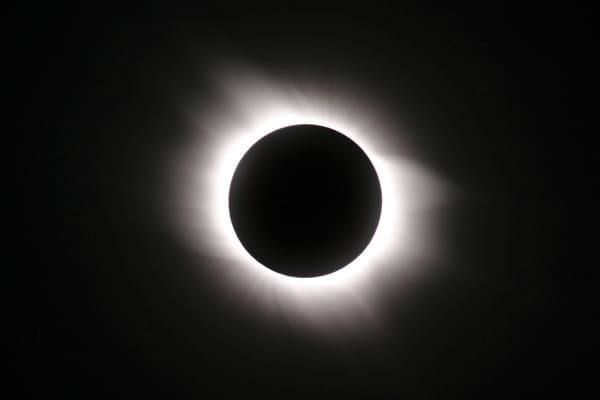
At 8:10, we pulled off the freeway and drove up a low hill, hopped out of the car, and looked anxiously westward. We could see darkness on the horizon forming into a shadow rushing towards us. Before we could exclaim a version of (the cleaned–up) “Oh, my!” we stood in darkness, with the blacked-out sun engulfed in the solar corona hanging low in the east. Venus was easily seen shining to its right. Stars were twinkling overhead. It was night, yet it was day. We were cheering!
It was my first, and, so far, only total eclipse of the sun. It was a sight I’ve never forgotten. It was a sight I want to see again.
Just such an event is approaching again, this time on the afternoon of August 21, 2017. It will be viewable, weather permitting, for millions of people across the United States, including those folks watching within a band through the southern Appalachian Mountains.
What causes a total solar eclipse?
The moon passes between Earth and the sun at some point on its monthly orbit around Earth. Most months, it appears to slide either slightly above or below the sun. Occasionally though, the moon moves exactly between Earth and the sun, blocking a portion of the sun and giving a solar eclipse. If the moon also happens to be relatively close to Earth, then viewers along a particular path on our planet see a spectacular and unforgettable total solar eclipse.
How to view this special cosmic event.
Just after 1 p.m. on August 21, the moon begins to slowly creep across the face of the sun. This can be seen directly by looking through number 14 welder’s glass or specially approved filtered eclipse glasses. The sun is 400,000 times brighter than the full moon, and even a 99 percent obscured sun can easily cause severe eye damage. Do not look at the partially eclipsed sun without the proper filters!
At 2:35 p.m., the lunar shadow’s cross–country journey reaches eastern Tennessee. The shadow then continues on its easterly way by moving through the Great Smoky Mountains National Park and western North Carolina, nicking the northeastern corner of Georgia, and passing through much of South Carolina before heading out to sea near Charleston. Only along this specific path will a total solar eclipse occur.
The weather is the biggest concern.
The real issue is not if the eclipse will occur—as it most certainly will—but will the skies be clear enough for viewers to appreciate the event. It is no secret that August afternoons in the Southern Appalachians are problematic regarding cloud cover—a value of 70-percent likelihood is not uncommon.
Not all is bad news, though. Since the sun’s light is being increasingly blocked by the advancing moon, less cloud development occurs. Clouds sometimes dissipate just before the moon’s shadow approaches, much to the relief of eclipse watchers.
… The story above is an excerpt from our July/August 2017 issue. For the rest of this story and more like it subscribe today, log in to read our digital edition or download our FREE iOS app. Thank you!