Skip to content


A storied American custom built of pain lives on with joy.
Photo Above: The present-day cakewalk at Fries, Virginia, involves live music, a small donation and gleeful participants. Courtesy of Kevin Combs.
It apparently started before the Civil War, with this piece of heart-rending history: Black slaves would dress up in their finery — eventually, silken top hats and tails for men, lacy ruffles for women — and strut in an exaggerated, straight-backed way to mock their white owners. These competitive performances were sometimes called prize walks, with the winning dancers awarded a cake.

With the end of slavery, the cakewalk dance style became ever more elaborate, featured in minstrel shows and migrating to the dance halls of Paris. Some were memorialized in early moving pictures.
Since then, the racial aspect has faded and cakewalks have become local fundraisers, like a low-tech GoFundMe. Several organizations in West Virginia host them, and Southwest Virginia Cultural Center & Marketplace now holds a cakewalk the first Thursday of every month; and the Lays Hardware Center for the Arts in Coeburn, Virginia, has also started a Friday cakewalk at their jam.
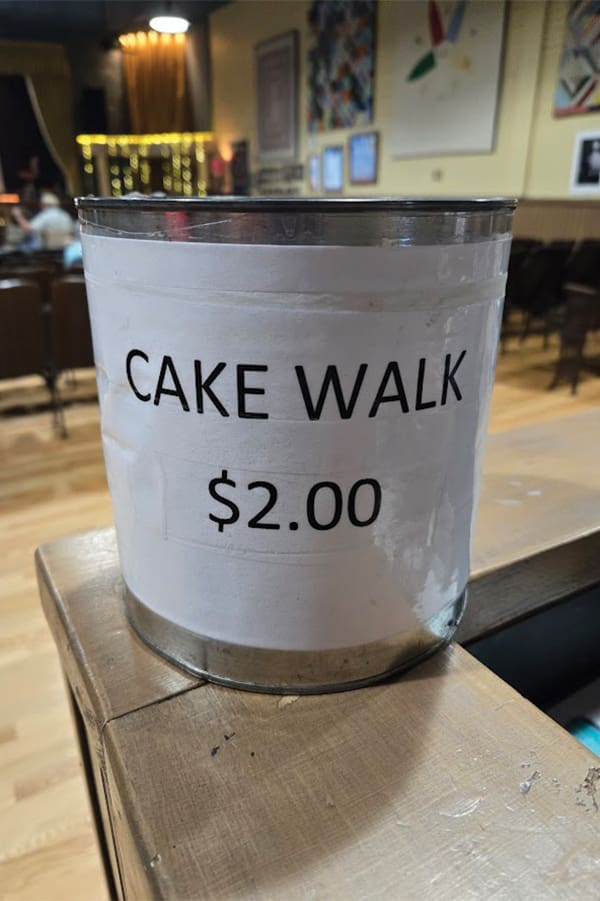
At the Fries (pronounced “Freeze”), Virginia, old-time music jam every Thursday night, the cakewalk during intermission operates like musical chairs, minus the chairs but with a numbered square on the floor for each person who pays $2. It’s not unusual for 50 or 60 walkers to vie for a dozen cakes and other baked goodies that neighbors bring, or fresh vegetables, flowers and farm eggs in season. The record cakewalk numbered 72 people, snaking through the lobby.
“When they win you’d think they were winning a million dollars,” muses Yvonne Burr, the director of the Historic Fries Theatre, home to the jam and cakewalk.
Admission to the jam is free, so the cakewalk acts as a painless fundraiser to keep the lights on. During the jam’s first hour, up to 40 musicians gather to make sweet music as couples waltz around the perimeter or stay in place to flat-foot. There might be a dozen each of fiddles, banjos and guitars, plus a few bass fiddles, dulcimers, mandolins, autoharps and even a washboard. Local fiddler and National Heritage Fellow Eddie Bond calls the tunes and adds vocals.

Before the intermission, Burr circulates with a tin can collecting money. “A lot of people give more than $2, and say keep the change,” she says. “Or they say, ‘I don’t want to walk’ and throw the money in anyway.”
In 2025 alone, the Fries jam attracted visitors from as far away as Texas, Hawaii, Ireland and Germany, and there’s definitely visitor karma. During one recent cakewalk three couples traveling together from North Carolina won three cakes among them.
The story above first appeared in our January / February 2026 issue.