Skip to content



The story below is an excerpt from our Sept./Oct. 2014 issue. For the rest of this story and more like it subscribe today, view our digital edition or download our FREE iOS app!
Tedious, time-consuming tasks like taking care of raspberries – tying up the canes, picking berries, then pruning out the spent canes once the harvest is over – provide me with lengthy stretches of uninterrupted time to think things over. Lately, I’ve been thinking about stories that last our lifetimes, and the part they play in our lives.
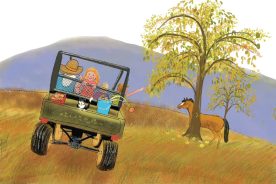
For most of my neighbors, the Bible was the source for such stories. For me, it was “From Long Ago and Many Lands,” a collection of very old stories, some biblical, some fables, compiled from many sources by Sophia Lyon Fahs in 1948. Although the book contains some familiar tales – the Blind Men and the Elephant and the Wind and the Sun, about a contest to see which could remove a man’s cloak – some are stories I have never encountered elsewhere. They all teach lessons, as, for instance, a Sicilian tale about an abandoned and starving horse that inadvertently rings the town of Atri’s Bell of Justice by chewing on its bellrope. In the tribunal that follows, the horse’s owner, a knight interested only in counting his money, sees the error of his ways, and readmits the horse to his barn and the estate’s lush pastureland. That was one of my favorites.
As was one from China, about travelers who go in search of the “Land of Great Men,” where they’re surprised to find that, in a place that otherwise resembles their homeland, each person walks on a small colored cloud that reflects his or her disposition toward others. Most desirable are rainbow-colored clouds; least, gray or black ones. The travelers see a beggar (and many others) with rainbow-colored clouds, but the high official the crowd makes way for has draped a silk cloth over his cloud to hide its color, fooling no one.
Then there’s the Ugandan story of “The Two Cheats,” about two merchants in a marketplace, one selling bark cloth, the other fried ants, a local delicacy. Under a top layer of the real thing, each has bundled worthless byproduct. At the end of the day, neither having sold his wares, they make a trade, each thinking he has fooled the other. Because neither wants his deceit discovered by the other, they scurry off in different directions before opening the bundles and learning that they’ve been had.
Only one story in the collection – a good one, from India – no longer “works.” In it, a distraught woman whose baby son has died, goes from house to house begging for medicine that will cure him. No one can help her, until someone tells her to go see the Buddha, then alive and teaching, who says he can cure her child if she brings him a handful of mustard seed borrowed from a home in which no one has died. Certain she can find it, she hurries off to knock on the same doors, only to discover that every household has, like hers, been visited by the death of a loved one. Slowly, she realizes that death is part of life, that no family is spared the pain of loss. Even when I was a child, lots of new houses were going up; hospitals were becoming the place where most people died. You could have borrowed mustard seed from a house where no one had died, though not from a family that hadn’t experienced loss.
I know we talked about these stories; they became part of the family lexicon. More important, though, I spent lots of time thinking about them on my own. I think they helped me find out who I was, and what kind of person I wanted to be, out there in the big world whose vague outlines I was only beginning to discern.