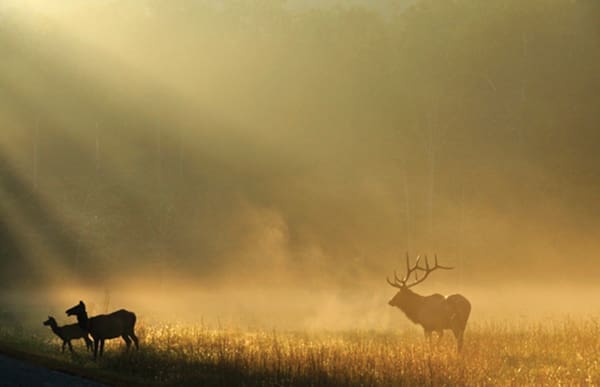
The Elk of Cataloochee Valley

The story below is an excerpt from our September/October 2017 issue. For the rest of this story and more like it subscribe today, log in to read our digital edition or download our FREE iOS app. Thank you!


Elk have been living in sections of the Great Smokies since 2001, when they were re-introduced, following an absence since the last of the original herds were killed off in the mid-1800s. Here’s a guide to viewing and photographing.


It’s 7:30 a.m., and an eerie bugling sound echoes through the valley. Mist hovers overs the open fields and hardwoods rise sharply. First light is just edging over the mountain peaks. My heart is racing.

More bugling, off in the distance. We’re here to catch a glimpse of these wild creatures, racks four to five feet across towering over their massive chestnut bodies.

These are the elk of Cataloochee Valley.

Two hundred years ago these wild creatures roamed unabated in these areas of the Great Smoky Mountain National Park near Waynesville, North Carolina. Native Americans hunted them, settlers came and hunted them, finally to extinction. And about 15 years ago, they were reintroduced to the Cataloochee Valley, once a prosperous proud settlement of the 1860s.

Today a thriving herd of elk lives amid the restored homes, the old church, school and outbuildings. And they are a photographers’ delight—especially in the fall, the time of the rut. The velvet on the antlers is gone, replaced by smooth implements of battle—for dominance of harems of female elk. A time of breeding. A time of growing the herd, and survival… Facing off with the older dominant bulls, young bulls challenge the right to the herd —but, in skirmishes the dominant bulls do not go quietly. Throughout the valley their bugle echoes the sound of battle, and warning off— “this is my territory and my girls—approach only with caution. Don’t test me!” This is the rut.

The road into the park from the North Carolina side, near Waynesville, begins at Cove Creek off Rt .276 by I-40—a twisty paved two-lane, once the original oxen trail blazed by ancient settlers. It rises more and after about 15 minutes turns to gravel. Some folks freak out and turn back. Rising upward, crossing the Eastern Continental Divide, we finally enter the gates of the Great Smoky Mountain National Park, now descending toward the peaceful Cataloochee Valley and a paved road that extends the length of the former settlement. Cleared fields past the campground, hiking trails and rushing water, the ranger’s house and there they are—the elk.

Elk are larger than the park’s black bears, and can be dangerous. Female elk with calves have charged people in defense of their offspring. Males (bulls) may perceive people as challengers to their domain and charge. The best way to avoid these hazards is to keep a safe distance.


… The story above is an excerpt from our September/October 2017 issue. For the rest of this story and more like it subscribe today, log in to read our digital edition or download our FREE iOS app. Thank you!

You Might Also Like:

Elizabethton, Tennessee, USA, - May 15, 2021: Reenactment at Sycamore Shoals State Historic Park of the Siege of Fort Watauga in 1776.

Revolutionary Roundup

On July 4, 1776, a new nation was born. In honor of this historic day, we explore the forts, battlefields, museums, trails, and more that trace the Patriots’ journey to freedom in the Blue Ridge Mountains.
2025 Festivals and Events

2026 Festivals & Events Guide

From the Virginias and the Carolinas to Georgia, Tennessee, and Kentucky, our annual compendium is the perfect travel companion.
A happy 8-year-old Eula Mae standing in front of her father, Woodrow, in this Golding family photo taken in 1952.

My Beloved Scenic

Before it became America’s Favorite Drive, the Blue Ridge Parkway was a farm family’s front yard, playground, and memory lane.
A bee clings to the center of a sunflower at Mill Springs Farm, located just up the road from historic downtown Jonesborough, Tennessee. From the photographer: “The farm grows a yearly crop of a variety of sunflowers. The bees love them!” Photo by Jay Huron

Among The Blooms: A Photo Essay

Our contributing photographers wandered the mountains in late spring and early summer to capture critters big and small frolicking, nibbling, and buzzing about.
2027 Best of the Mountains Awards

2026 Best of the Mountains Awards

Submit your nominations for the finest in the Blue Ridge today!
Hikers willing to take on a moderate climb are rewarded with incredible panoramas from the summit of Marys Rock.

An Insider’s Guide to Shenandoah National Park

This year is a landmark one for this treasured piece of mountain land in Virginia: the 100th anniversary of Congress authorizing its establishment and the 90th anniversary of its dedication.
Blue Ridge Country Parkway Guide 2026

2026 Blue Ridge Parkway Guide

Start planning your next trip on America's Favorite Scenic Highway
A Virginia Historical Marker stands at the entrance to Green Pastures.

Green Pastures’ picnic area was build by the Civilian Conservation Corps in the late 1930s.

Green Pastures Reborn

When it officially opened in 1940 — in the depths of the Jim Crow era — Green Pastures was likely the first U.S. Forest Service recreation area in the nation constructed for African Americans.
Chimney Tops Trail in Great Smoky Mountains National Park rewards a steep climb with exceptional mountain views.

Inset: Gatlinburg, Tennessee’s Chimneys Picnic Area sits beside the West Prong of the Little Pigeon RIver.

11 Picnics with a View

These bucket-list destinations are perfect spots to kick back, enjoy a delightful meal and take in the great outdoors.

CALENDAR OF EVENTS