Skip to content



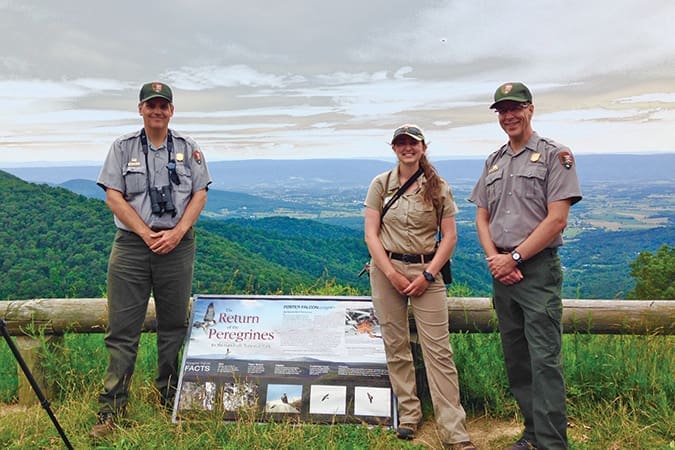
Schaberl, right, meets with U.S. EPA Administrator Gina McCarthy before a trek to Hawksbill Summit in 2016. Courtesy of Jim Schaberl
Jim Schaberl works to protect wildlife from climate change in Shenandoah National Park.

One day, after venturing into an old logging camp in an abandoned section of forest in remote northern Pennsylvania where he lived, 10-year-old Jim Schaberl leaned against a wild apple tree, unaware that a life-changing moment was literally just around the corner.
“I didn’t know that a porcupine was on the other side of the trunk,” he says. “And it was just chattering away. We had this little conversation. That porcupine didn’t care … and I had fun.”
Fittingly, that natural connection with wildlife has turned into a 33-year career with the National Park Service. Schaberl, 55, now serves as division chief of natural and cultural resources at the 200,000-acre Shenandoah National Park, where he oversees research, conservation and management of 500 miles of hiking and horse trails.
Schaberl was in high school when he heard about a two-year wildlife technology degree at Penn State that would allow him to do everything from stock fish in streams to transfer wild turkeys to safer locations. But by the time he completed his studies in the 1980s, the recession had hit and few jobs were available. So a professor suggested he bide his time by earning a bachelor’s degree in wildlife management.
Diploma in hand from West Virginia University, Schaberl once again ran into roadblocks finding employment, so instructors urged him to go to graduate school. “I don’t think I can do that,” he told them. “I’m kind of out of money.”
Fortunately, a paid ecology assistantship at State University of New York offered a work-study program concentrating on white-tailed deer at Saratoga National Historical Park in Stillwater, New York. The pace was already incredibly difficult—the work was full time, and so were his studies—but when his supervisor left six months later and there were no funds to replace him, the superintendent announced to Schaberl, “Oh, you can do that too.”
The workload didn’t deter Schaberl. “That’s where I got hooked. I became passionate … about leaving resources unimpaired for current and future generations. That’s a conservation ethic that I really bought into.”
Jobs at the NPS were still hard to come by in the 1990s—they are now too, he admits—but eventually he landed a plum assignment at Voyageurs National Park in northern Minnesota. The land was largely undisturbed, with the only known population of wild wolves in the U.S. outside Alaska cohabitating with moose, black bears, and bald eagles. Schaberl reveled in the variety of projects, from conducting beaver surveys to determining how lake levels affected fish and other wildlife in a frontier-like landscape comprised of 40% water.

His next NPS post gave him even more close-up experiences with wild animals. At Mt. Rainier National Park in Washington state, Schaberl worked with elk and studied northern spotted owls, banding specimens and tracking their movements to understand their nesting habits.
In an effort to determine the health and number of mountain goats in the park, Schaberl and his team often flew helicopters over the rugged terrain.
“It’s kind of like an iMAX movie, where it’s just jaw-dropping,” he says. “You’d see waterfalls cascading and green meadows and wildlife moving through them. The scenery is unmatched from what I’ve seen in small aircraft.”
Once, as the helicopter began to lose power in the steep elevation, the pilot kept going until the team crested the peak at 9,000 feet and came upon an astonishing sight in the snow field. Schaberl and his colleagues proceeded to herd and count 115 mountain goats as the maxed-out aircraft circled, unable to climb any higher.
“It’s dangerous work,” Schaberl says. “You’re darting out of the helicopter or shooting a net gun to try to catch a mountain goat on the ground. I had a fair number of hours in the air in these small aircraft, so I said, ‘Do I need to keep doing this?’”
As an ecologist at Shenandoah National Park, Schaberl shouldered a broader goal of improving air and water quality. His task, he says, was to tell the story of how air pollution and acid rain impact streams, and therefore the trout and macroinvertebrate bugs living in them.
Three years later, he moved into his current position. He now serves as a liaison between scientists who collect data and executives who decide how to act on it. Building on research he’d begun at Mt. Rainier, Schaberl is trying to gauge which plant and animal species are most affected by climate change. Brook trout, for example, need cold water buffered by springs flowing into the streams. And the critically endangered Shenandoah salamander, found on three sites in the park and nowhere else in the world, can only survive in cool temperatures at steep elevations. The amphibians have already migrated as high as they can go in response to gradual warming.
The job comes with other challenges too. Invasive pests like the hemlock woolly adelgid, emerald ash borer and, more recently, spotted lanternfly, keep park employees scrambling. And as a federal agency, Shenandoah often suffers from underfunding.

That doesn’t keep Schaberl from being grateful for what he’s been able to accomplish.
“My heart has always been about protecting and conserving. That’s what mostly resonates with me,” he says. “There are biologists before me at a park and there are biologists after me at a park, and they’re all trying to do the mission of the park service. During my tenure, if I had information that is useful for people that follow behind me and they can use those decisions to further conservation, that gives me comfort. That says that I made a difference.”
JIM SCHABERL’S 3 FAVORITE THINGS ABOUT SHENANDOAH NATIONAL PARK
The scenery. “There is basically a vista around every corner. You don’t have to hike for a day to get to a mountain summit and sometimes have close to a 360-degree view, a full panorama to see sunrises, sunsets, moonlight.”
The water. “I’ve always connected with streams and fish, to be able to hike to an area and catch a waterfall and experience the sounds of the water in all seasons, when things freeze up in the winter to a certain degree or in the summertime or during a flood.”
The diversity. “Growing up in the East, I thought I had that figured out because I knew those things. I grew up with them. Certainly seeing black bears in the wild or a wild turkey or deer, those larger charismatic animals, is always neat, but the forest is full of life that is maybe on a smaller scale that you don’t see or doesn’t get a lot of fanfare. But it does exist, and there’s always something to learn.”
The story above first appeared in our January/ February 2022 issue.