Skip to content


Pick your own and more at Stepp’s Hillcrest Orchard.
Photo Above: Mike Stepp began working with his father at Stepp’s Hillcrest Orchards when he was a boy. Today he oversees a sprawling family operation that offers apple products, merchandise, pick-your-own produce and a five-acre corn maze.
Photos Courtesy of Stepp’s Orchard.
One day years ago, when Mike Stepp’s dad J.H., the patriarch of Stepp’s Hillcrest Orchard, caught his son racing through the apple house, he teased, “Mike, slow down! You’re getting in too big of a hurry.”

“Daddy,” Stepp replied, “That’s the only gear I got.”
On any given day, 73-year-old Stepp can still be seen flitting around the farm, checking on the 20 varieties of apples he and his own family grow on 45 acres on the outskirts of Hendersonville, North Carolina. One of the oldest pick-your-own operations in the industry, Stepp’s Hillcrest Orchard also offers pumpkins, grapes and sunflowers.
“That’s the only speed I know,” he says of his trademark breakneck pace, especially during fall harvest season. “To be honest, I’ve tried consciously to make myself slow down, but a lot of times I don’t think about it. I outwalk people younger than me a lot of times because I’m determined to go do something. It’s just who I am.”
Even before he was old enough to go to school, Stepp was helping J.H., who began farming in the mid-1960s, pick cucumbers and peppers with his older brother Joby on summer breaks.

“As a boy, to get to go with your dad to where he works and see what he does, I mean, it’s just something you can’t really explain. It’s just a great feeling,” Stepp says. “We would ride with him, and he’d go to all these different fields and we’d get to see all these different people. And of course, the tractors thrilled us as children. We’d sit in his lap and he would let us turn the wheel, kind of school us on how to do things.”
Once, when he was about 10, he tried to steer the vehicle at the end of a field but the tractor had a mind of its own and kept going. “My dad said, ‘Make it do what you want it to do.’ And that stuck with me all these years.”
By the time Stepp turned 16, his father had stopped growing the other vegetables to concentrate on cabbage and gave Stepp and his brother eight acres to tend. They were allowed to keep the proceeds without having to pay for the land’s upkeep. To Stepp’s surprise, that year cabbage brought $5 per crate—the most it ever had—and Stepp and his sibling earned enough to buy their own cars. Stepp chose a Pontiac GTO.

“So here we were, a junior and senior in high school, with two brand new cars,” he recalls. “I was just in hog heaven.”
Eventually, the cabbage crop went south and J.H. made a bold move to grow nothing but apples. In 1969, at the suggestion of his wise wife Yvonne, they introduced a pick-your own option and invited the public to come to the farm. They also shut down the wholesale side of their business. Over the years, as other avenues dried up—imported concentrate suppressed prices on fresh apples grown for juice, hitting American suppliers hard—more and more people flocked to Stepp’s orchard to fill baskets with fruit straight from the family trees.
As inevitably happens in the weather-dependent profession of farming, there were a few bad years. Joby had already moved to Virginia when, in the 1980s, a series of freezes decimated much of the crop, sending Stepp off to find other work. He landed a job with Duke Power, then took his uncle’s place at the Employment Security Commission, connecting farmers and laborers.
Twelve years after he left, vowing to come back when he could, Stepp returned to manage the farm, with his wife Rita, a retired teacher, coordinating school tours. His dad passed away in 2011.
Today Stepp runs the apple farm with his spouse, daughters Danielle and April, sons-in-law Rex and Kevin, and a passel of grandchildren who help out during the peak fall season, which starts in August. From their on-site store, they sell pre-picked apples, T-shirts and other gifts alongside treats ranging from apple cider doughnuts and fried pies to cookies and slushies. Kids of all ages line up to navigate the corn maze, take a tractor-pulled wagon ride through the orchard, and shoot apples out of a cannon.
Like his father before him, it’s important to Stepp to be a good steward of the land. “He was always trying to take care of the ground so that it didn’t erode. That was the biggest thing that I took away from him: What do I need to do to keep it from washing away?”

He also strives to use only the chemicals that are absolutely necessary to spray trees for pests. “I always work with the PhD people that advise us every year,” he says. “We’re trying to take care of the environment.”
Despite his Speedy Gonzalez demeanor, as he’s gotten older, relationship-building has become more important to Stepp than efficiency and production.
“I can’t tell you how good it makes me feel when we’ve got customers that tell us, ‘I came here with my parents when I was a kid.’ And they got their kids with them and they still come to us. And then all the new people talk about how beautiful our place is and say, ‘We appreciate what you do. Your products are great.’
“The relationships we’ve built over the years with repeat customers, and then the new ones—that is the thing that makes me feel the best about what we do right now, just to know that people are satisfied with what we do and are happy to come. God’s just blessed us to have this place and all that goes with it. Every once in a while, somebody will stop me and ask me a question, wanting my opinion about something that they can actually take home. I slow up a little bit and it calms me down.”
Mike Stepp’s Favorite Apples
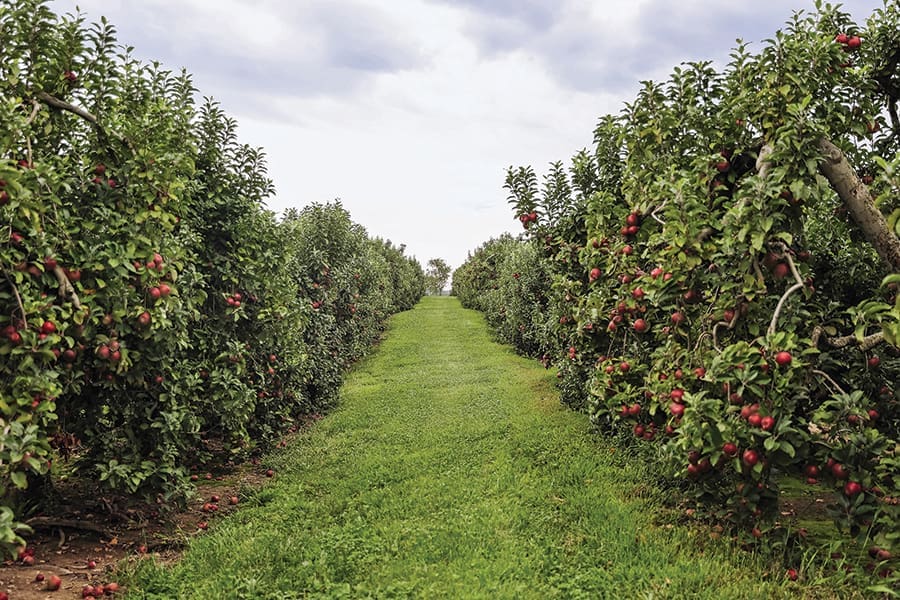
“This is in no certain order,” says the owner of Stepp’s Hillcrest Orchard in western North Carolina. “But Jonagold, Cameo, Fuji and Honeycrisp—I like all of those equally, pretty much.”
For Stepp, it’s all about taste. “Some people like the look, like a solid red apple because it has such great appearance. To me that’s not a big deal because I’ve seen the good, the bad and the ugly on all of those. I go for the taste.
“Oh, and I would add Pink Lady in there. It’s hard, maybe more so than the others, and it’s got a great flavor too. So I’ve got five that I would take at any time.”
The story above first appeared in our September / October 2023 issue.