Skip to content


Courtesy Eliot Berz
Eliot Berz studies migratory birds while protecting a unique Tennessee river system.

The more he talks about the Louisiana waterthrush—a small migratory songbird few people have even heard of—the more excited Eliot Berz becomes about the species that returns from Guatemala each spring, often to the exact same place in the Tennessee River Gorge near his hometown of Chattanooga.
“I can think of one bird that we’ve caught three years in a row within a couple feet of the same spot,” he says. “It’s pretty incredible the navigational skills that these birds have. How many people have to use Google Maps or Apple Maps on their phone to get around the city, and these birds are traveling without any of that, thousands of miles?”
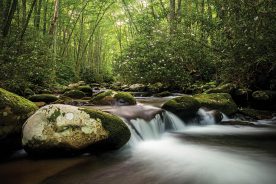
Since 2020, Berz, 28, has served as director of conservation and access for the Tennessee River Gorge Trust (TGRT), a nonprofit that strives to safeguard 17,000 acres of steep river canyon punctuated by twisting streams and towering forests. It is the only such tract located next to a mid-size city.
Equally fascinated by the forests, creeks and streams surrounding his boyhood home, Berz often played outside “until I heard the whistle from my parents to come in for dinner. I was always wandering away from home a lot further than I think they realized on the weekends and after school. … I think the fact that, day after day after day, I had the opportunity to wander around with my buddies in the woods and figure out what was happening for ourselves, rather than being taught by textbook or in a classroom, really sparked my interest in all this and got the ball rolling.”
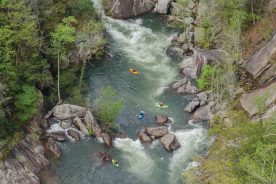
By the time he was 12, Berz was proficient in whitewater kayaking and, through a program at his high school, taught other kids how to paddle and roll on the nearby Hiwassee and Ocoee rivers. But it wasn’t until the economics major signed up for a forestry class in college that it occurred to him that he could turn his love of nature into a bona fide career. Two leadership-focused internships, first with Outdoor Chattanooga, then with Thrive 2055, a regional planning initiative where he met members of local, state and federal conservation groups, opened doors to a vocation that suited him much better than his original business track.
In 2016, Berz found a way to use both sets of skills, and his detail-oriented personality, when he joined the TRGT. He’d never paid much attention to birds, he admits, but an invitation to set up equipment and help band migrating species changed that.
“I became awestruck that we were, for this brief moment in time, interacting with these little birds that were trapped in the middle of a 1,000-mile-plus journey … and spending over half of the year in the neotropics and then coming right back to the same spot.”
At first, Berz studied a variety of migratory birds, monitoring any that flew through the Tennessee River Gorge corridor. But he soon zeroed in on the Louisiana waterthrush, a neotropical warbler that resides in Mexico, Central America and the Caribbean through the winter months and returns to the eastern U.S. in the spring, only to repeat the cycle the following year. A ground-nesting species that feeds on salamanders and other animals in mountain creeks and streams, it is drawn to the pristine waters of the Gorge.

Over the course of three years, Berz and his research team conducted a pilot study of the birds, equipping some of them with geolocator “backpacks” that collected data showing their whereabouts and breeding habits. Return rates for the waterthrushes reached 30% to 40%, “which is actually a little high because some of the birds have a very short lifespan,” he says. “Some of them don’t make it. Some of them find a new spot the next year they like better.”
In an effort to conserve the bird’s habitat, not just in the gorge, but in its southern home in Guatemala, TRGT has since teamed up with a birders’ association, a wildlife conservation group and eco-tourism guides in that country to teach residents how they can help and incentivize palm oil farmers and other landowners to leave the jungles intact. Guatemalan school kids now monitor the Louisiana waterthrush as part of an after-school project.
Despite the broader responsibilities that came with his promotion two years ago—Berz still leads the organization’s research efforts but also facilitates public recreation access, building trails and acquiring land while keeping a finger on the pulse of the forest to protect it—tracking the Louisiana waterthrush is still his favorite project.
“You start to realize that some of these individual birds have different personalities. Some were more aggressive than others. Some were secretive. Some had different dialects, and you can tell the difference between some of the individuals by the way they sing. That was something I’ve never experienced before.”
These days, Berz is studying the belted kingfisher, a showier, blue-and-white water bird (it’s named for the striking orange “belt” on the female’s belly) that uses its strong bill to catch fish and excavate nesting tunnels in the side of riverbanks that can stretch more than 10 feet deep. It’s a prime example of a “common” bird that’s worth keeping tabs on, he points out.
“There’s this trend where the more rare or endangered species are the ones that get research attention. So you often find yourself with a common bird that doesn’t have much research done on it because of the fact that it is common. But you have to keep in mind that it might not always be a common species. With water quality issues in the Tennessee River, we’re worried that down the road we might see declines in belted kingfishers. There’s this movement in ornithology now to keep common birds common.”
Under Berz’s watch, the TRGT is also raising funds to build a new 12-mile, multi-use trail system, primarily for mountain biking. “Driven by my passion for conservation, the work comes easy,” he says. “I want to get the job done. I want to get it right. Really, though, it doesn’t even feel like work. I just have so much fun doing it.”
Besides, he adds, “I’m going to work in these places and then often returning that weekend with my kayak or fly rod hanging out in the exact same spaces. That’s kind of a selfish part of my job. I get to help create public access to these wild lands that I get to enjoy myself.”
ELIOT BERZ’S 3 FAVORITE THINGS ABOUT THE TENNESSEE RIVER GORGE
The creeks. “After it rains a lot, I like to whitewater kayak down them, and then once they dry up in the summer, I like to go swim in them. And there are some really cool blue holes.”
The wildness. “Because of the fact that it has steep mountainsides leading down to the river, many places are inaccessible. They can’t be developed and it’s difficult for people to get there, period. So we’ve seen everything: black bears, bobcats, coyotes, incredible migratory birds and clean creeks with interesting salamander and fish species in them.”
The views. “Because of the topography and geological anomaly that the river gorge is, it offers up some of the most breathtaking viewsheds that I’ve ever seen—scenic overlooks throughout the gorge.” —NH
The story above first appeared in our September / October 2022 issue.