Skip to content


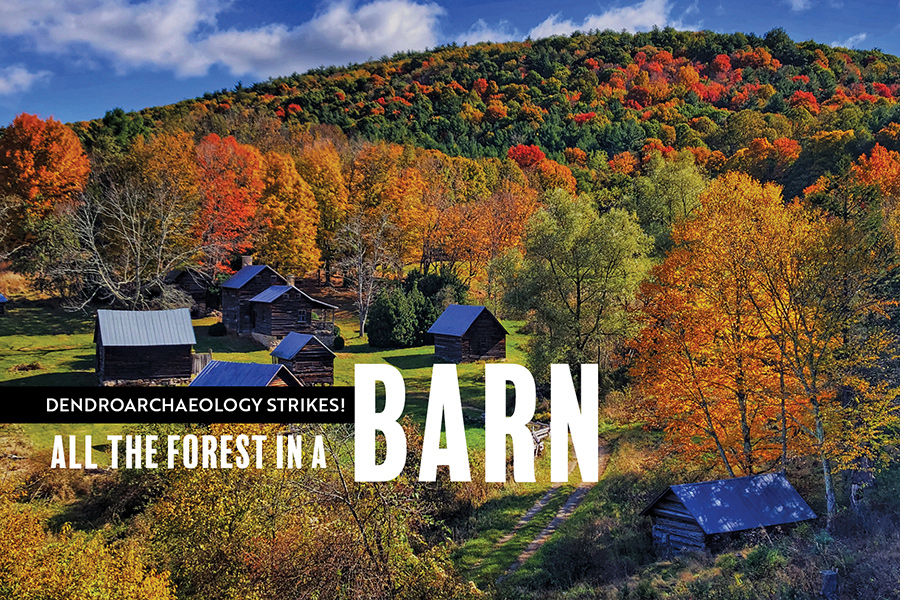
At Loafer’s Glory in Pendleton County, West Virginia, de Graauw’s work revealed new facts about the barn and house, and about the forest that provided the logs. Teresa and Jeff Munn
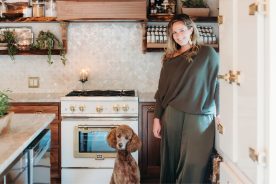
Kristen de Graauw’s passion is learning the age of the wood in old structures, thus unlocking mysteries about the people who built them.

As you drive the curvy roads of any rural county in the Southern Appalachians, you are witness to history that has disappeared from the more developed areas of the East Coast. You can spot it in old equipment rusting away in weeds at the edges of farm fields or see it in the shape and line of old buildings, but Dr. Kristen de Graauw, dendroarchaeologist and owner of Historic Timbers, is looking for even older history—the stories of the ancient mountain forests.

De Graauw came to this passion in a rather roundabout way.
“I had an ordinary upbringing. I read books and rode my bike with friends, but I wasn’t particularly outdoorsy,” she says. That changed when she took a college course on proxy records. Proxy records are the stories of ancient life found in things like ice cores and fossilized pollens. De Graauw was enthralled. “I thought it was so cool that you can reconstruct the past using environmental proxies.”
She especially loved what she could tease out when studying tree rings, so she spent much of her time in her master’s program drilling holes in old trees as she studied periodic insect events. Then, at a Forest Ecology workshop near Blacksburg, Virginia, de Graauw and her classmates took core-samples from the logs of an old barn to figure out when it was built, and she was hooked.
“I loved it. It felt like a puzzle.” So, she completed her doctorate by drilling even more holes into log buildings. That’s when she realized that old buildings could tell more than their own stories. They could also tell the stories of long-gone historical forests in the area.
“I developed a robust record of forest composition and growth in eastern West Virginia that pre-dates European influence as I completed my dissertation,” she says.
De Graauw’s current project is with John Adamson and the Shenandoah County Historical Society in Virginia. They are working to create a database of the barns in the county. Adamson believes that barns are the most important architecture in an agricultural area. What they discover will either support or supplant local oral histories. As he explains it, “the stories change a bit with each telling, but the science tells the truth.” And, as de Graauw works to help them date the barns, she is adding to her own research about ancient forests.
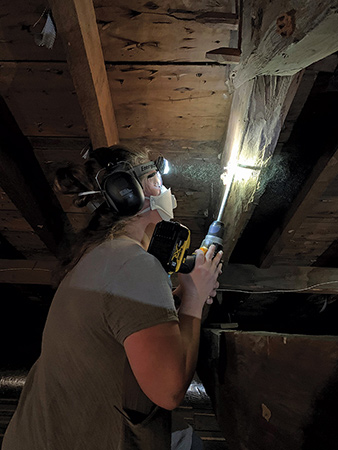
Today, de Graauw is collecting samples from the James Wellard barn near Forestville, Virginia. Drilling a hollow bit into extremely old oak is hard work. As de Graauw backs the bit out to cool it off, the air is rich with the smell of charred wood. The cores are hot to the touch when they drop out and de Graauw is sweating from her effort.
She will collect 20 samples from various log walls within the barn. When she compares these cores to those from other buildings in the area they will hint at the story of the forest where the logs grew. Each line from a log’s revealed rings tells about the tree’s birth and life before it was cut and placed in the barn. It’s like looking at ghostly fingerprints.
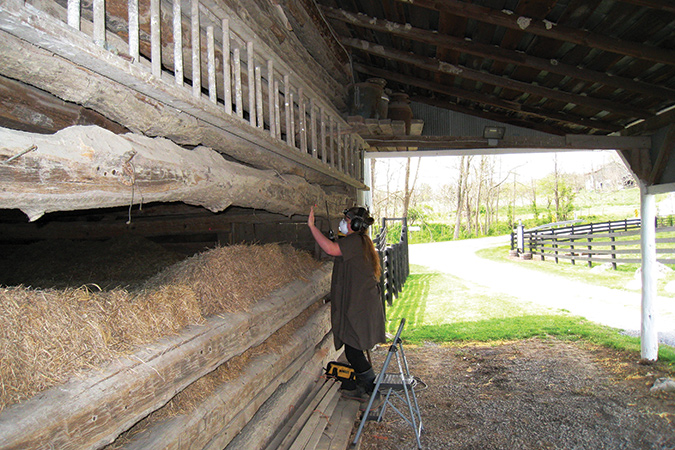
“Few scientists are using logs from buildings to reconstruct ecological events,” she says, “but from these logs we can see when trees in a forest started growing, and what ecological events they experienced as they matured.”
De Graauw discovered that many of her sampled logs, from Monroe County to Hardy County in West Virginia as well as those in Highland County, Virginia began growing around the same time: from 1670-1690. She wonders why. What events made that happen? Was it indigenous land management or a severe drought? This is a new field so the answers to these questions may not be discovered in her lifetime, but her data will help provide clues.
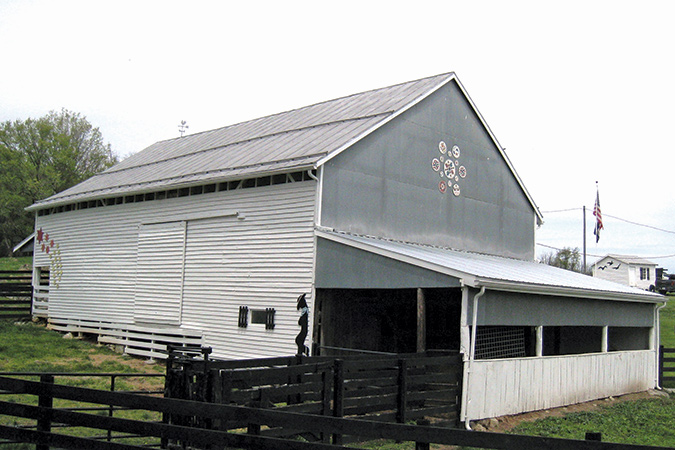
If you would like to get up close and personal with an old forest and some of de Graauw’s work, then visit the Airbnb, Loafer’s Glory, in Pendleton County, West Virginia. Once the Ananias Pitsenbarger homestead (circa 1840), this farm is now on the National Register of Historic Places. The current owners, Teresa and Jeff Munn, say that de Graauw’s work there was illuminating. Her samples showed that the double-cribbed log hay barn was started about five years before the house. This would imply that settlers found it more important to take care of livestock before building a house for family. Perhaps they lived above the barn while the house was being completed.
There’s a log apartment available at the Airbnb which was part of de Graauw’s research as she drilled into the history of the farm and the original forest around it. If you stay there for the night, you will be sleeping inside a story. One told to anyone who knows how to listen.
3 Things Kristen de Graauw Loves about Being a Dendroarchaeologist
Meeting the People. Dr. Kristen de Grauuw says one thing she loves about her job is the new friendships she develops as she works. “I love getting out in different communities and meeting people I wouldn’t otherwise meet.” Some of those relationships have developed into lifelong friendships.
Finding the Hidden Surprises. She often finds surprises as she examines the “nooks and crannies” of a structure. She sees things “that most people don’t get to see or don’t notice.” For example she’s discovered old bullets and buttons lodged in logs.
Sharing the Joy. While de Grauuw doesn’t always have the date that a client is looking for, when she has good news it’s joyous. “I’ve seen tears of excitement over a date and it makes me feel like I’ve done some good in the world.”
The story above first appeared in our November / December 2021 issue.