Skip to content


We at Blue Ridge Country got a note in the email awhile back, about a new scientific study looking at “the electrical conductivity of Earth’s crust and mantle below the mountain chain,” and such. We wanted to understand it better than we did after several tries, so we contacted the study’s lead author. He was kind enough to take it a bit toward better understanding for the rest of us.
Although the last major tectonic event to affect eastern North America ended more than 100 million years ago, the Southern Appalachian Mountains remain surprisingly sharp and steep.

And because the conventional scientific understanding of how topography evolves over time would suggest that these mountains should be much broader and smoother, geoscientists have for decades debated the reasons for this unusually sharp contemporary relief. Our recent scientific study offers a new take on this problem in the context of the impressively sharp break at the southeastern edge of the range—the Blue Ridge Escarpment.
This work, entitled “Insights into Intraplate Stresses and Geomorphology in the Southeastern United States,” by me (while a PhD student at Oregon State University), Lijun Liu (University of Illinois) and Gary Egbert (Oregon State University), finds that the steep escarpment between the Appalachians and the adjacent Piedmont could be the result of zones of weakness within the underlying crust.

How and why? Isostasy is the key. Isostasy essentially describes the buoyancy of the rigid crust sitting on top of the quasi-liquid mantle. The physics of this are very much like those that describe how one would float in a pool on a pool float: the underlying liquid pushes upwards and thereby supports the individual on the float.
A similar situation exists beneath the Southern Appalachians; the mountains here appear to be isostatically compensated, meaning that they are buoyantly supported by the Earth’s underlying structure.
However, a traditional analysis of isostatic compensation for the Appalachians would predict that the region of high elevation should be much broader and smoother than is observed. Notably, the concept of isostasy has a hard time explaining the abrupt nature of the Blue Ridge Escarpment. This is because isostasy usually assumes that the crust has a uniform strength.
This concept of strength can be illustrated by considering the flexure of a wooden plank when a heavy object is placed upon it. For a coherent wooden span—one that has no cuts or defects so that it has uniform strength—a heavy load causes the plank to bend into an arc. However, if the piece of wood does have a cut or major structural defect (that is, a zone of weakness), the pattern resulting from the imposed load will be significantly changed.
This latter case is what our study argues may be happening beneath the Southern Appalachians: although the mountains are supported by crustal buoyancy, zones of weakness within the crust may modulate exactly how the crust responds to that upward push. Our numerical simulations show that such a phenomenon could produce sharp topography like what we see in the Blue Ridge Escarpment today.
OK, enough science. Ready to go see this unusual sharp break in the topography? Here are three great places:
- Caesars Head State Park, South Carolina: From here, one can see how the low-relief, low-elevation Piedmont abruptly gives way to the high elevations of the Southern Appalachians. Just watch your car’s brakes on the way down—U.S. Highway 276 here really demonstrates the impressive steepness of the Blue Ridge Escarpment.
- Table Rock State Park, South Carolina: From the lofty viewpoint at the top of the eponymous landform, one can look northwards to again see the sharp break between the Appalachians and the adjacent Piedmont. Steep in places but overall fantastic, the trail that leads up the mountain really instills respect for the magnitude of the Escarpment.
- Grandfather Mountain, North Carolina: Driving along the Linn Cove Viaduct—itself an engineering marvel—inspires an appreciation for the impressive geology and geography of the Blue Ridge.
For more information, the curious reader can click here for the complete study.
Benjamin Murphy completed this research while a PhD student at Oregon State University, and he has since moved on to a postdoctoral position with the USGS.
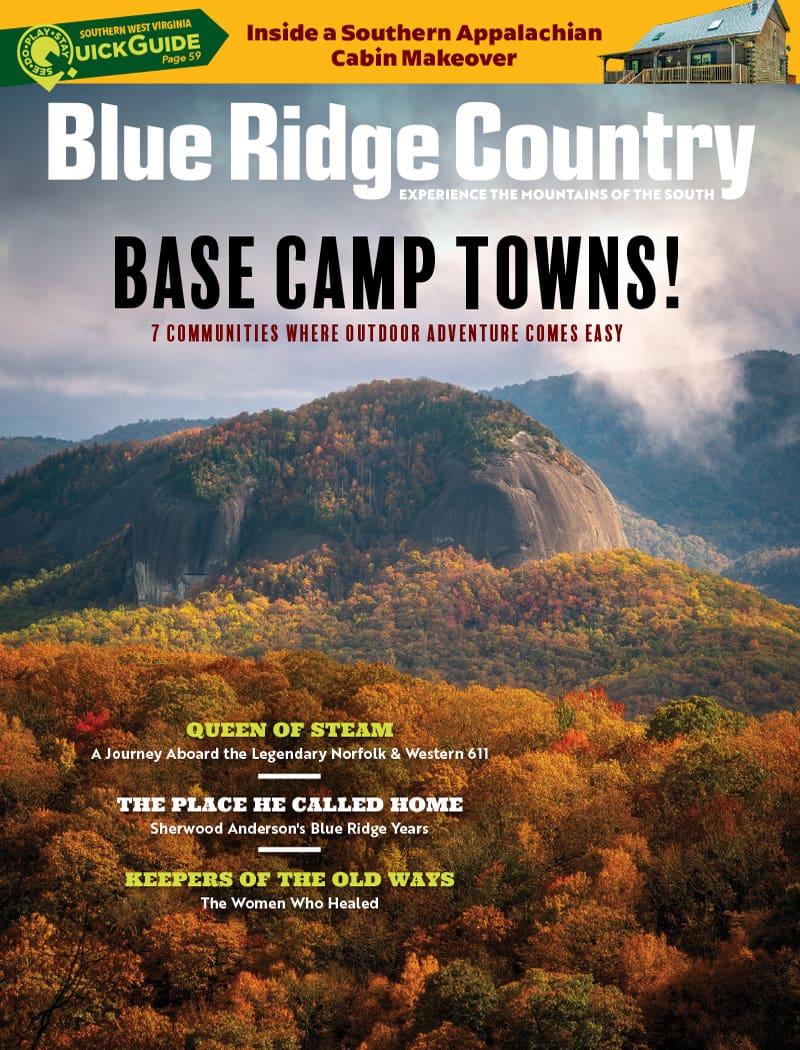
The story above is from our January/February 2020 issue.