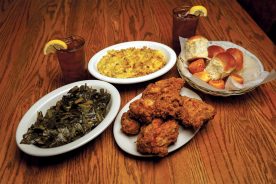
The “zip on the lip” flavors—mild to extra hot—are the products of careful and extensive research.
Burgeoning populations and rhyming names aren’t the only things that Nashville, Tennessee, and Asheville, North Carolina, have in common. Add hot chicken to the list.
Compared to Nashville’s hot chicken history, Asheville is a relative newcomer, but its reputation for the spicy bird is growing by the day, thanks to Rich Cundiff, a former executive with Whole Foods and Earth Fare. Cundiff and his wife Lauren own Rocky’s Hot Chicken Shack, with locations in Asheville and Arden, with another on the way in Greenville, South Carolina.

Cundiff shares credit for his success at Rocky’s widely, beginning with the time when he first tasted Rocky Lindsley’s hot chicken in Fletcher, North Carolina.

“We got to be friends, and he asked me to be his investor,” says Cundiff, who holds an MBA from the University of Texas at Austin. “Four months in, Rocky took early retirement.”
Cundiff opened the first Rocky’s Hot Chicken Shack on Asheville’s Patton Avenue in 2009. In addition to keeping Lindsley’s first name on the business, Cundiff retained some of his recipes, including the one for oniony, buttery green beans. A gifted singer and musician, Lindsley opens and closes the annual music series, Wings and Strings, at the Arden location.
Credit, too, is shared liberally with André Prince Jeffries, the current matriarch of Nashville’s oldest and most storied hot chicken joint, Prince’s, opened by her great uncle James Thornton Prince in 1945. “There’s a special twist to what Prince’s does, and I think it stands above everybody else,” Cundiff tells us. “Our hot chicken at Rocky’s is Nashville hot chicken.”
With his finance background and his “by the numbers” style of running the business, Cundiff employed an equally methodical approach to recipe development, with some fun along the way.
“For about six months, we had a party at our house every Friday night, and we introduced three to four items at each party,” Cundiff says. “All our friends had to give us written feedback. Once we determined what was the right recipe for that particular item, we would learn how to make it on a much grander scale.”
Unsatisfied with chicken farmers who insisted on selling birds when they weighed only three pounds, Cundiff sought out more patient producers who were willing to sell chickens that tipped the scales at seven and eight pounds. Chicken is sourced from farms in Mississippi, Georgia, and North Carolina. The bone-in breast Rocky’s serves is typically 14 to 16 ounces.
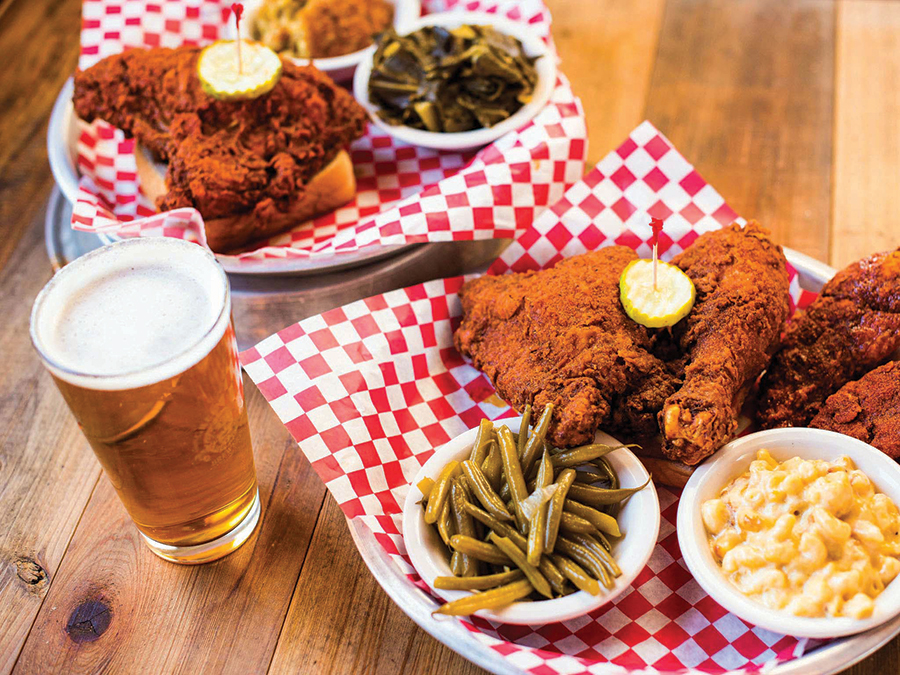
Cundiff explains that hot chicken begins as “just great plain fried chicken.” From there, spicing levels cover every preference. Honey style isn’t spicy at all, with a little black pepper and lemon. Honey mild has become the most popular flavor at Rocky’s, with a little spice, balanced by the sweetness of the honey.
“And, next up, our mild has enough kick that you’re going to feel it,” Cundiff says. “People are sometimes a little startled, but it’s not going to do any damage. You get used to it rather quickly, but it does have some zip on the lip. From there you go to medium, and medium is what other people usually call hot. Our hot is pretty hot.”
The next level is Rocky’s hot, described by Cundiff as “an extreme flavor experience. The people who eat that won’t eat anything else because it’s the big boy.”
There is an extra hot, too. “And I don’t personally recommend it,” Cundiff adds. “It’s got ghost chili in it, and ghost chili is not something that I think is particularly enjoyable. We used to do extra extra hot, but we don’t do that anymore. People were hurting themselves.”
…END OF PREVIEW
The story above appears in our Jan./Feb. 2019 issue. For the rest, subscribe today or log in to the digital edition with your active digital subscription.