West Virginia Buzz: New Bee Campus in Morgantown

Many Blue Ridge region colleges are looking out for pollinators.

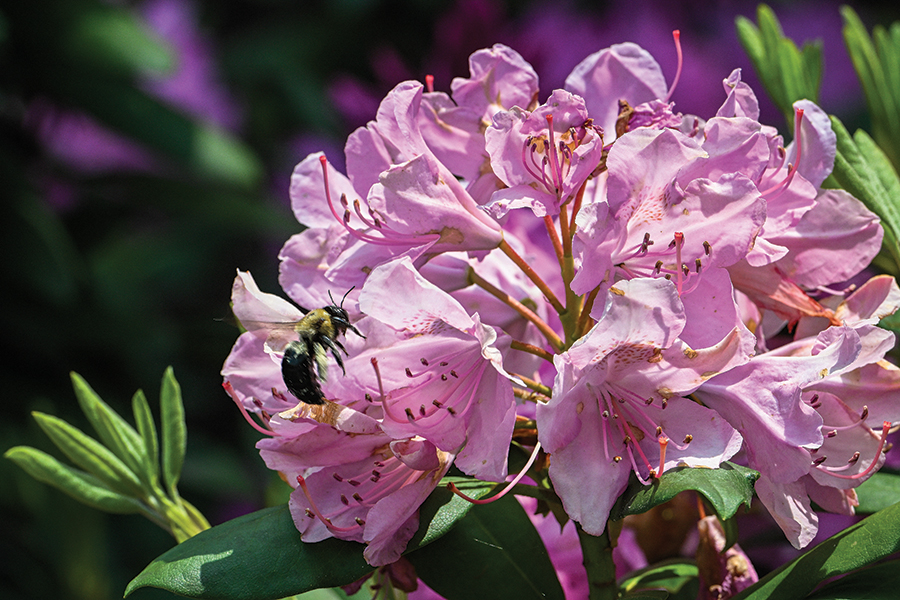
A plethora of pollinators has found a welcome at a West Virginia University’s Morgantown campus—this year’s first Bee Campus USA designee,  based on its work building native plant gardens and nest sites.

A bevy of beneficial bugs and birds will be welcomed back to campus at the first pollinator garden planted in 2022. They will also discover the newly redeveloped “cattail garden” filled with “more than 100 pollinator and water-loving” species created in the fall of 2023.

The original program (Bee City USA®) was founded in Asheville, North Carolina, and has expanded to include Bee Campus USA. Both are initiatives of the Xerces Society for Invertebrate Conservation. While bees are the focus (with more than 3,600 native bee species in the country), native plants help reverse the significant decline of all pollinator species.

According to Bee City USA®, “Pollinators are keystone species in essentially every terrestrial ecosystem on earth, assisting in plant reproduction and supporting other species of wildlife.

 Additionally, healthy native habitats require less maintenance and no pesticides. Visit beecityusa.org for details.

Of the 180 total Bee Campus Affiliates in the USA, many are in the Blue Ridge region:

  • Chattanooga State Community College (TN)
  • University of Tennessee Knoxville (TN)
  • University of South Carolina Upstate (SC)
  • Blue Ridge Community College (NC)
  • Warren Wilson College (NC)
  • University of North Carolina Asheville (NC)
  • NC Arboretum (university affiliate) (NC)
  • Appalachian State University (NC)
  • Surry Community College (NC)
  • Berea College (KY)
  • Morehead State University (KY)
  • Virginia Tech (VA)
  • Virginia Western Community College (VA)
  • Randolph College (VA)
  • University of Virginia (VA)
  • James Madison University (VA)

The story above first appeared in our May / June 2024 issue.

You Might Also Like:

This is a landscape photograph of the night sky with the Milky Way over rural Bryson City during summer in the Great Smoky Mountains North Carolina.

Skywatch: September/October 2026

Summer is winding down.
Coyote (Canis latrans) wandering out from the forest into the loop road on a summer late morning.

Critters Crossing! 

States across the Blue Ridge are investing in wildlife crossings to protect animals and improve roadway safety.
Eugenia Williams House. Photo courtesy of Bruce Cole

A Mystery on the River

The once-private estate of enigmatic heiress Eugenia Williams is now open to visitors. 
Spotted Lanternfly

The March of the Spotted Lanternfly

Don't let the striking appearance of this troublesome pest fool you.
Virginia Creeper Trail in Damascus, photo by Town of Damascus. Photo courtesy of the Town of Damascus.

Damascus Renaissance

A project to repair the Virginia Creeper Trail is spurring growth in this beloved AT town.
At Coopers Rock State Forest, new Stargazer cabins invite guests to look up through skylights and telescopes.

Even Closer to Almost Heaven

New Stargazer cabins at Coopers Rock State Forest offer a skyward escape in the mountains of West Virginia.
This is a landscape photograph of the night sky with the Milky Way over rural Bryson City during summer in the Great Smoky Mountains North Carolina.

Skywatch: July/August 2026

How many stars can you see?
©Duncan Seaman

A Mountain Tradition Turns 90 

Visitors flock to Galax, Virginia, each summer for the Old Fiddlers’ Convention, a days-long celebration of Appalachian music.
NightFlight Expedition Takes Off at Dollywood

NightFlight Expedition Takes Off at Dollywood

The new coaster is the Tennessee theme park’s largest single attraction investment to date.
Ron Messina | Courtesy of the Department of Wildlife Resources

Historic Easement Protects SWVA Land, Opens It to the Public

Lovers of wildlife, woodlands, and waters will soon have a vast area to explore in Southwest Virginia.