Skip to content


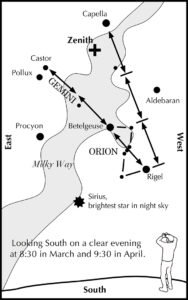
Use winter’s most recognizable constellation to meet new stars. Orion’s easily recognizable stars provide convenient guides to find your way to other, lesser-known star patterns. Look north of Orion about twice the distance that it stands tall, toward the fourth brightest star seen from the Blue Ridge, Capella. This luminary first rises in the early evening in late October and remains in the sky through early June. From a dark location, Capella now is seen to lie just left of the subtle band of the Milky Way which winds from the south to the northwest.
Draw an imaginary line from Rigel, Orion’s southwest corner star, through Betelgeuse occupying its northeast corner. Extend the line about twice that length. It lands near two very famous stars, Castor and Pollux, the twin stars of Gemini. Consider that astronomers have found that Castor is not just one star, not two, but six stellar components all orbiting each other! How strange must a world be in that system! Six suns!

Meet new stellar friends in person by visiting a dark area such as one along the Blue Ridge Parkway, or at a state park. Be sure to carry binoculars. Enjoy nature at night!
The story above first appeared in our March / April 2022 issue.