Skip to content



Are reptilian encounters on the rise?
Photo Above: The timber rattlesnake, like most wild animals, strikes only when threatened.
Last summer, The Wall Street Journal and other news outlets reported an increase in venomous snakebites in the Southeast, with some blaming the preceding warm, wet winter. Some predicted similar dangers for 2020.

Not so fast, says Chris Ogle, wildlife surveys manager for the Tennessee Wildlife Resources Agency in Morristown.
“I think it is more a coincidence and maybe more just the reporting of it,” he says. “We don’t track numbers like we would on the elk herd on North Cumberland, but we do keep up with inventory and monitoring and we haven’t noticed any kind of major increase.”
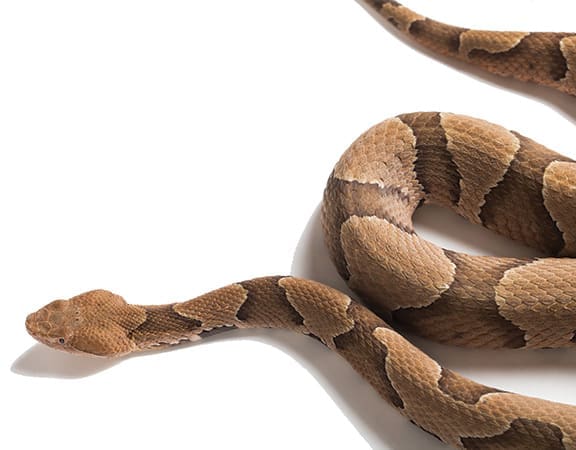
The Blue Ridge region is home to just two types of venomous species: the timber rattlesnake and the more common copperhead, which Ogle says are pretty evenly distributed in the mountains of Tennessee, West Virginia and other Southeastern states. They prefer overgrown fields, forests and rocky outcrops where they can hide thanks to their camouflage coloring. Of the numerous snakebites Ogle has experienced in the course of his career, none have been from venomous species, although twice he came close when he got near a rocky area.
Most hikers encounter the reptiles on sunny trails, he points out. “[Snakes] go there because they don’t thermoregulate their own body temperatures. They’re not like us. They have to use outside forces to warm up their body heat to either be active or hunt or digest prey or if they are pregnant.”
Like most wild animals, snakes generally strike only if threatened. And even a venomous one may inflict a “dry bite” to save venom, which is costly for their bodies to produce.
“They’re not going to chase you down,” Ogle says. “The snake doesn’t want to bite you. It wants to get away. … You’re a giant compared to that snake. If a giant picked you up, you’d probably do whatever you could to get away from it.”
All types of snakes benefit humans by eating mice, rats and other pests, Ogle notes. The black king species and others will even eat their venomous cousins because the toxin doesn’t bother them. “So they play a vital, important role in the environment.”
Snake Handling
Tennessee Wildlife Resources Agency biologist and surveys manager Chris Ogle offers these tips on dealing with snakes:
If you hike in the woods
- Be able to identify venomous snakes, which are typically thick-bodied with triangular heads. Timber rattlers sport distinctive markings and copperheads have “Hershey Kiss” saddles on their backs.
- Wear the right shoes—ideally boots that cover your ankles.
- “Even more [important],” says Ogle, “is situational awareness, a term in the law enforcement world. Be aware of your surroundings. When you’re hiking, look down at the trail and pay attention.”
If a snake crosses your path
- Leave it alone. “I have seen people use larger sticks to shoo the snake away,” Ogle says. “Sometimes that works and sometimes that snake will coil up and be more defensive and more likely to bite. It would’ve been better for you to make a circuitous path around it.”
- Keep an eye on it as you move away, just in case.
- Don’t try to harm it unless you need to defend yourself. In some states, it is actually illegal to kill a snake.
If you do get bitten
- Try to remain calm. “It’s difficult in a situation like that,” Ogle admits. “But the less amount of blood flow you have, the less the venom is going to get to other places.”
- Don’t try to suck out the poison or apply a tourniquet.
- Get to a hospital as quickly as possible, especially if the snake is a timber rattler. Dehydrated anti-venom must be activated, so call ahead. “Time equals tissue,” Ogle says. “The more time it takes, the more tissue you lose because that’s what the venom is going after.”
The story above appears in our May/June, 2020 issue. For more subscribe today or log in to the digital edition with your active BRC+ subscription. Thank you for your support!