Hard Candy Christmas

Craft show

By Joe Tennis

All over the calendar, craft fairs bloom like kudzu on tomato vines: The Mount Mitchell Craft Fair attracts 30,000 to downtown Burnsville, N.C., on the first weekend of August, while Alabama’s mini-town of Mentone may appear quite quiet during weekdays but mushrooms into a metropolis with events like Colorfest in October, a time when colorful leaves seemingly inspire all kinds of arts and crafts events.

Then come the heavy-hitters of November and December – a time when buyers shop and crafters love to sell.

But, wait – that’s not all there is to it.

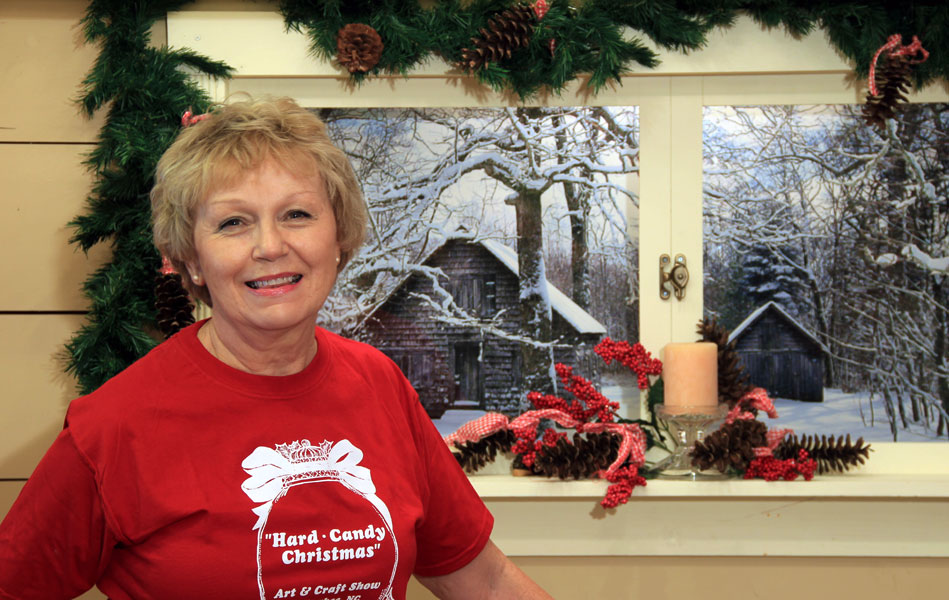
“This whole thing is not about money,” says folk artist Doris Hunter of Franklin, N.C., and the founder of the Hard Candy Christmas Art & Craft Show, held at Cullowhee’s Western Carolina University on Thanksgiving weekends.

“I just fell in love with making birds from pinecones. It was so intoxicating,” Hunter says. “And, if you ever make money from people buying something that you make from your hands, it will send you to the moon.”

At the Ramsey Center arena on the Cullowhee campus of Western Carolina University, you can take a taste of the Hard Candy Christmas Art & Craft Show, presented by Mountain Artisans, on Nov. 23-24.

Originating in 1987, this event takes its name from show founder Doris Hunter, the youngest of eight children and a lady who remembers Christmas as a “transformational time” while growing up in the mountains of Franklin.

“Christmas enchanted me,” Hunter says. “We knew that, even if Christmas was tight, we could still have a hard candy Christmas.”

Coming here, these days, you get so much more: The show has grown to 115 exhibitors offering gourds, birdhouses, books, rocking chairs and carved bowls.

“And I am real particular,” Hunter says. “I am looking for hand-done products. You can have a nice, original piece, and you can meet the person who made it.”

>> FOR MORE ON CRAFT SHOWS, pick up a copy of the Nov/Dec 2012 issue of Blue Ridge Country

You Might Also Like:

White jelly snow fungus growing in the author’s Botetourt County, Virginia woodlot.

May’s Wild Edible: White Jelly Snow Fungus

“Pass the fungus,” is not common dinnertime conversation in the Blue Ridge Mountains region, but that’s because folks perhaps have not heard of the white jelly snow fungus.
Wild garlic growing in Fayette County, West Virginia.

April’s Wild Edible: Wild Garlic

Fayette County, West Virginia’s Mitchell Dech is one of my foraging mentors, and when he wants me to try an edible new to me … I’m ready to learn about it.
A May apple in bloom in Southwest Virginia.

March’s Wild Edible: May Apple

Sometime this month in the Blue Ridge Mountains, one of these highlands’ signature spring plants will ease from the soil … the May apple (Podophyllum peltatum).
e1b70596-05c8-11f1-92e0-1248ae80e59d-3-2026rueanemone--credit-Joe-Cook

March’s Mountain Wildflower: Rue Anemone

A member of the buttercup family and found in the open woodlands, rue anemone (Thalictrum thalictroides) has long, thin stems that tremble in the slightest of winds—prompting its other common name, windflower.
Pokeweed growing in Floyd County, Virginia.

January’s Wild Edible: Pokeweed

Pokeweed is one of the wild plants that is most associated with the Blue Ridge Region.
A purple-spored puffball growing in a field in Botetourt County, VA.

December’s Wild Edible: Purple-Spored Puffball

The purple-spored typically grows in this region’s fields, often appearing from October through December and into early January.
d289022c-696f-11f0-a179-1248ae80e59d-CGZ_0845-011

Ride the Rails, Explore Rockbridge County: Make a Weekend of the 611 in Goshen!

This fall, one of America’s most iconic steam locomotives is making tracks and memories.
The compound, lancelike leaflets of the bitternut are a good identifier.

November’s Wild Edible: Bitternut Hickory

Frankly, this native species to the Blue Ridge mountains comes by its name honestly.
Mullein growing in Ingram's backyard.

October’s Wild Edible: Mullein

Earlier, this year, a lone mullein plant appeared along the fence that encloses my garden, which made me curious about this plant.
An indigo milk cap growing in Botetourt County, Virginia.

September’s Wild Edible: Indigo Milk Caps

When young, indigo milk caps are one of the most stunningly beautiful mushrooms in the Blue Ridge Mountains.

CALENDAR OF EVENTS