October’s Mountain Wildflower: Chicory

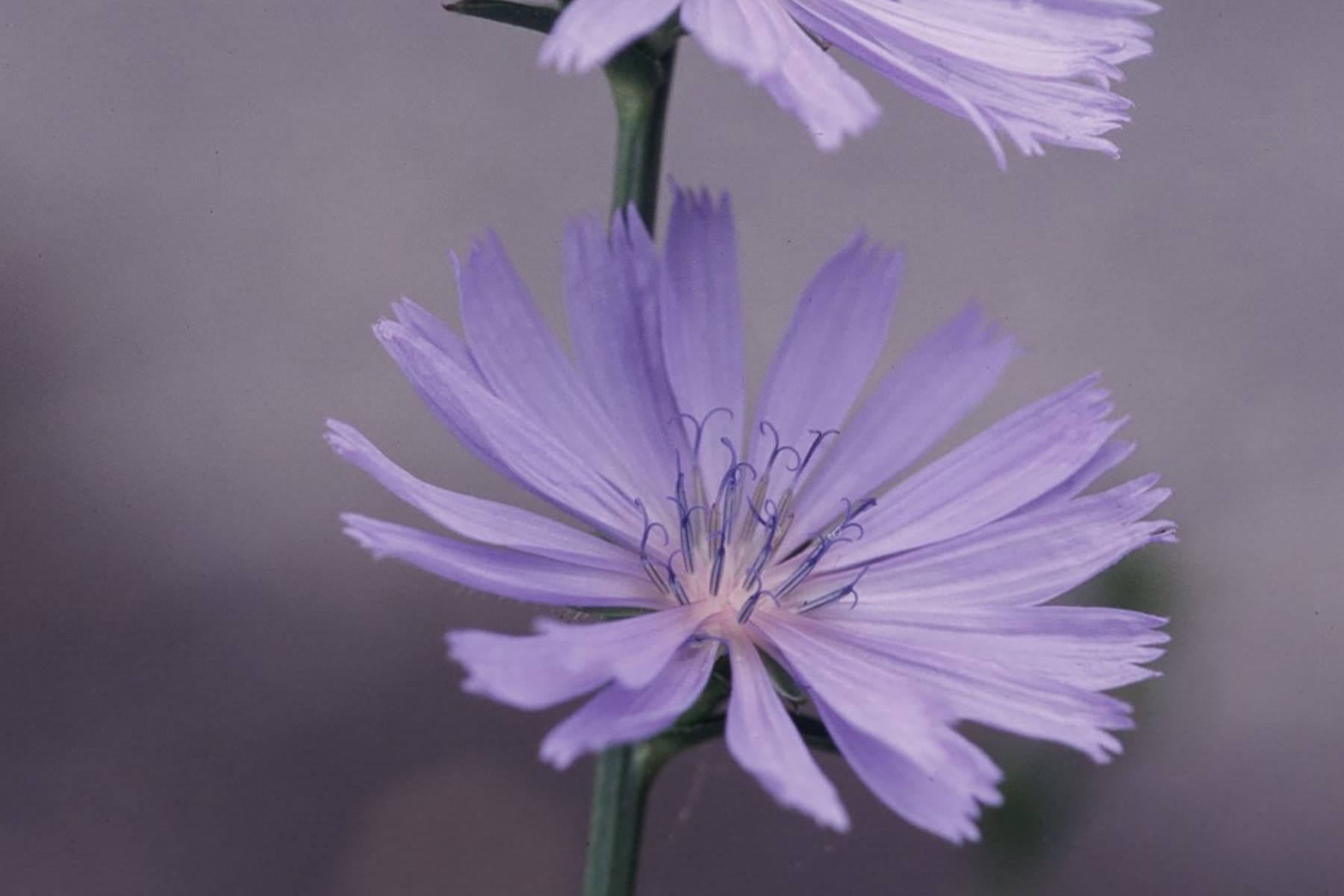
Chicory. Credit Joe Cook and Monica Sheppard

The blossoms grow at intervals along the upper portion of the stem, opening early in the morning to entice passing bees and other insects. Yet each flower lasts but a day.

Photo Credit Joe Cook and Monica Sheppard

Because it is such a common plant—often considered just a weed in its habitat along roadsides, in waste places, and in open fields—chicory (Cichorium intybus) is easy to overlook. Yet, of the plants found in our area, its flower possesses a blue of the clearest kind. In his book A Countryman’s Flowers, Hal Borland was moved to say the flower was as “blue as the innocent eyes of a six-year-old.”

The blossoms grow at intervals along the upper portion of the stem, opening early in the morning to entice passing bees and other insects. Yet each flower lasts but a day. By early afternoon the petals have begun to wither, and they will have completely fallen off by the time darkness approaches. New blossoms will appear at different spots along the stem the next morning.

The early colonists imported chicory from the Old World, where it had been cultivated as livestock feed for centuries. Turning it into a popular beverage, Egyptians harvested the plant from gardens along the Nile River more than 5,000 years ago, and the Greeks who were contemporaries of Christ used it for medicinal purposes. Recent investigations have found that the plant has antibacterial properties and that a substance in its roots can lower heart rates.

Chicory’s leaves have been added to salads, while its roots have been dried and roasted as a substitute for, or an additive to, coffee. You will find an abundance of references to people enjoying chicory coffee, but it is an acquired appreciation. The beverage is much stronger and quite a bit more bitter than the ground coffee most of us are used to buying in the supermarket.

Flower Fast Facts

FLOWER: The 1.5-inch-wide flowers have anywhere from 12 to 20 rays, whose square tips are finely fringed.

LEAVES AND STEM: Looking a bit like the leaves of dandelions or endive lettuce—to which chicory is related—the basal leaves are 3-6 inches long, while the ones along the 1- to 4-foot stem are shorter.

BLOOM SEASON: June-October


About This Series

“Mountain Wildflowers” features a wildflower from the Blue Ridge region each month from March to October. Leonard M. Adkins has written for Blue Ridge Country for more than two decades and is the author of 20 books about travel, hiking and nature. His Wildflowers of the Appalachian Trail, which received the prestigious National Outdoor Book Award, provides the photographs and some of the information he writes about in each “Mountain Wildflowers.” It and his other works may be obtained through his website.

You Might Also Like:

Credit Joe Cook and Monica Sheppard

September’s Mountain Wildflower: Ghost Pipe

Containing no chlorophyll, this plant rises from the soil on translucent, waxy-looking stems, and the pinkish-white flower nods back toward the ground, giving the whole plant the appearance of a fancily carved soapstone pipe.
Trumpet Honeysuckle. Credit Joe Cook

August’s Mountain Wildflower: Trumpet Honeysuckle

Like spotted jewelweed and trumpet tine, the flower’s deep throat and red color make it attractive to ruby-throated hummingbirds, who are its main pollinators.
Oxeye Daisy. Credit Joe Cook and Monica Sheppard

July’s Mountain Wildflower: Oxeye Daisy

The oxeye daisy is a member of the composite family, which American naturalist Roger Tory Peterson believed to be the most recent one to make its appearance on Earth. 
Mountain Laurel. Credit Leonard M. Adkins

June’s Mountain Wildflower: Mountain Laurel

If you are out in the fall, stop to examine the small capsules on the mountain laurel; these were once the plant’s flowers in May, June, and July.
Mayapple. Credit Joe Cook and Monica Sheppard

May’s Mountain Wildflower: Mayapple

Despite its name, the fruit, which looks more like a yellowish-green, egg-shaped berry than an apple, usually does not begin to develop until early to mid-summer.
Trout Lilly. Credit Joe Cook and Monica Sheppard

April’s Mountain Wildflower: Trout Lily

Like its western relative the glacier lily (Erythronium grandiflorum), trout lily (Erythronium americanum) is often found pushing its way through a blanket of snow in early spring.
e1b70596-05c8-11f1-92e0-1248ae80e59d-3-2026rueanemone--credit-Joe-Cook

March’s Mountain Wildflower: Rue Anemone

A member of the buttercup family and found in the open woodlands, rue anemone (Thalictrum thalictroides) has long, thin stems that tremble in the slightest of winds—prompting its other common name, windflower.
ec3b964c-5201-11f0-968d-1248ae80e59d-9-2025spottedjewelweed--credit-Joe-Cook-and-Monica-Sheppard

September’s Mountain Wildflower: Spotted Jewelweed

Seek out spotted jewelweed growing beside a stream or along a moist area and you will have a good chance of getting to watch one or more ruby-throated hummingbirds flit from flower to flower.
b278bbc8-5202-11f0-9ff6-1248ae80e59d-10-2025butter-and-eggs--credit-Joe-Cook

October’s Mountain Wildflower: Butter-and-Eggs

Originally a native of Asia, butter-and-eggs (Linaria vulgaris) was introduced into the United States by way of Europe and can now be found in temperate zones throughout the world.
aafec0b2-51fe-11f0-9b55-1248ae80e59d-8-2025turk_s-caplilly--credit-Joe-Cook

August’s Mountain Wildflower: Turk’s Cap Lily

Its species name of superbum means “superb” and is an acknowledgment of the plant’s glamour and charm.