Skip to content


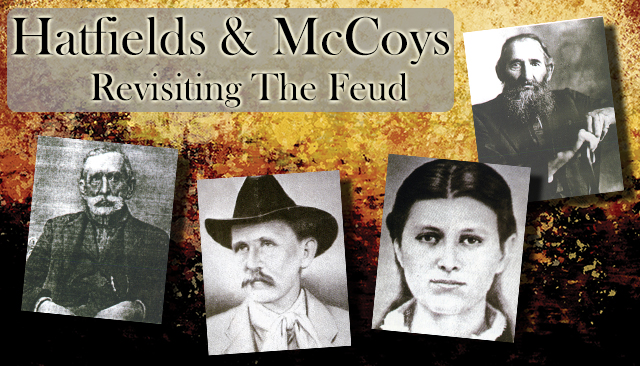

About the author: Tom Dotson was born and raised on Blackberry Creek, a mile from where the 1882 Election was held. A direct descendant of Preacher Anse Hatfield and of Uriah McCoy, Mr. Dotson knew many people who remembered the 1880’s as he grew up during the late 1940’s and 1950’s. He has a Masters Degree in Labor History from Cornell, and is the author of “The Hatfields & McCoys after Kevin Costner: Rescuing History.“
In his introductory post, Ryan Hardesty wrote: “These tall tales, from their creation in the 1890s until their most recent incarnation in the History Channel Mini-Series and popular books by Lisa Alther and Dean King, rely upon that original portrayal of the people of the Tug Valley as barbarous, uncivilized and savage.”

This is because those writers rely on the easily discredited feud story and not on the historical record. A glance at the index of Pike County, Kentucky cases, which is available both in Pikeville at the Circuit Court Clerk’s office, and at the Department for Libraries and Archives in Frankfort is enough to illustrate this in both of the best-selling books that have come out in the wake of the Kevin Costner movie:
Lisa Alther, in her 2012 book, “Blood Feud,” writes: “Ranel McCoy did eventually retaliate, though, however blandly. Fifteen months after Harmon’s death, in April, 1866, he charged Devil Anse Hatfield with stealing a horse from his farm in 1864.” (p. 35) Alther gives no reference to a case number in support of her claim, and for good reason: No such case was ever filed! Misinterpreting evidence is common among writers, but the manufacture of fake evidence permeates feud writing.
While several of the cases in the index are suits for restitution for items stolen by marauding guerrilla bands during the war, no such suit ever involved any Hatfield vs any McCoy, much less Devil Anse and Randolph.
Alther, whom the Wall Street Journal considers to be “an expert on the feud” then writes: “Ranel McCoy and Devil Anse Hatfield filed several similar civil suits against each other in the years following.” Again, she gives no citation, because no such cases were ever filed.
The record, in fact, shows much more friction within the two families than there was between them. So, in order to document a long, festering squabble between Hatfield and McCoy, Alther is forced to invent cases from whole cloth, while conveniently ignoring the actual record. Nine times in the Pike County records we see a McCoy suing another McCoy and seven times we see a Hatfield suing another Hatfield. Only once do we see the two surnames listed as contending parties.
That case came in 1885, nearly three years after the Blackberry Creek bloodshed, and involved a McCoy and a Kentucky Hatfield, only distantly related to Devil Anse. Calvin McCoy, son of Ran’l and Sally, sued a Pike County deputy sheriff named Hatfield for false arrest. Clearly, the conflicts within the two families themselves were far more serious than the conflicts between them.
Dean King, in his book “The Feud: The Hatfields & McCoys: The True Story,” claims that Tolbert McCoy, the villain of the Election Day, 1882 fight, was a wealthy timber man, who left his wife a sizable estate. The Census for 1880 tells a far different story, showing Tolbert as a farm laborer, living on a neighbor’s farm.
In King’s yarn, the financial affairs of the deceased farm laborer, Tolbert McCoy, were so complicated that his brother, Calvin, acting as Tolbert’s executor, had to file multiple lawsuits to unravel the estate. (p. 124). The index of cases, however, shows no lawsuits with Mary Butcher McCoy, Tolbert’s widow, as a party, and none with Calvin McCoy as an executor. There is no record of any Tolbert McCoy estate anywhere, and, given the extensive nature of the Pike County records, had there been such an estate, it would have left a paper trail!
These are not the kind of minor errors one can find in any historical writings; they are major distortions, simply because they support major contentions of Alther and King. Alther’s fabrication of multiple lawsuits gives the impression of two families at loggerheads over a period of decades, thus validating her book’s title, “Blood Feud.” This is categorically false.
Dean King’s gross distortion of the facts is part of his stated agenda of proving that Altina Waller, in her monumental book, “Feud: Hatfields, McCoys, and Social Change in Appalachia, 1860-1900,” was wrong in finding a connection between economics and the violence that forms the core of the feud legend.
In reality, as laid out in Altina Waller’s work, in August, 1882, Tolbert McCoy was a good-looking, intelligent and landless twenty-eight-year-old man, with no visible prospects for bettering himself economically, who drank too much moonshine on Election Day and committed a foul deed. In King’s fabricated story, he becomes instead a wealthy timber merchant who started a fight with the town drunk over a buck and change.
The real history of Tug Valley in the quarter century following the Civil War, as seen in the records, is only very slightly related to the feud legend as it has been presented by most feud writers for more than a century and a quarter. Except for Professor Waller, each of them came to the events with a preconceived notion of what “really” happened, and all somehow managed to find, or fabricate, the facts needed to support the story that they wanted to tell.