Skip to content



As this series is proving, much of the feud story is illogical, impossible or downright ludicrous. A surprising amount of it is also in clear conflict with official public records. The tale gains strength with each retelling, as each succeeding writer cites the prior writers, adding a few flourishes of his own. When traced to the origin, most of the tales originated with a 19th century newspaperman from a big city paper, who never saw an official Kentucky document in his life.
Sometimes the story is so strong that it is actually written in stone, as is the case with the infamous “hog trial.” There is no documentary evidence that the hog trial ever took place. It is entirely based upon local lore and the 1888 writings of the New York reporter, John Spears. Having personally heard the local lore from people whose memories went back further than John Spears, I believe that there was a dispute over a hog involving Ran’l McCoy, which was settled by Preacher Anse Hatfield. While I believe that, I KNOW that the hog trial could not have happened the way it is presented in the feud tales.


In the 1870’s, the major feud characters were involved in lawsuits over debt, land and timber, involving sums ten to one thousands greater than the value of a hog. In every case, the loser complied with the decision of the court without resort to violence. Yet, we are to believe that a vicious family feud began over the loss of a hog in a trial.
The sign starts off wrong: Floyd Hatfield was NOT charged with hog stealing, which was a felony, and, as such, could not have been tried by a Justice of the Peace.
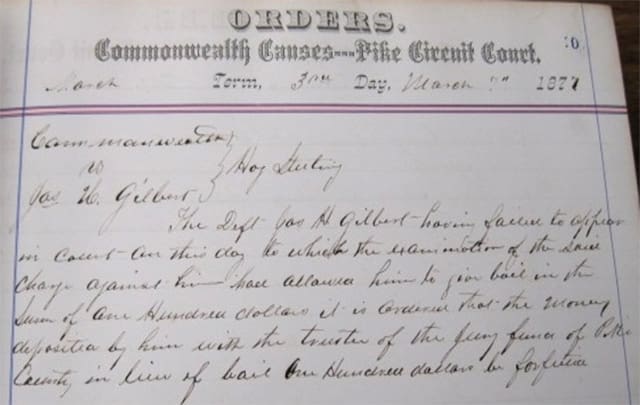
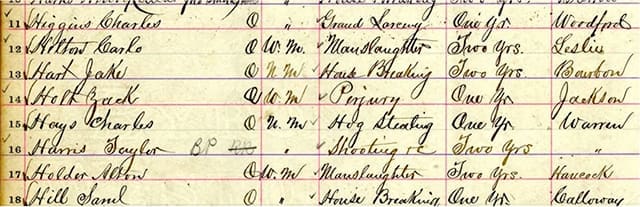
The 1890 register of prisoners in the Kentucky State Pen has several men incarcerated for the felony of hog stealing. Here’s one, on line 15:
Ran’l obviously charged Floyd with penning up one of his free-running hogs – not with stealing it. The trial had to have been to establish ownership and not the felony charge of hog stealing.
All the yarns have a jury of six men from each of the two families. That is a legal impossibility, as Kentucky law set a maximum of SIX members for a jury in a Justice of the Peace court. (Section 2252, Kentucky Statutes). When the Constitution was rewritten in 1890-92, the same language restricting such a jury to six men was incorporated into the Constitution, Section 248.
The same six-man jury in a JP court was also the law in West Virginia. West Va. Code, ch. 50 sec. 72.
The sons of Preacher Anse told me that he was usually able to settle disputes by meeting with the parties as a mediator. In the infrequent cases where a trial was held, it was held at the home of Jeremiah (Jerry) Hatfield. The rare jury trials were held in the rear of the house, with Preacher Anse and the jury on the back porch and spectators in the yard.
In addition to the super-sized jury, some feud yarns have more than twelve others in the room. The house stood until the 1970’s. I delivered papers to Uncle Ransom, son of Preacher Anse, daily for over three years, and I was in the room many times. It was about the size of a room in a Holiday Inn Express. One book has the trial in February, with approximately thirty people in the room. In February, the roaring fire in the fireplace would render a third of the room uninhabitable.
The claim on the marker that the two McCoys who killed Bill Staton (his story comes next) were tried in Wall Hatfield’s court is also false, as Wall Hatfield was a Justice of the Peace, and Justices of the Peace did NOT try murder cases in either state.

Lastly, the Commonwealth of Kentucky has TWO hog trial markers, the other one cast in metal:
As with the granite marker, there is not one bit of documentary evidence for anything on this marker. It is clearly in error on the number of jurors.
Note that the metal marker gives the date as 1873, while the granite one has 1878. If the Commonwealth of Kentucky does not know the date of the trial within five years, how do writers know the other details etched or embossed on the markers?