Skip to content



Prelude to the Feud
By Guest Contributor Ryan Hardesty, Creator of “The Real Hatfield, Real McCoy, Real Feud, Real Matewan Facebook Group”

Almost everyone in America has heard of the Hatfield McCoy Feud. It’s right up there with Custer’s Last Stand and The Gunfight at the OK Corral as famous American historical events, and in many ways it has come to define the entire concept of the 19th century mountain feud. Over at The History Channel, it gets described in this way: “The Hatfields and McCoys. Mere mention of their names stirs up visions of a lawless and unrelenting family feud. It evokes gun-toting vigilantes hell-bent on defending their kinfolk, igniting bitter grudges that would span generations.” I suspect that this is a good summation of how most people think of the Hatfield McCoy Feud, especially after having seen the History Channel’s 2012 mini-series “Hatfields & McCoys.” But I would argue (as several of us on this blog will actually do over the coming weeks) that it is almost entirely untrue. The real history of the feud is, I think, far more interesting and relevant than the fictions offered up by Kevin Costner and The History Channel.
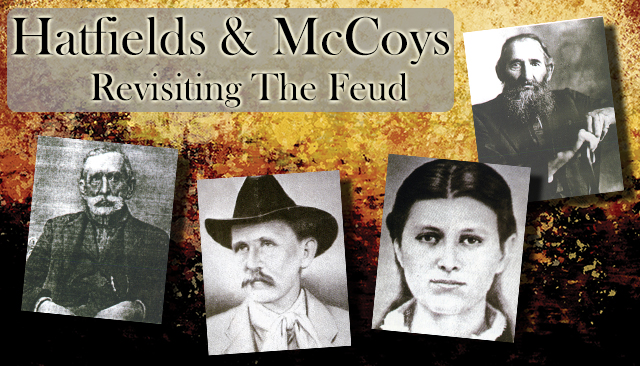
Let me pause here and provide a little background. I grew up on Blackberry Creek, where many of the events of the feud took place, and I knew many descendants of the feudists. Two years ago, just before the premier of the Hatfield McCoy mini-series, I started a Facebook group devoted to the history of the feud. Before long, I had a more than 2,000 members, who shared photos, personal stories, family history and historical documents, and we used the group to bring this information and these documents together so that anyone could have access to them. Currently, we have over 5,000 members, over 1,500 feud-related photos, and can claim as members both professional and amateur historians, artists and writers with an interest in the feud, genealogists and family historians, as well as thousands of people who are simply fascinated by the feud, the people and the history of the area.
But a strange thing happened as we worked, collectively, on documenting the feud (as well as the larger history of the Tug Valley area). We started to see court records that had never been previously discussed. We had researchers scouring the court records of Pike County, Kentucky and Logan and Mingo Counties in West Virginia. We had experts in photography taking a fresh look at feud-related photos. We had a number of people pointing us in the direction of useful historical texts that shed light on the region and its people. We had long-time residents of the area and family members of the feudists adding new stories into the mix. And what we saw, as our work evolved, was that the feud had been misunderstood, sometimes innocently, sometimes intentionally, for over a century. In 1889, T.C. Crawford, a reporter for The New York World newspaper, referred to the area as “Murderland” and called it “a barbarous, uncivilized, and wholly savage region.” Over 120 years later, despite Altina Waller’s groundbreaking attempt to put these events in their proper social, political and economic context, too many people still preferred to peddle the tall tales first put into play by writers such as Crawford and John Spears. These tall tales, from their creation in the 1890s until their most recent incarnation in the History Channel Mini-Series and popular books by Lisa Alther and Dean King, rely upon that original portrayal of the people of the Tug Valley as barbarous, uncivilized and savage.
Over the coming weeks, this blog will revisit the feud, rethinking the events and the people and retelling the stories. We will be using actual historical documents to cut through the legends, the tall tales and the outright lies in order to make these stories and the people who lived them come alive again in all their fascinating complexity. The blog will be a collective endeavor with a small group of feud specialists. We will feature work by Altina Waller, whose book “Feud: Hatfields, McCoys and Social Change in Appalachia, 1860-1900” is the gold standard for recent academic studies of the feud and its historical context. We will also feature work by Thomas Dotson, a Tug Valley native and descendent of both Hatfields and McCoys, whose recent book “The Hatfield & McCoy Feud After Kevin Costner: Rescuing History” digs deeply into the local history of the region in an attempt to set the record straight. Also on board is Randy Marcum, currently an historian at the West Virginia Archives and History, who brings to bear an extensive knowledge of the history of the Tug Valley and its people.
So welcome to our new blog. One thing is for certain: you will never think of the Hatfield McCoy Feud the same way again.