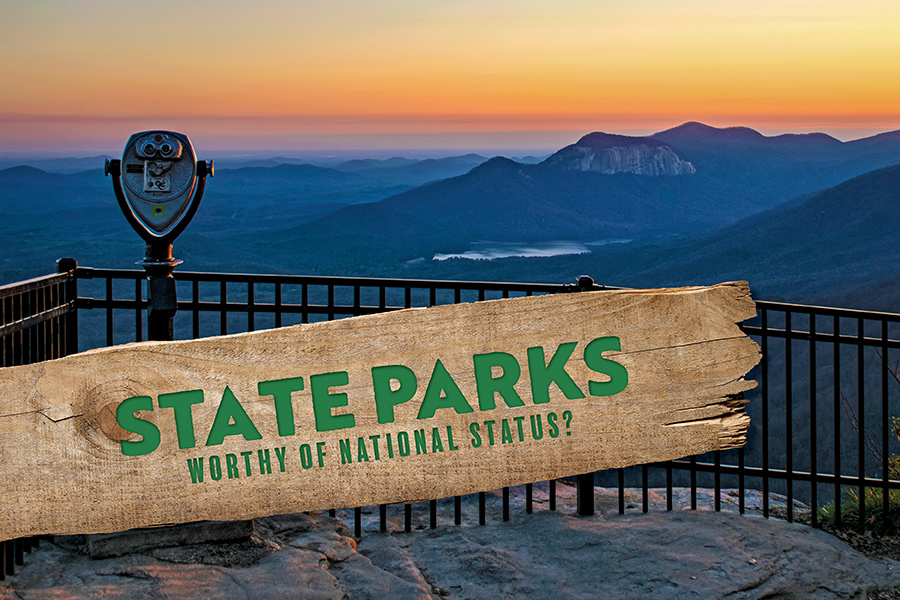
South Carolina’s Caesars Head State Park/Jones Gap State Park are now collectively designated an official Wilderness Area.
The recent designation of New River Gorge as a national park brings to mind other possibly worthy parks in the Southern Appalachians.

With some 339 state parks in the states of the Blue Ridge Country coverage area, there are at least a few in the mountains with enough size and superlatives to attract “national” attention.
Let’s explore seven of them.
West Virginia: Watoga State Park
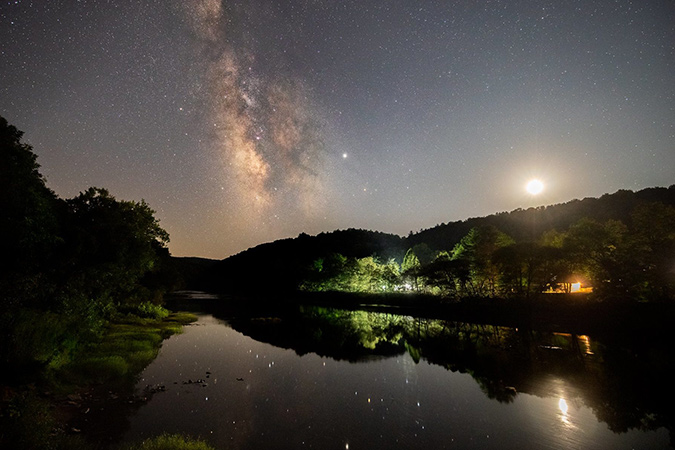
While sitting around the campfire with darkness filling the forests, prepare yourself for what happens next in the state’s largest park. For a hint, consider the First Nation name, Watoga, which means “starry waters.” The first surprise is celestial and occurs in “one of the largest and darkest skysheds within the eastern United States”: a universal light show. At this location you can see galaxies, planets, constellations and our own Milky Way. This vast experience recently earned Watoga an Official Dark Sky status in 2021; a designation with rigorous standards only awarded to 60 locations in the country.
“Starry” wonders also happen closer to the ground. For only a few weeks during the year, a rare sparkling light show is performed by synchronous fireflies. Their claim to fame is rhythmically blinking together in time and intensity as well as displays of “wave” lights trailing through the forest. There are only a few species, of the 2,000 on the planet, who synchronize their bioluminescence. These “habitat specialist” lightning bugs need moist forests at high elevations (and serious darkness) to perform their stunning displays. The ecosystems here are ideal; and the park has earned a special designation for this nature-based light spectacle as well.
For daylight adventures, learn about the life of a Revolutionary War hero, Anne Bailey; stand beside 300-year-old trees; run a half-marathon trail race (yes, that’s 13 miles—but what a scenic route!); and, join hundreds of Watoga State Park Foundation nature programs.
Historical Notes: The Civilian Conservation Corps (a program in FDR’s New Deal) built roads, trails, walls and cabins. The latter, with native stone, pine and chestnut plus modern renovations are available for overnight stays along with 100 camp sites.
- 10,100 acres
- Established 1937
- wvstateparks.com/park/watoga-state-park
Virginia: Douthat State Park
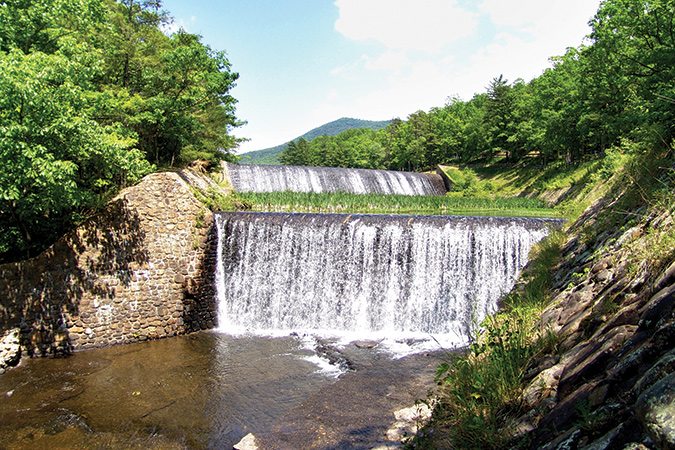
As the largest park in the state’s system, Douthat (pronounced DOW-thet) possesses several unique attributes from history. First, this location was chosen to represent one of the four main geographic regions in Virginia—the mountain and valley area. As such, it became one of the first six in the state park system. Second, original construction lasted from 1933 to 1942 under the auspices of the Civilian Conservation Corps. Some 600 workers built the trails, a dam, bridges, cabins and even forged hinges, handles and other hardware on site. Last, the design of Douthat SP with its utilization of “local materials to create a simplistic and secluded atmosphere [with] primitive and rustic architecture” became a model for “the development of parks nationwide.”
Experience the 40 miles of trails (the most of any in the state’s parks) and see why this destination is called the “Disneyland of Mountain Biking.” There are extended, challenging climbs with quick drops requiring a good amount of technical skill. Or, try one of the 24 short trails for the perfect day hike. The 50-acre lake and Wilson Creek are stocked with trout; and, there are two wildlife sanctuaries along with nature and history programs and events. Book a stay at one of the three lodges, 32 cabins or bring your pets and horses to the campgrounds.
Historical Notes: Douthat is on the National Register of Historic Places due in large part to the high level of preservation of original structures. The NRHP Nomination Form states: “Through a combination of quality craftsmanship and careful consideration of the relationship between architectural and landscape design, the district has maintained the spirit and character in which the park was originally conceived and built.”
- 4,545 acres
- Established 1936
- dcr.virginia.gov/state-parks/douthat
Kentucky: Cumberland Falls State Resort Park
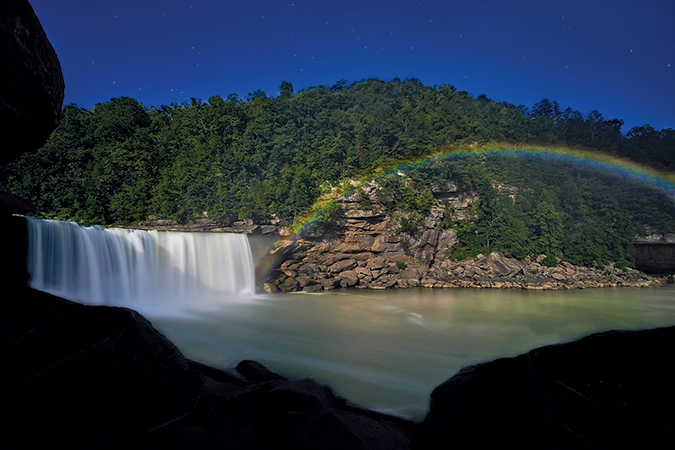
Gear up, hop in a raft with a guide (who does all the paddling) and sit at the foot of the “Niagara of the South” waterfall! Plunging 65 feet over sandstone caprocks and stretching 125 feet wide, this roaring wall of water drops into a gorge and fills the air with fine mist. Truly a sight to behold in the daytime with the rare bonus of a bit of nighttime magic as well. Cumberland Falls is one of only two places on the planet that naturally and predictably creates a moonbow. (The other is Zimbabwe’s Victoria Falls). This lunar rainbow happens (on clear nights) for a couple of days on either side of a full moon.
Located in the midst of the Daniel Boone National Forest, this state park also contains a 1,294-acre Nature Preserve and a major flyway for bird migrations. Of the park’s 17 miles of hiking trails, over four are found in the Preserve and offer the chance to see rare and protected plants and animals. Fish the Cumberland River for bass, cats and other species. Climb the historic 1937 Pinnacle Knob Fire Tower. Take a guided horseback ride through the forests. Swim, picnic, play tennis and horseshoes, mine for gems and fossils, or grab a partner for a toe-tapping good time at the dance pavilion.
For an overnight stay, reserve a room in the historic Dupont Lodge where massive stone fireplaces, hemlock beams, knotty pine and full amenities await guests. (Stop in the Blair Museum at the lodge for exhibits on natural and human history of the area.) Or, book accommodations in one of the CCC-built cabins and other cottages. Also available are 50 campsites with electric and water hookups for tent and RV visitors (pets welcome).
Historical Notes: Geological structures in the park date back 250 million years. Over time the falls carved into rock and receded upstream approximately 45 miles to its present location. Both Cumberland and Eagle Falls (also in the park) were sacred locations to First Nation peoples who inhabited the area for 10,000 years.
- 1,657 acres
- Established 1931
- parks.ky.gov/corbin/parks/resort/cumberland-falls-state-resort-park
North Carolina: Mount Mitchell State Park
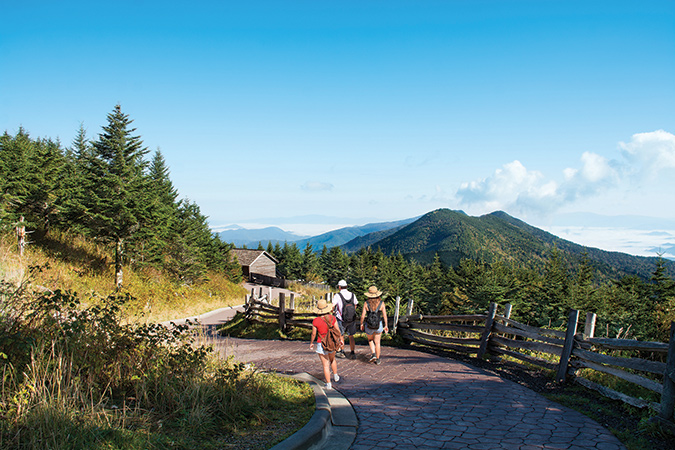
The distinction of the highest peak east of the Mississippi River belongs to Mount Mitchell at a soaring height of 6,684 feet. It is located in a 15-mile-long area of the Appalachians known as the Black Mountain range. Despite the small length, this range contains five more of the 10 highest peaks in the eastern United States. The igneous and metamorphic rock foundations of these mountains still stand after a billion years of erosion.
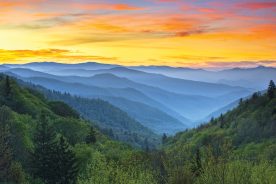
Come for the views and stay for…well…the views! At the summit on a clear day, you can see 85 miles of undulating mountains and valleys. It’s a vista for all seasons. Then, focus your eyes a bit closer and witness a unique ecosystem unlike others in the region—Canadian alpine! This park contains one of the “most distinctive and diverse [environments] in the Southern Appalachians.” The cold climate of the Pleistocene Era (2.5 million – 11,000 years ago) brought plants and animals here. Rare flora and fauna from that time still reside in these high peaks, and hiking the many trails provides up-close access.
Bring along a picnic for a mile-high cookout at one of the 40 tables that include grills. Drinking water and restrooms are available seasonally along with a gift shop, concession stand and small museum. For overnighters, nine tent sites are available (with the same in-season amenities); or, experience the wilderness with backcountry camping.
Historical Notes: Formation of this state park occurred in the early days of the country’s preservation efforts at the state level. Additionally, Mount Mitchell was the first in North Carolina’s state park system which now includes 41 locations (34 parks, four recreation areas and three staffed natural areas).
- 4,789 acres
- Established 1915
- ncparks.gov/mount-mitchell-state-park/home
Tennessee: Hiwassee/Ocoee Scenic River State Park
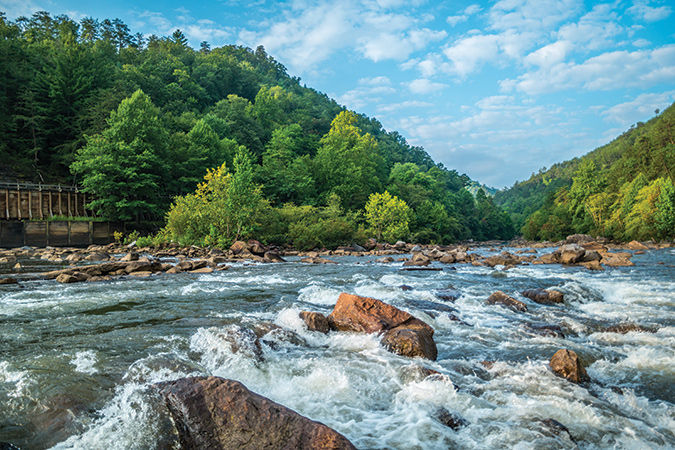
The Olympics, John Muir, eagles and hydroelectric dams. What do these disparate topics have in common? Water—and lots of it! The fresh, wilderness kind rushing through gorges surrounded by lush forests occupied by native species.
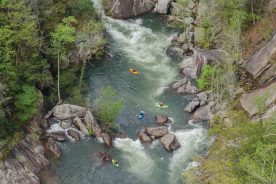
These two sister-rivers are destination waterways for visitors to float, canoe and raft. The Hiwassee offers Class I, II and III experiences; and the Ocoee has Class I – V rapids. The latter was the whitewater slalom venue for the 1996 Olympics—the only natural river to be used for this competition. Visit the Whitewater Center’s 7,200 sq. ft. space to ask about bear sightings; attend current whitewater events; and, walk beside and over the river.
For land lovers, a vast system of trails wind through the park and the surrounding Cherokee National Forest. To enjoy the Hiwassee River gorge from the shore, hike the 16-mile section of the John Muir Trail (named for the famed naturalist and founder of the Sierra Club). Bring along field guides for wildflowers and birds.
Stop along the roadsides at numerous places to have an impromptu picnic. Riverside areas have tables, grills, water and restrooms. And, keep a sharp eye along the water’s edge for the American bald eagle. Once imperiled, this majestic bird can once again be spotted fishing along the rivers and lakes. And, speaking of…bring gear and try your luck catching brown and rainbow trout (both stocked), yellow perch, bass and cats.
Historical Notes: Harnessing the Ocoee River’s “power” was a literal endeavor in the early part of the 20th century. A system of dams and a one-of-a-kind, tongue-and-groove flume brought electricity to the mountains—and continues to do so today.
- Almost three dozen combined miles of river waterways
- Established 1972 following the 1968 scenic river protection of the Hiwassee
- tnstateparks.com/parks/hiwassee-ocoee
South Carolina: Caesars Head State Park/Jones Gap State Park
Two companion parks, whose boundaries touch and histories date back over 400 million years, are now recognized as the Mountain Bridge Wilderness Area. This sprawling, pristine wilderness along the northern boundary of the state is a mecca of hardwood forests, geological wonders, rivers and waterfalls, and rare flora and fauna. For the latter two, there are over 500 plant species (many rare), 41 mammal species, 10 species of fish, 44 representatives of reptile and amphibian species, and 160 recorded bird species (including up to 6,000 migrating hawks).
Residing at the southern side of the Blue Ridge Escarpment, these parks are best explored via 60 miles of hiking trails (for all skill levels). Massive granite outcroppings offer views for miles; and trout fishing opportunities abound. Numerous hikes to waterfalls are well worth the effort, particularly to watch the power of the 420-foot cascade known as Raven Cliff Falls (named for the birds living here). Take a stroll across the suspension bridge for a unique perspective.
For an immersive wilderness experience, stay at one of the various trailside backcountry (primitive) campsites. Some have firepits (only). Pets are welcome. And, “leave no trace” is asked of all visitors.
Historical Notes: History itself remains a hot topic of discussion as scientists debate the geological origins of the area. Did ancient eras bring tectonic shifts? Climatic changes? Variable influences upon different rocks? Regardless of the beginnings, the abrupt contrasts of this area from the mountains to the Piedmont, once (aptly) named the “blue wall” by the Cherokee, continue to change through time.
- 13,000 acres combined
- Both established 1976
- southcarolinaparks.com
Georgia: Amicalola State Park
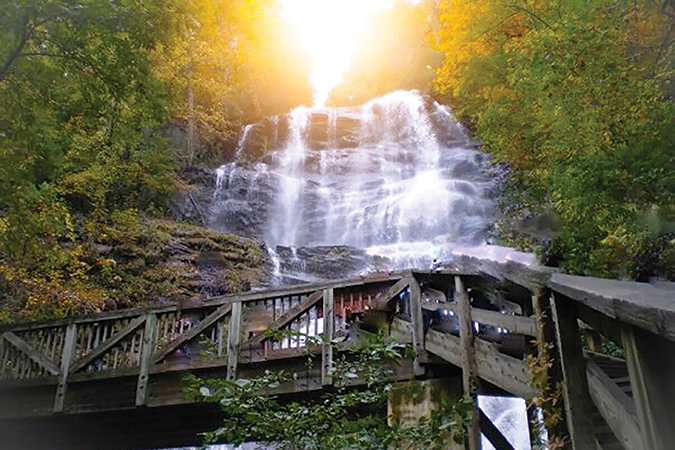
Snuggled near the southern boundary of the 750,000-acre Chattahoochee National Forest lies this mountain wilderness state park. It is aptly named Amicalola, a First Nation Cherokee word meaning “tumbling water,” for its most notable feature—a 729-foot waterfall. With seven dramatic drops, it is the tallest in the state and the third highest cascading waterfall east of the Mississippi River. Bring a camera and enjoy the scenery from a series of platforms along the walkway that extends from the bottom of the falls to the top. Easily reach ADA accessible views at the base of the falls.
Known by its visitors as an adventure destination, Amicalola SP has activities for a variety of interests. Choose from 20 zip lines ranging from beginner height to 250 feet in the air and fly over the treetop canopies. Learn a bit of archery with a compound bow and 3D targets and then practice tomahawk throwing skills, both under the tutelage of expert instructors. Stop by on the weekend to meet Ambassador Animals of the forest. Take a self-guided GPS scavenger hunt up the mountain or a course in primitive survival skills. Catch-and-release trout await, as well as 14 miles of hiking trails—including access to the southern terminus of the Appalachian Trail.
The luxury resort lodge offers 57 rooms and suites with views and comfort amenities. A well-appointed blend of rustic and modern along with decks and fireplaces are available in 14 cabins on the property. For campers, 24 wooded sites and facilities are ready for an RV or a tent. All visitors are welcome at the onsite restaurant (open 7 days for breakfast, lunch and dinner) notable for traditional American and Southern classic cuisine (and the sunset views!).
Historical Notes: The nearby Dahlonega Gold Rush of the early-mid 1800s altered the land’s occupants via arbitrary distributions in a series of lotteries. This disenfranchisement of Cherokee people (and the resultant Trail of Tears) left the area around Amicalola Falls uninhabited for 100 years—with the exception of one Native woman who refused to leave.
- 829 acres
- Established 1940
- gastateparks.org/AmicalolaFalls
The story above first appeared in our May / June 2022 issue.