Skip to content


It’s the Pigs!
I am sure that many intelligent readers of feud books wonder, as I did for several decades, why people believe the cartoonish feud yarns. Ryan Hardesty recently wrote:
“These were men and women who tamed a wilderness, who created a vital and vibrant community (that still thrives today despite decades of pressure), who educated their children to become political leaders and governors, who fought bravely in wars, who turned themselves into successful businessmen, who displayed talents and virtues and skills almost unimaginable today, and we have them taken from us and turned into barefoot cartoon characters who are more concerned with being insulted than with taking care of their families. Our ancestors were made out to be not only bloodthirsty barbarians but complete idiots. Those were people who deserved to have their land taken. Those were people who deserved whatever happened to them. And still do!”
In the tales, people repeatedly behave in cartoonish ways. For the feud yarns to be true, the people of Tug Valley in the late nineteenth century had to have been different from any other people anywhere. Their actions show irrationality and/or stupidity repeatedly, but most folks accept the yarns as history.
A recent iteration of the yarn has seven mountain hunters setting up an ambush thirty feet off the road. They empty their Winchesters at three men riding abreast and score not a single torso hit. Seven men who shoot squirrels out of tall trees with .22 rifles, hitting them in the head to preserve the meat, can’t hit three men riding abreast from a distance of ten yards in that yarn; yet most readers accept it, and prestigious organs like the Boston Globe laud the writer’s work. Why is this?
I realized several years ago that it is possible only because the reader has been pre-conditioned for all the tall tales by being exposed to the tale of the pig trial early in the books. The pig trial yarn is on the concrete sign erected by the Pike Tourism people.
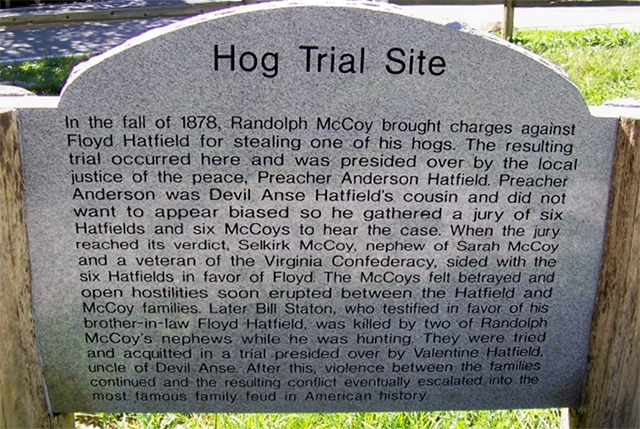
Preacher Anderson Hatfield was Devil Anse’s cousin, Selkirk McCoy was Sarah’s nephew, and Bill Staton was killed by two McCoys. There is not an iota of documentary proof for anything else on the sign.
Most importantly, everything on the sign that is amenable to documentary proof is WRONG!
- Preacher Anse was NOT justice of the peace in 1878.
- Floyd could not have been tried for hog theft in a justice of the peace court. Hog stealing was a felony offense, which could only be tried in the circuit court.
- Kentucky law restricted a jury in a justice of the peace court to a maximum of SIX members.
- According to the 1880 Census, to have six McCoys on a jury in Preacher Anse’s district would have required that three of the members of Ran’l McCoy’s immediate family be allowed on his jury.
- Justice A.W. Ferrell, NOT Wall Hatfield, presided over the hearing for the McCoys who killed Staton.
The question becomes then, “Why is such a patently false tale included in ALL the feud tales?” The answer is that it presents a people who are capable of all the other outrageously false claims in the yarns. If people abandon their homes and farms in great numbers to attend a trial over a ten dollar pig, and then harbor killing enmity over the outcome, then they might do all the other galactically stupid things the feud tale says they did. The pig yarn is absolutely necessary in the feud story; without it, the writers would have to ascribe motives for all the other fabricated events.
In a decade during which the major feud characters were actually involved in several lawsuits which contested the value of hundreds—even thousands—of pigs, with the parties accepting the court’s ruling every time, it is really quite remarkable that feud writers have been able to sell the pig yarn. That they have done so says as much about the readers as it says about the writers.
Mr. Hardesty also wrote:
“That’s why the Hatfield McCoy feud mythos was so easily turned into hokey cartoons. It is in fact a cartoon from the beginning, with two dimensional fictional characters who do stupid cartoon things to fit ridiculous cartoon plot lines. Once you have two proud mountain families killing each other over a $10 hog, all bets are off. There’s nothing that any subsequent writer can write that will cause anyone to question its stupidity.”
Hogs enter the tale a decade later, as the degradation of the people reaches its apex. On New Year’s night, 1888, Ran’l McCoy’s home was burned, two of his children were murdered and his wife was beaten. Whereas a normal father would have done everything possible to relieve the suffering of his womenfolk and children, the feud yarn says that Ran’l M’Coy curled up among the hogs in the hogpen and enjoyed their warmth for the remainder of the night, while his wounded and ill-clad family were left to the mercies of the sub-freezing night.
While it is impossible to invent a more degrading tale about any man, the people who belong to what I call “The Ran’l McCoy Cult” cling tenaciously to the tale.
John Spears, writing the year of the tragedy, said that Ran’l slept with the hogs, even though he didn’t use the words “Hog pen.” Truda McCoy said Ran’l slept in the hog pen, and the Historian Laureate, Otis Rice, followed suit. Dean King said that Ran’l didn’t sleep with the hogs, but he slept in their warmth after “routing them out.”
Under oath in the 1899 trial of Johnse Hatfield, this exchange occurred:
Prosecutor: “Where did you spend the remainder of the night?”
Ran’l McCoy: “At John Scott’s house.”
The feud yarns have convinced the world that the Scotts, three families of whom lived within easy earshot of the gunfire, simply ignored the battle next door and left their neighbors to fend for themselves. And Ran’l McCoy is presented as such a coward that he snuggled up to Miss Piggy, knowing his womenfolk and children were exposed to the freezing January night. Only cartoon characters in a cartoon show such as the feud yarn would behave in such a manner.
Of course the Scotts took the homeless McCoys into their home and cared for them.
Writers who have read that transcript and know for certain where Ran’l McCoy spent that night still write books that say he slept with the hogs. It’s a cartoon, but sheer repetition has made it “history.”
I eat bacon every morning and I love a good ham on rye, but I hate to hear anyone talk about their source. I’ve had the pigs up to the gills!