Skip to content

The story below is an excerpt from our January/February 2018 issue. For the rest of this story and more like it subscribe today, log in to read our digital edition or download our FREE iOS app. Thank you!
A popular North Georgia attraction is also a little-known haven for peregrine falcons.

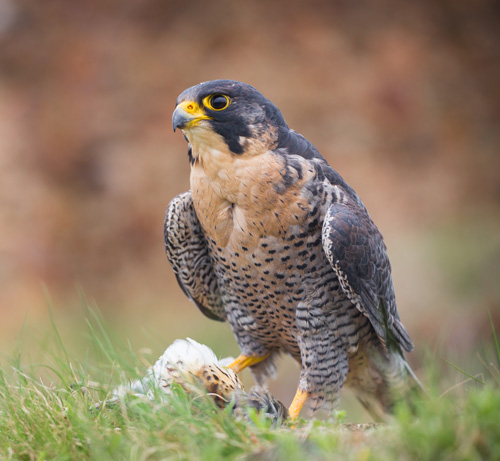
John Stokes opens the door of a towel-draped pet carrier and retrieves Vika, a 3-year-old female peregrine falcon. Immediately, she perches on his thick glove in the small amphitheater at Rock City Gardens on Lookout Mountain, Georgia, where she and other birds of prey entertain guests in summertime shows. When two visitors wander into the outdoor space to snap photos, Stokes can’t resist lapsing into his role as show host.
“This is the fastest creature in the world when it’s diving,” says Stokes, a former zookeeper who in 2005 co-founded the non-profit Wings to Soar, which manages Rock City’s peregrine falcon restoration and education project under federal and state directives. “Dive speeds are estimated to range from 150 to over 270 miles per hour. They’ve made quite a comeback from just a couple pairs east of the Mississippi River in the 1970s and have recovered so well with captive breeding release programs that in 2007 they were taken off the Endangered Species list.”
Currently the only peregrine release effort in the Southeast, Wings to Soar has cared for and released 14 of the falcons from Rock City owner Bill Chapin’s bluff-side property on Lookout Mountain, plus one atop a bank building in downtown Chattanooga. One of four birds in the program right now, Vika was brought here from Texas in early 2015 after she hit a telephone pole and shattered her right wing. Her predecessors in the program include Lookout, who was tracked all the way to Honduras as the first peregrine from the South equipped with a satellite telemetry device, and Fourscore, who was discovered in a flowerpot on a condominium balcony in Atlanta.
“His mother was a teenage mom and she wasn’t very responsible,” says Stokes. “She didn’t really know what she was supposed to do. The male ended up doing the bulk of the incubation. She wasn’t bringing any food back for her young.”
Brothers Heckle and Jeckle, so named by their social media followers, were released in 2017.
By the mid-1970s, overuse of pesticides had all but wiped out the most imperiled peregrine subspecies, Stokes says. Thanks to restoration efforts like the one at Rock City (and until recently, Atlanta and Greenbrier Pinnacle in the Smokies), the birds are slowly returning to the Blue Ridge. A few have been spotted at Tennessee’s Mount LeConte, Chimney Rock State Park and Highlands in North Carolina, and Georgia’s Tallulah Gorge. Others occasionally show up on skyscrapers and other manmade nesting sites in urban areas. No one knows how many pairs there are, says Stokes, since most are not monitored.
So far, most of the peregrines in the Wings to Soar-Rock City program have been males, because they are the ones who find and anchor the territories and are more likely to return to their release sites with mates. In 2018, Stokes and his colleagues will attempt to release at least one female. They will also be testing a GPS locator called Ping that can be used with a smart phone and is much less expensive then traditional satellite telemetry, which can cost up to $4,000.
When asked to describe the importance of this project, Stokes is both scientific and spiritual. “Their job as a predator is to keep the balance in nature,” he says. “When you lose an essential predator, the prey species becomes out of balance and that causes problems on down. The peregrine is an essential part of the ecosystem to keep that balance.
“Some of it is deeper. It’s in your soul,” he adds, nodding toward Vika. “My life isn’t any more important than hers in the natural scheme of things.”
… The story above is an excerpt from our January/February 2018 issue. For the rest of this story and more like it subscribe today, log in to read our digital edition or download our FREE iOS app. Thank you!