Skip to content



This South Carolina mountain walk is the result of an effort of save the land for public use.
Photo Above: The bridge over Canes Creek leads to the Issaqueena Falls Overlook.
Photos Courtesy of Leonard M. and Laurie Adkins.
Area residents reacted quickly, and in numbers, in 2007 when it was learned that Walhalla, South Carolina, was going to sell a beloved Stumphouse Mountain recreation site to a developer for a gated housing community. Letters were written, public meetings attended and, in the space of six months, a coalition of conservation organizations and newly formed citizens groups raised approximately $4.5 million to purchase the land.

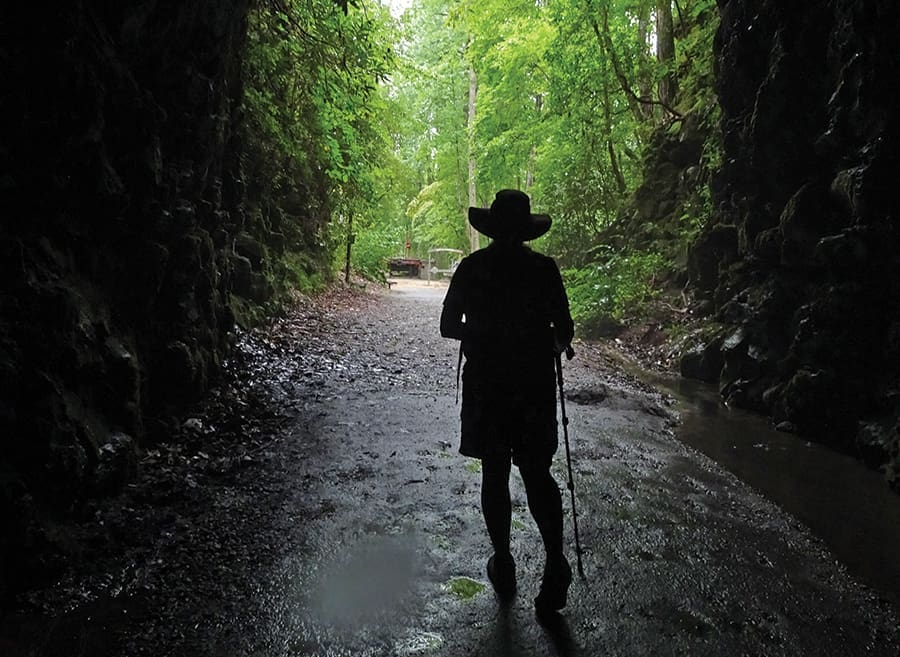
When I told Ken Sloan, president and CEO of Visit Oconee, South Carolina, that Laurie and I were coming to Upstate South Carolina to do some foot travel research, he enthusiastically pointed me to Stumphouse: “It’s now a part of Walhalla’s park system with Issaqueena Falls, Stumphouse Tunnel, a railroad trail and a connector route to the long-distance Palmetto Trail.”
It was a damp and foggy day when we visited, matching the atmosphere of Stumphouse Tunnel as we walked into its dark cavern. This had been envisioned to be the world’s longest tunnel, nearly 6,000 feet, at the time work started in 1853. Six years later, when the effort was halted due to lack of funds, the tunnel only went 1,617 feet into the mountain. Yet, when I passed my light across the jagged, dripping rock walls and ceiling, I was impressed that the laborers were able to carve out this much using only basic tools such as sledgehammers, hand drills and black powder.

It’s a few hundred steps through rhododendron thickets from the tunnel to the overlook of Issaqueena Falls, dropping 100 feet along the steep mountainside. Although vegetation obscures much of the falls, Cane Creek spreads itself across various boulders and ledges, providing a decent view of the cascade. We heeded the advice found on visitoconeesc.com: “There is a rough trail to the bottom of the falls, but it is quite dangerous and visitors are not encouraged to take it.”
Local lore, of which there are several versions, holds that a Native American maiden, Issaqueena, learned that her tribe was going to attack her white husband’s community. She raised the alarm, saving the settlers, but angering the Indians. She escaped captivity by jumping over the falls (some story versions say she merely hid below the lip) and survived to return to her husband.
A short, steep ascent from the falls overlook brought us to the Blue Ridge Railroad Historical Trail, following the route of the never-finished transportation project. The near-constant song of red-eyed vireos accompanied us as we went by two more tunnels (one completed, the other not, but both inaccessible), a fearless box turtle that never fully retreated into its shell and a few juicy, late season blueberries to munch on. In this forest of maple, oak and hickory, we felt compelled to pause often to pay homage to an abundance of towering trees that had obtained impressive sizes in both girth and height.
And to think, all of this history, lore and natural beauty could have become off limits to the general public. Here’s a big thank you to everyone that helped keep this special place accessible for all to enjoy!
When to Go
The Walk: Round trip walks inside a tunnel (.6 mile), to a waterfall overlook (.4 mile) and along a historic railroad route (4 miles).
Getting There: From the SC 183/SC 28 intersection in Walhalla, drive 5.5 miles northward on SC 28 to turn right into the park.
More Information: A basic map of the trails is on www.sctrails.net/trails/trail/issaqueena-falls.
An Entire House Just For You

Laurie and I had the whole house to ourselves (it’s yours whether one person or a group of eight) at Ram Shack (airbnb.com/rooms/51651489) in Seneca, less than a 30-minute drive from Stumphouse. Neat and fastidiously cared for, it is just a minute’s walk to restaurants and attractions (and only an eight-mile drive to Clemson’s football stadium).
Leonard has written 20 books on the outdoors and travel. Find out more at www.habitualhiker.com.
The story above first appeared in our January / February 2024 issue.