Skip to content

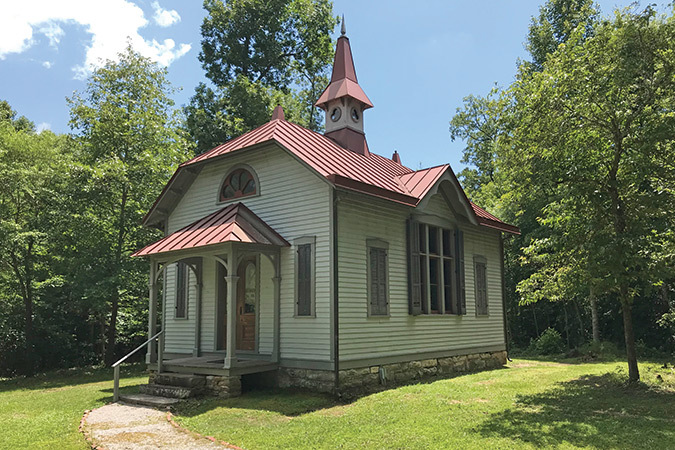
The Rugby School is now a museum. courtesy of Historic Rugby
Planned as a utopian settlement—a place where upper-class English second-born sons could live hard-working, honest lives—tiny Rugby is a lesson in perseverance.

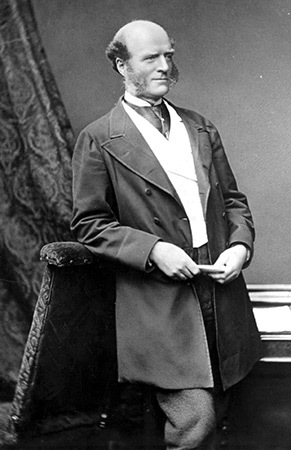
In early October of 1880, Rugby founder Thomas Hughes spoke to a crowd gathered in front of the Tabard Inn, named for Chaucer’s famous Canterbury Tales hostelry. Hughes had lofty goals for his new Victorian town:
Our settlement is open to all who like our principles and our ways. Englishmen and Americans can stand shoulder to shoulder, and work with one mind and one heart for the same great end…Our aim and hope are to plant on these highlands a community of gentlemen and ladies; not that artificial class which goes by those grand names,…but a society in which the humblest members, who live by the labour of their own hands, will be of such strain and culture that they will be able to meet princes in the gate…
Hughes saw his carefully planned Cumberland Plateau town as a place where whites and Blacks, Welsh coal miners and British noblemen would work side by side. He championed Christian Socialism: its elevation of the working classes and elimination of class privilege.
Did Hughes—and his dream—succeed? The answer lies in the story.
The second son of an English middle-class clergyman, Thomas Hughes was educated at prestigious Rugby School, and soon after graduating wrote a wildly successful novel, “Tom Brown’s School Days,” based on his years there. It was money from the novel’s sales that provided Hughes with the funds to build his “distant Eden” in America. Hughes went on to write a dozen more books, practice law, and serve in the House of Commons.
He championed the rights of British commoners and spoke against the English system of primogeniture, which dictated that family wealth go to first-born sons, leaving their brothers relatively penniless yet discouraging them from going into crafts or trades for a living. (Never mind the daughters, for whom marriage was the only option.)
Having traveled to America in 1870, Hughes dreamed of a different way of life for his fellow second-born countrymen. With initial support of a group of Boston capitalists who owned large tracts of land in East Tennessee, Hughes formed a group of equally wealthy Englishmen, the Board of Aid to Land Ownership, Ltd. The new international company began in 1879 to plan and build Rugby, which, in two years, had 300 residents, more than a dozen buildings, private homes, a newspaper, a commissary owned by shareholders, a boarding house, and the three-story Tabard Inn.
But the coming year brought hard times to Rugby. The winter of 1881 was bitterly cold, followed by a hot and dry summer. The English noblemen in Rugby found farm work hard and uninteresting. In August, a typhoid epidemic struck, found to have started at the Tabard Inn. Five months later, just 60 residents remained in Rugby.
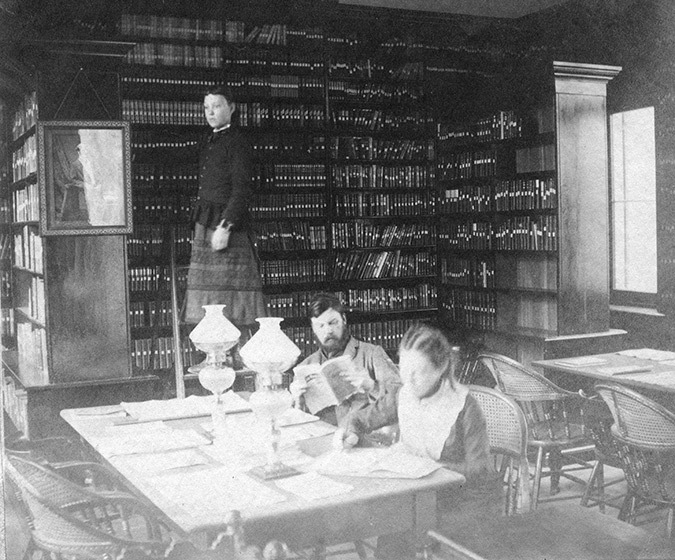
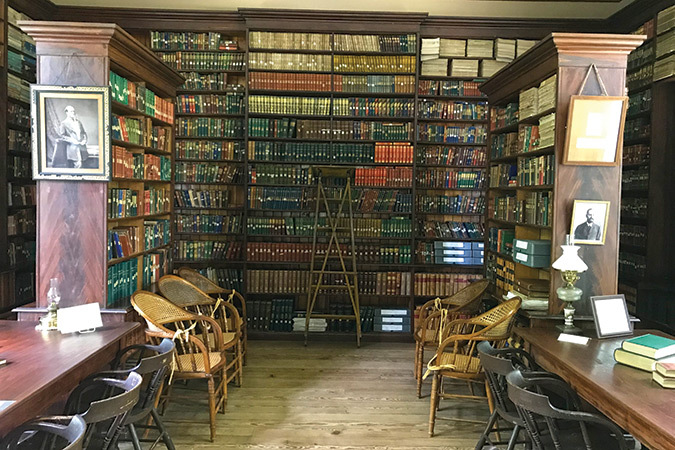
Hughes’ London Board was determined to keep Rugby afloat. The Tabard was deep-cleaned and reopened; a school opened, a public library was built and stocked. By 1884, the town had more than 400 residents.
Rugby’s fortunes ebbed and flowed throughout the last years of the 19th century. And when Hughes died in 1896, he’d lost more than $1 million in today’s currency on his “New Jerusalem.” For the first half of the 20th century, Rugby hung on as best it could, thanks to the maintenance and oversight of the surviving children of original settlers.
It took another visionary to save Rugby. Seventeen-year-old Brian Stagg, who’d grown up in nearby Deer Lodge, formed the Rugby Restoration Association in 1966. The group successfully lobbied to have the town placed on the National Register of Historic Places in 1972. Stagg and many others worked tirelessly to create, in his words, “a positive, active restoration, rather than a stand-still preservation or a museum.” The 125,000-acre Big South Fork National River and Recreation Area was established in 1974, protecting Rugby from commercial development. In the mid-1980s, Beacon Hill, a section of the original Rugby plat, was developed with strict adherence to Victorian architecture, right down to paint colors and roof slope. (Enviably, all utilities are underground.)
Which brings us to today. What will you see when you go to Rugby?
Among the 20 original structures are these:
- The 1882 Thomas Hughes Library, which holds one of the finest collections of Victorian literature in America, many of them first editions, as well as many of the original Rugby records. The library appears as it did in 1882—and is thought to be the oldest public lending library in the South.
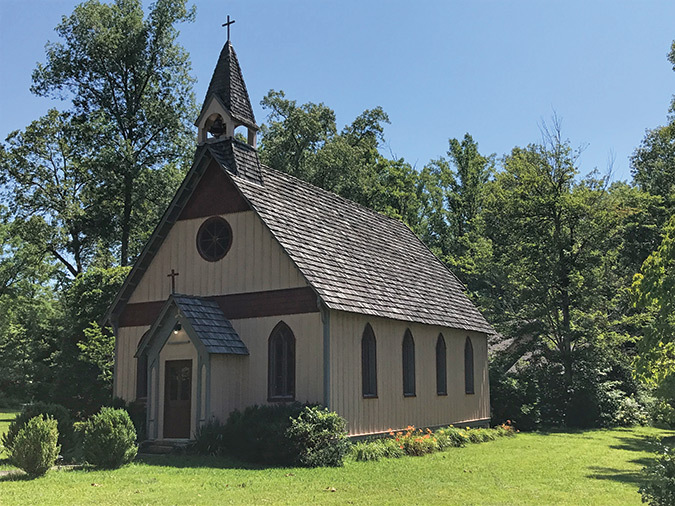
- The 1887 Christ Church Episcopal, with hand-hewn beams, original hanging lamps and stained glass, and an 1849 rosewood reed organ, one of the oldest in the United States.
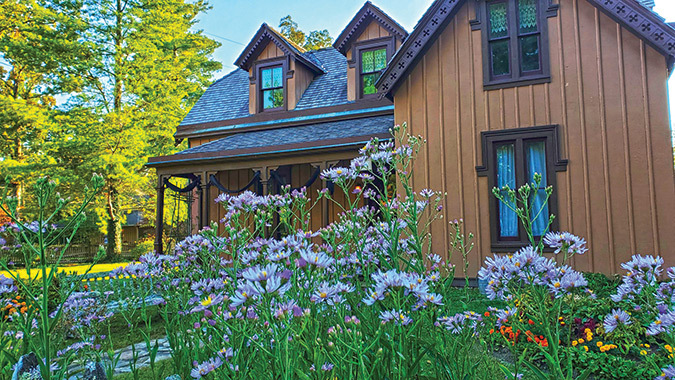
- Kingstone Lisle, an English Rural Style cottage to which Hughes planned to retire, furnished with original Hughes family belongings.
- The 1907 Rugby Schoolhouse, used by villagers as an all-grade school until the mid-1950s. The first floor is now a museum.
Depending on the season, you might see people dancing around a maypole, or competing at Irish road bowling. You might listen to costumed storytellers spinning ghost tales. (Rugby, like most historic towns, claims to be haunted.)
Or you might get the chance to talk to Jordan Hughett, Historic Rugby’s Development Associate and enthusiastic Rugby supporter. The recent college graduate (who, like Brian Stagg a half-century earlier, grew up a stone’s throw from Rugby) is clear on one thing: “Rugby was not a failure.”
“Rugby adapted,” he says. “Yes, a number of the original settlers went other places…but they succeeded where they went. They did exactly what Hughes wanted them to do: They came to Rugby, and they found their way.”
Hughett says that several Rugby homeowners have made what was a second home into their primary residence, having discovered that telecommuting from Rugby is quite doable.
If not, with its preserved wild surroundings, downright Utopian.
The story above appears in our January/February 2021 issue.