Skip to content

The story below is an excerpt from our Jan./Feb. 2015 issue. For the rest of this story and more like it subscribe today, view our digital edition or download our FREE iOS app!
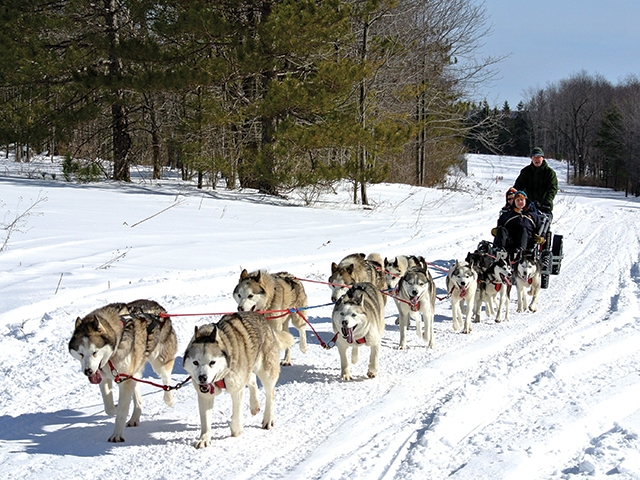
For 2015, our annual travel guide not only puts you on the road to mountain beauty and fun, but puts you into the experience. C’mon, let’s get busy learning something new, like maybe mushing huskies, making biscuits or slinging inner tubes.
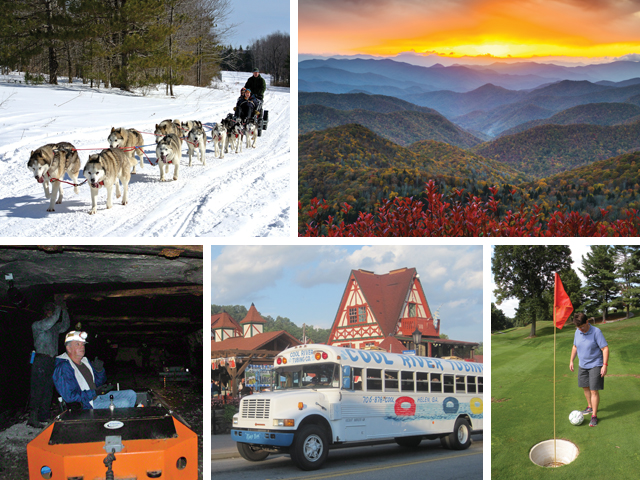
Mushing Huskies Through Western Maryland
I hear them before I see them. It’s like nothing I’ve ever heard before: a cacophony of howling resonating eerily through the Western Maryland woods.

“What’s making them do that?” I nervously ask Mike Herdering, retired Marine, who has met me at the head of his driveway. He’s standing very still, listening almost with reverence to the baying. He looks down at me, grinning.
“You are,” he says.
The howlers, I see, when we reach the yard a few moments later, are 14 brilliant-eyed, lush-furred Siberian Huskies, somehow managing to make the otherworldly racket while engaged in sniffing each other, lounging on the roofs of their doghouses and other time-honored dog activities. They quiet down when they spy the intruder – me – arriving with their master, “Colonel Mike.” We’re joined by another visitor, Iditarod handler and dog enthusiast Nancy Hermle, and Mike’s wife and fellow dog-musher, Linda Herdering.
Deep in the pines of Garrett County, the Herderings run Husky Power, a business dedicated to educating folks about dogsledding. It’s the kind of dedication that sometimes compels Mike to sleep in the pen with the dogs on winter nights and Linda to talk for hours on end about the joys of dogsledding.
Thanks to the Herderings, I’m about to do the improbable: I’m going dogsledding. There’s no snow, so we’re “drysledding” in a metal rig.
“It’s in their genetic code to pull and work. They’re athletes,” says Linda, as the Huskies are harnessed and attached to the gangline, connecting them to the sled.
I’m OKed to pet the dogs but they ignore me. They’re sleek bundles of anticipation, ready to run. We take our places in the rig. It’s time to hit the trails.
“Ready – hike!” Mike barks.
We take off with a lurch that jolts me into hyper-awareness. We’re going uphill but the dogs are moving at a velocity usually associated with emergency vehicles. Becoming airborne seems like a possibility. I’m whacked by a gauntlet of weeds overhanging the brush-lined course.
The pace slows just in time for dogs and rig to expertly navigate a series of thrill-ride-level hairpin curves. Then we halt.
It’s my turn to command the dogs.
I stand, feeling like an imposter. I deliver a feeble “Ready – hike!” in what’s barely an outside voice. The team, unimpressed, hesitates. I have zero trail cred. I think I see one dog roll its eyes.
On my third try I manage the command with more authority – and volume. The huskies bolt. I’m part of the team, and the ride is exhilarating.
Later, Mike lets me hop out and run ahead. The photo I snap is a blur of motion, but as the dogs charge toward me what I see is a pack of happy, tongue-lolling goofballs, elated to be dashing along the mountain trail.
After the run, the dogs’ mood shifts. They have an air of satisfaction, a job-well-done vibe. We’re taken into the pen for a meet and greet. This time, the dogs are ready to socialize.
“Good job, Babydoll,” coos Mike the Marine, ruffling the tawny fur of a dog named Goldie. My face is soon sticky from slobbery Husky kisses.
The Herderings show us more dogsleds. Taking the helm of a classic wooden sled, I’m dreamily transported to a snowy tundra – one that I, with the help of my team of faithful dogs – can navigate, can conquer. Before visiting Husky Power, dogsledding was an abstraction. Now, I think, I’m starting to get it…and then the Herderings break out into a wacky song about Huskies and butt-sniffing.
I ponder who has more energy and enthusiasm, the dogs or the Herderings, and conclude it’s a tie. They’re a good match – or, I should say, a good team. And when dogs and humans work together, everyone wins.
–Susan Fair
Wenching at Smithfield Plantation, Blacksburg, Virginia
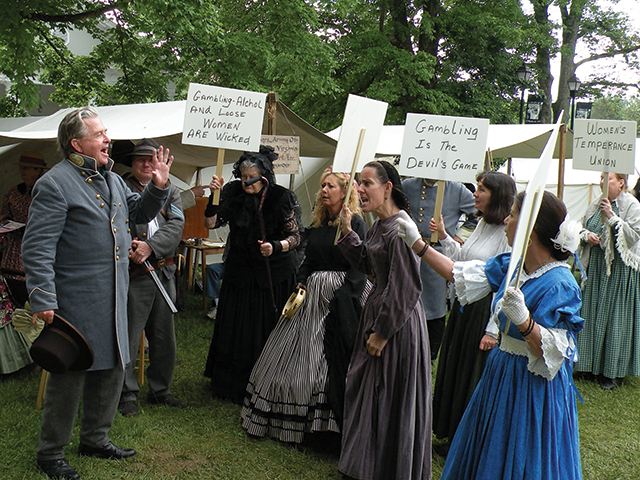
I wanted to be a common working woman, an indentured servant – a wench. That’s my role at the colonial Smithfield Plantation, where I point out the gaudy teal paint that signaled the Preston family’s wealth and the rope jack used to firm up their beds. I like playing a servant, not wearing waist-cinching stays and being privy to the family secrets. I cup my hand over my mouth and blather away like the gossipy house servant I am, about the gentlemen visitors’ gambling debts, marriage proposals wordlessly refused and sweet poems written by the master of the house.
To portray this wench, I’ve had to dig into 18th-century life, both into the recorded facts, such as Colonel Preston’s role in the Revolutionary War, and into behind the scenes minutia, such as the number of baths folks took in the winter (0), which Preston wore the most makeup (the dad, William), and Smithfield’s major cash crop in the early days (hemp).
What I do is many things: education, history, role-playing and Halloween year-round. When I step across the hand-hewn floor, the 1774 plantation becomes my whole world. To get into character, I might carry medicinal herbs snipped from the kitchen garden or a piece of wool that needs carding. I imagine myself as a scared young English woman in this strange, wild country, so I ask my visitors if they’ve seen any Shawnees. I want them to strain their ears for those war whoops, to scan the fields for smoke. As an interpreter, I want to impart some sense of the hardships and danger faced by people who settled here at the edge of civilized society.
These colonials – their men may wear face powder, but they’re no wimps – that I’ve learned from being a colonial character. –Su Clauson-Wicker
Tube-Squadding in North Georgia
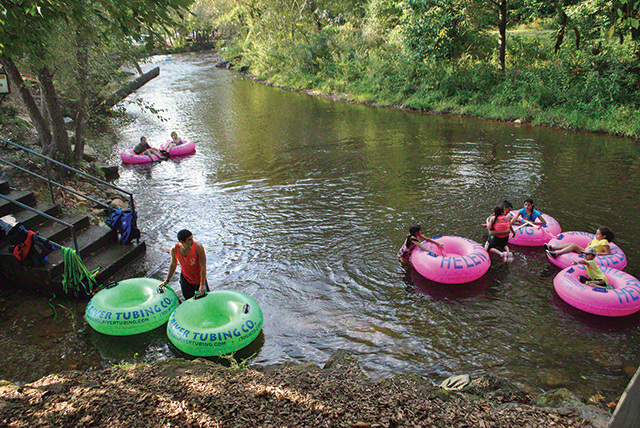
On a sunny Sunday in September, I stand with water up to my knees, learning how to be a Tube Catcher, Tube Thrower and Tube Stacker. These are actual jobs in the mountains of Helen, Georgia. And here, on the Chattahoochee River, it’s the mission for the employees of Cool River Tubing Company to make tubing seem seamless for thousands of visitors each year.
To get in the tube mood, I simply started my day by going tubing – and seeing Helen’s restaurants, like Cafe International, at the river’s edge. Next, I feasted on drunken mussels and broccoli for lunch at Bigg Daddys. Then I returned to the takeout at Cool River and became part of what I call the “Tube Squad.”
This is a friendly and efficient assembly line on the river banks. “We keep boys out there all the time,” says Teri Sims, who owns and operates Cool River Tubing with her husband, Terry. “Everybody kind of has their own job.”
Next to frothy rapids, I shadow a 19-year-old named Moises. “My job is to get people out of the river,” Moises tells me. “Then we have somebody who grabs the tube and puts it back in the tube room.”
Helping out, at one point, I thought I had saved the day. My eyes caught a missing item in an empty tube: a pair of damp socks belonging to a little boy. I returned those socks and was rewarded with a smile.
But my real test came when I tried throwing those large tubes over a fence. I tried tossing. But, more than once, I had tubes bouncing back in my direction – into the river. Then Moises, less than half my age, demonstrated how he could effortlessly make those tubes soar with a magical spin.
What I didn’t try, however, was the last job of the day: It’s what’s called “tube fishing.” Here, you actually get paid to go tubing. But you have to start at the top of the run. And, no, you’re not really floating for fun. Instead, you’re armed with straps, and it’s your job to float down the river and catch every stray tube that’s on the river banks or beached somewhere along the way. –Joe Tennis
Workin’ in a Coal Mine: Well, as a Tour Guide
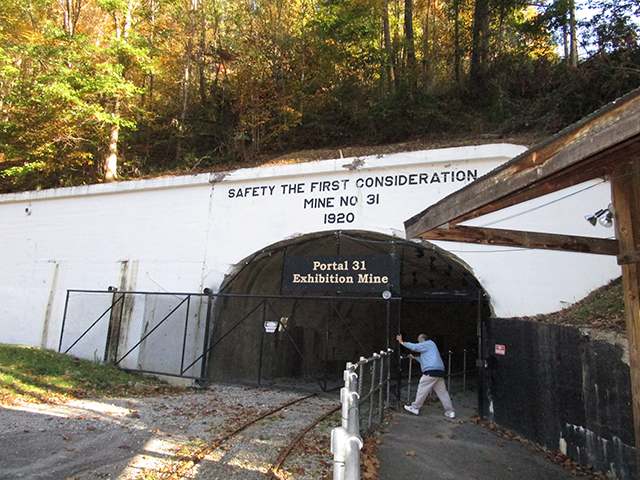
Clay Slusher would rather be mining coal than explaining the history of how it’s been done in the mountains of Eastern Kentucky. Still, he says, he loves his job as a tour guide at Portal 31, an exhibition mine at Lynch.
“I’ve been a miner for 35 years, but most of my experience has been on the surface,” says Slusher. “Naturally, I have a love for the mine, growing up with it and spending a career with mine work. And then, also, I have a compassion for the people.”
That’s why Slusher loves the job he tried to train me for: being a tour guide in coal mine. It’s one that requires, obviously, being able to talk to people and not having stage fright.
“Talk to them like they’re family,” Slusher says. “In other words, don’t be intimidated by a big crowd.”
At Portal 31, riders breeze through the underground on a car that runs on amusement park-style rails.
“This is like a Dollywood track,” says Melvin Dixon, who helps operate Portal 31. “It’s like a ride.”
Or as Slusher puts it: “A chimpanzee could run this thing,” going forward or reverse. “Driving the car is not that hard. You just have to be careful around the rough spots at the crossings. It’s kind of bumpy.”
The toughest part of working in this coal mine, I found, would be to simply know what you’re talking about. That’s why not just anyone can get a job here. “We would like for them to have some mining experience,” Dixon says. “You’re asked a lot of questions that only a coal miner can really answer.”
The coal mine tour stops at several stations with talking figures explaining the history of coal mining methods, starting with picks and shovels. Then, it’s the tour guide’s job to add a few comments – and, of course, drive the car.
“We don’t really go fast. It’s not really a thrill ride,” Slusher says. “But what they like about it is just the eerie part of going in a cave. They’re in here where it’s dark. That scares them a little bit. It’s a fear factor, more than anything.” –Joe Tennis