Skip to content

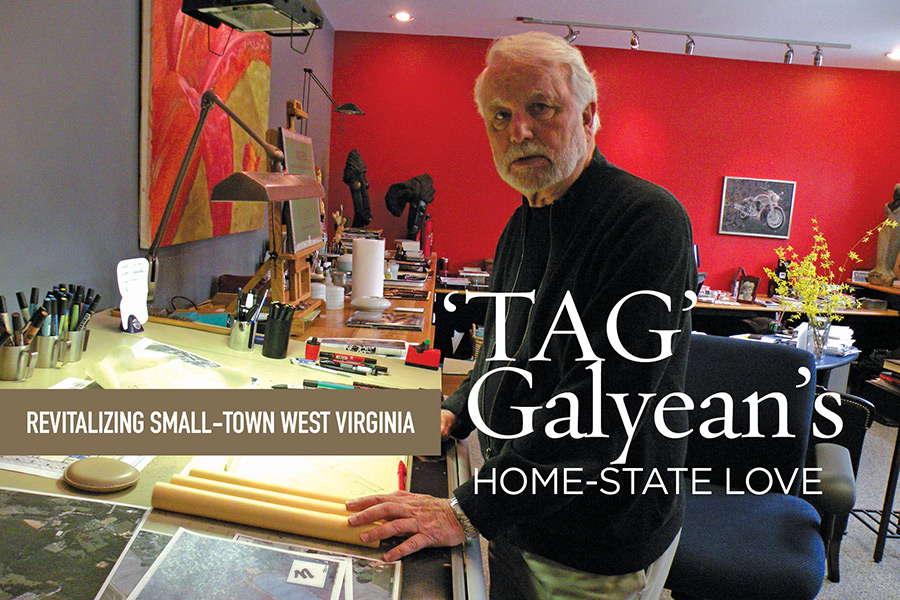
The acclaimed resort architect has brought his energy and vision to helping with the economic recovery of the Greenbrier Valley after the devastating 2016 flood. A new barrel factory and a community aquatic center are just two of his ideas coming to fruition.
Tinsley Azariah—better known as “TAG”—Galyean is lucky enough to work all over the world while keeping his home base in beautiful little Lewisburg, West Virginia. The acclaimed resort architect and master designer is committed to Appalachia and to devising ways to export quality products from the Mountain State without jeopardizing its beauty and integrity.
Galyean grew up in Charleston, West Virginia, and experienced the wider world while attending boarding schools in Virginia and England, then earning his architecture degree in New York City. But he never lost his connection with his home state and his respect for its values.

“I like the way people here can make anything and fix anything; I like their independence,” Galyean says. “I like West Virginians’ family values.”
Galyean is devoted to Lewisburg, to preserving its charm and helping it thrive as a stimulating, healthful place to live. His efforts run from creating a patchwork of downtown green space to co-founding what’s been acclaimed as the nation’s best craft distillery as well as a state-of-the-art cooperage, to helping a team of high school students plan and raise millions for a community aquatic center.
“My wife Annabelle and I made a decision when we moved here 30 years ago to avoid being on a lot of committees, but to devote ourselves to one big project at a time,” Galyean says.
Galyean has been creating designs and master plans for resorts around the nation from his Lewisburg base since he re-invented the Greenbrier’s mineral bath department in the mid-1980s. His client list includes RockResorts, Anheuser Busch and Hershey. He’s designed architecture, landscape and graphics as the master designer for the Broadmoor in Colorado Springs.
“Here in Lewisburg, we decided to do things that needed to be done, things that required our skill set in design and building. We committed without fee to projects till they were done,” he says.
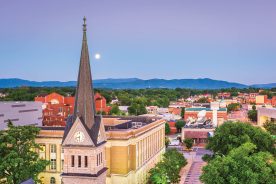
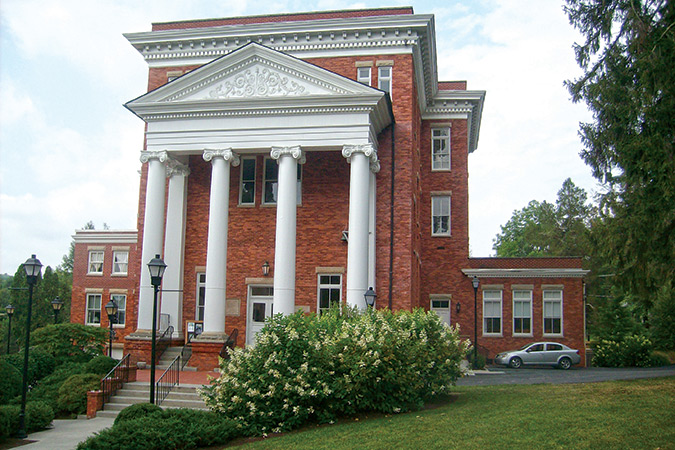
Carnegie Hall came first—Lewisburg’s own Carnegie Hall, funded by steel baron Andrew Carnegie as a classroom building in 1902. The four-story Greek Revival structure was converted to a cultural center in 1983 and needed some work. Galyean designed a major renovation, making the Carnegie into a community showplace worthy of hosting Wynton Marsalis and the Vienna Boys Choir as well as a woodwind orchestra of nearly 100 Greenbrier County fourth graders.
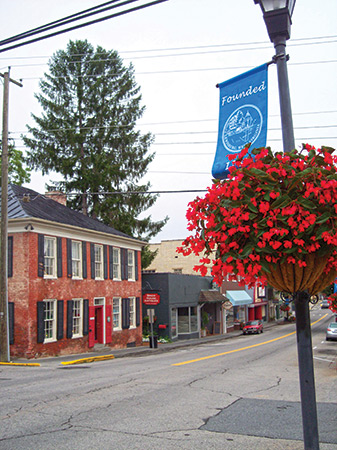
Then he started on the town.
“When we moved back here, 25 to 30 percent of the stores were empty. There was maybe one good restaurant. Downtown was hollow,” Galyean says.
The Lewisburg Foundation had created a historical district, removed overhead powerlines, installed street lamps, and considered their work done. Galyean thought more could be done to lure in businesses, and asked if he could take over leadership of the foundation.
“That’s the great thing about a small town,” he says. “You couldn’t just come in and take over in New York, but here people said ‘sure.’”
The Galyeans had their eyes on regional tourism. Under their leadership, the foundation created and maintains small parks, gardens and public sculpture in downtown Lewisburg. Thousands of flowers are planted each spring and fall. No government money is involved. Galyean simply asked 120 local citizens for contributions and the funding rolled in.
Things began to happen. The Greenbrier Valley Theatre, formerly in a barn, moved into the old Leggett’s store downtown. Stores, galleries and restaurants opened. Residents and visitors now have a dozen options for good dining.
“It’s a desirable destination,” says Galyean, still foundation president after 22 years.
Superior Spirits and Homegrown Barrels
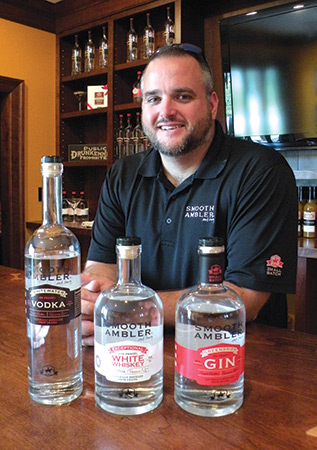
But Galyean was far from done. In 2009, he and son-in-law John Little started Smooth Ambler Spirits, a distillery of small-batch handcrafted whiskies, outside of Lewisburg. They employ 24 people and use as much local grain as they can find.
USA Today named Smooth Ambler the No. 1 craft distiller in America in 2018, fulfilling Galyean’s desire to produce a world-class consumer product in West Virginia.With the recent sale of two-thirds of the company’s stock to Pernod Ricard, the world’s second-largest spirits group, Galyean realized another goal: to market West Virginia’s fine spirits worldwide.
Another Galyean project, the West Virginia Great Barrel Company, has a link to Smooth Ambler Spirits. After the horrific June 2016 floods in Greenbrier County killed 15 people and left hundreds homeless, the public responded generously. Hope Village, a 42-home community was created for flood victims. But many believed true economic recovery required something more—jobs.
Galyean and White Sulphur Springs architect Tom Crabtree batted around ideas for a project. Galyean mentioned his distillery needed white oak barrels for aging bourbon.
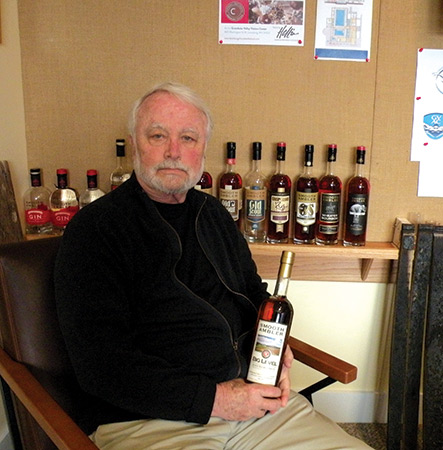
“They’re cutting the trees we need just 20 miles away, but we have to get our barrels from Missouri,” Galyean said. “If you make barrels here, we’ll buy them.”
They pulled together a group of 20 investors to make the barrel factory a reality. Smooth Ambler Spirits needs only 3,000 new barrels for a year, but the bourbon industry—which requires new oak barrels for each batch—is on the rise globally. The WV Great Barrel Co. will produce 150,000 barrels annually—and that’s with just one shift.
“We’re hitting the market at just the right time,” says Galyean, who is a co-founder and brand manager of the new company. “When we started Smooth Ambler, just over 200 distilleries existed nationally; 10 years later, there are almost 2,500.”
WV Great Barrel Co. is a $40-million endeavor that will employ 60 at the cooperage (barrel plant) and 30-40 at the mill in nearby Gap Mills, where sustainably harvested oak will be quarter sawn into staves and aged. With barrels selling at $200 each, it will do a $30-million business each year. The cooperage is being outfitted with the most advanced barrel-making equipment in the world, Galyean says.
“The mill and cooperage will employ good folks at good wages to manufacture a top quality product right here in Greenbrier County,” he says.
The company expects to produce its first barrel in October; they’d already received their first contract by April. When the charred bourbon barrels start coming off the line, the White Sulphur Springs plant will begin giving factory tours, Galyean says. An onsite visitor center will tell their story.
Collaborating with Kids
In another ambitious project, Galyean has teamed up with high school students to design and raise funds for a $6-million aquatic center in Lewisburg. In his spare time, Galyean teaches a class for pre-engineering and pre-architecture students at Greenbrier East High School. Each spring, he works with a small group of students who want to tackle a real-world project. Two cohorts of students have labored toward making the aquatic center happen.
“Families drive 40 miles into Virginia to a year-round pool,” Galyean says. “The first spring students researched and planned a first-class aquatic center with three pools. Last year they decided it was such a good idea we should figure out how to get it built. So we asked business students to join us, drew up a plan, created a brochure, and they began giving PowerPoint presentations to the public.”
This project shows what high school students can do, Galyean says. “The aquatic center is doable without government money; it should be self-supporting from membership fees and rentals once it’s up. I’m very impressed with how many people have already written checks. It shows how much interest there is and how much trust they have in us.”
Galyean and the students have a land donation and, through private contributions, have raised almost half the nearly $6 million needed. They’ve hired an energetic, well-connected center manager, who is charged with raising the remaining $3 million by 2020. If on schedule, construction of the proposed 22,400-square-foot facility will start in March 2020 and be open for swimming in the summer of 2021.
And then everyone will wonder what TAG Galyean will choose for the next big project.
The story above is from our September/October 2019 issue.