Skip to content



During the Depression, they delivered books and other reading materials in remote rural areas, to people with no other access to the world of reading.
A few months back, I came across a novel by Kentucky writer Kim Michele Richardson, “The Book Woman of Troublesome Creek.” Compulsively readable, Richardson’s novel tells the story of Cussy Carter, the last of the “Kentucky Blue” people, who takes a job with the Depression-era WPA Pack Horse Library project to deliver books into the remote mountains of eastern Kentucky.
I love the mountains; I love books. I love horses; I love brave women. So how come I’d never heard of this steep-trail horseback library project, launched by Franklin Delano Roosevelt in the depths of the Depression? A project that, from its inception in 1935 to its end in 1943, reached 1.5 million Kentuckians and enabled nearly 1,000 women to support themselves and their families in 48 Kentucky counties? That in 1956 inspired Kentucky Congressman Carl D. Perkins (who’d benefitted from the Pack Horse Library program as a teacher in Knott County) to sponsor the Library Services Act, which provided the first federal appropriations for library service.

I went in search of the story. What I learned taught me a lot about the power of words in hard times, and the courage of those who traveled to shared them.
By 1933, unemployment in Appalachia had risen to 40%. Hundreds of coal mines had been closed in response to the shutdown of factories nationwide; thousands of miners were out of work. A few years into the Great Depression, reporter Lorena Hickock traveled to Appalachia and witnessed infant starvation, rampant pellagra and a severe lack of sanitation. Poor rocky soil made growing food difficult. Desperate times in the mountains.

In response, FDR’s Works Progress Administration (WPA) program set out to put people to work. Putting people back to work most often meant putting men back to work, and most WPA jobs involved heavy manual labor. Roads and schools and parks were built; tunnels were dug; buildings were constructed.

As the Depression intensified, men abandoned their families, leaving many women as heads of households. In response, WPA jobs were created that were seen as more “seemly” for women—sewing, the creation of Braille books, work in schools and cafeterias.
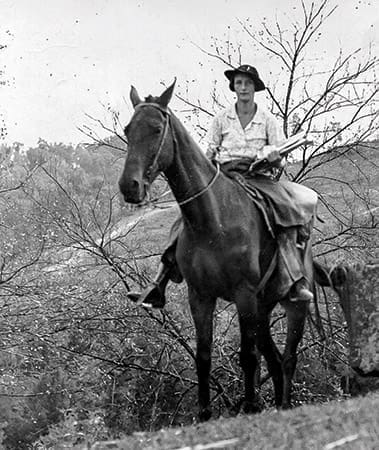
And the Pack Horse Librarians project. Book delivery? That could be accomplished by women. Never mind that it often meant traveling by horse or mule (or by foot) up a nearly invisible trail, covering 18-20 miles a day. Never mind that one Pack Horse Librarian, Mrs. Mary Littrell, recalls rainy-day roads that were knee-deep in mud. (“I’d have to hold my feet out to the sides of the horse, the mud was so deep on the roads….And the horse would have to swim the creek when it rained. Old Pearl took me every place that I wanted to go.”)
It’s no surprise that Kentucky was home to one of the earliest pack horse library programs: the state was notoriously under-booked at the start of the Depression, with 63% of its residents having no access to public libraries. The first Pack Horse Library program was established in 1934 in Leslie County. Within two years, nearby Harlan, Clay, Whitley, Jackson, Owsley and Lee Counties had their own programs.

In their young-readers book “Down Cut Shin Creek,” Kathi Appelt and Jeanne Cannella Schmitzer do an admirable job of conveying the structure of the pack horse project:
The way it worked was simple. The WPA paid the salaries for the librarians to maintain a headquarters library, usually at the county seat, and to carry books on horseback throughout the county. Their circuits were worked out so that new books were dropped off at Center 1, the books already there were taken on to Center 2, and so on. A center might be a school, or community center, a post office, or even a home.
Salaries for the librarians and supervisors were the only thing supported by the federal government. (The “Book Women,” as they were called, were paid $28 a month, from which pack horse feed and lodging had to be paid.)
Finding the books fell to the localities. And it wasn’t easy. At the request of the Kentucky State PTA president, Mrs. B.W. Whitaker, PTAs across Kentucky donated used books and magazines. It wasn’t long before word got to Lena Nofcier, the chair of Library Services for the Kentucky Congress of Parents and Teachers, who set up the Penny Fund Plan. The result? $101.70 raised; 131 new books purchased. Over time, donations came from all over the country.
Most desired were children’s books—“Robinson Crusoe,” “Rebecca of Sunnybrook Farm” and “Gulliver’s Travels” were favorites. Picture books were a plus; the pictures helped nonreaders figure out the story. Poetry was often requested, with Robert Louis Stevenson’s “A Child’s Garden of Verses” at the top of the list. Men sought magazines like Popular Mechanics; women requested Woman’s Home Companion and Ladies’ Home Journal.
Not allowed in the Book Women’s sacks were “thriller” magazines like Love Story and True Story, or detective magazines. Always, Bibles were available—and sometimes were read from as declarations of faith and trustworthiness.
Pack horse librarians stopped at schools, where they were greeted by grateful teachers and students. And sometimes, they stopped at a cabin so remote that the resident hadn’t seen a soul since the last book delivery. Book women often did double duty, carrying messages, letters, and news of the world through the mountains.

Packing reading materials in saddle bags and feed sacks and slinging them across the backs of horses and mules left the materials in constant need of repair. Heavy usage by patrons was also damaging, a problem that some pack horse librarians solved by making highly treasured bookmarks from old Christmas cards to keep readers from folding the page corners.

Many librarians took magazines and newspapers so worn they couldn’t be restored, and made scrapbooks from the pages. Jason Vance of Middle Tennessee State University’s James E. Walker Library traveled to the FDR Presidential Library in Hyde Park, New York, to read and photograph the collected scrapbooks. They fall, Vance writes in his 2012 article in Library & Information History, into 11 theme categories: “recipes, mountain ballads, pictures, postcards, biographical sketches of famous people, local histories, Kentucky history, quilt patterns, odd place names, local flora, and collections of articles on a given subject.” There was a great demand for religious materials, and many of the scrapbooks featured Scripture and Sunday School lessons.
The scrapbooks were compiled by pack horse librarians during weekly report gatherings at county library headquarters, and included many contributions from library patrons along their routes. In 1940, Vance writes, 2,653 scrapbooks were circulated among Pack Horse Library patrons. “They became important cultural artifacts that offer a window into the lives and interests of readers in the Depression-era Appalachian region of eastern Kentucky,” Vance asserts.

In this way, worn-out reading material found new life—and allowed the Pack Horse Librarians to conduct what Vance calls “a unique, federally funded guerrilla publishing programme.”

You can’t really know what pack horse librarians accomplished in eastern Kentucky until you’re on the roads they traveled. So I set out to find Cut Shin Creek in Leslie County.
Confession: I did it mostly by car, all-wheel drive. On real roads, albeit twisted and potholed. With GoogleMaps. Even so, it wasn’t an easy climb up that single-lane gravel road, and I left with full appreciation for the Book Woman brand of courage.
Standing at road’s edge, you can hear Cut Shin Creek a few hundred feet below, a nearly vertical drop. Deer paths wind up from the creek through heavy tree stands, rocks and tangled vines.
Behind me, the road cut rises high, eroded by runoff. Somewhere up there, likely a homestead stood. Likely the pack horse librarian was a rare and welcome visitor. And what she delivered must have been a bound miracle.

In a New York Times essay from September 9, 2018, Eric Klinenberg made a plea for continuing library support in a time when books and the communities they create seem less crucial in our culture.
“It’s worth noting that ‘liber,’ the Latin root of the word ‘library,’ means both ‘book’ and ‘free,’” he writes. “Libraries stand for and exemplify something that needs defending: the public institutions that—even in an age of atomization, polarization and inequality—serve as the bedrock of civil society.”
We have Franklin and Eleanor Roosevelt to thank for providing both to pack horse librarians in Depression-era eastern Kentucky: freedom from poverty, and the freedom of books, shared. It’s a story worth remembering.
Want to Know More?
- “The Book Woman of Troublesome Creek” by Kim Michele Richardson
- “Down Cut Shin Creek: The Pack Horse Librarians of Kentucky” by Kathi Appelt and Jeanne Cannella Schmitzer
- “Reaching Out to the Mountains: The Pack Horse Library of Eastern Kentucky,” Register of the Kentucky Historical Society, Winter 1997.
- Kentucky Department for Libraries and Archives (kdla.ky.gov) has a large photographic record of the Pack Horse Library project, as well as photocopies of newspaper articles written in the 1930s-40s.
- The Kentucky Historical Society has a series of recorded interviews with Pack Horse Librarians as well as Lena Nofcier, who solicited money for book purchase and donations of used materials.
- A podcast of the Kitchen Sisters’ National Public Radio story on the pack horse librarians at kitchensisters.org.
The author is grateful to Jason Vance for sharing his photographs of the Book Woman scrapbooks and interviews with Pack Horse Librarians, to Lisa Thompson of the Kentucky Department for Library and Archives for her sharing of archival materials and photographs, and to Chuck Almarez for historic photo resolution work.
The story above is from our November/December 2019 issue.