Skip to content



In which four women of a certain age carry out a very special trip in the mountains to celebrate a half century of friendship.
Photo Above: The Prestonsburg, Kentucky, Mountain Arts Center was a welcome stop for four liberal arts majors.
Photos Courtesy of Joan Vannorsdall.
We’d been doing them for years, our miniature St. Olaf College class of 1973 reunions. Four of us—who’d been assigned to the same freshman dorm corridor in the fall of 1969 and built our friendship as we endured homesickness, Minnesota winters and exams—coming together once a year for a few days of remembering and reconnecting.


Starting in 2007, we’d met up in busy cities (Atlanta, Washington, Memphis and Minneapolis/St. Paul) and quiet retreats (Wisconsin’s Door County and rural Vermont). We did our reunions on the East Coast (Outer Banks) and the North Woods (Duluth, Minnesota). We’d spent time in rustic cabins and center-city hotels. And every time, I left feeling lucky to have stayed friends with these women despite living 800 miles away.
Now it was early 2023—nearly 50 years since we’d graduated—and for the first time in three years, travel wasn’t terrifying. Where would we gather this year?
How about if you take us on a tour of your mountains? We want to see the towns you’ve visited and written about. Please?
I wondered. Could Leslie and Candy and Marnie—all Midwestern city dwellers—handle the steep and twisty mountain roads? Were they ready for small-town restaurant meals?
And could I help them see the places we’d go with clear eyes, hear the stories with open ears?
Could I, in short, put together a route for our four days that would show them the infinite variety as well as the strong unity of this place? The beauty alongside the hard times that have been lived in our mountains?
How could I not?
Getting out my maps, I decided we’d ease into the mountains, spending the first night in Abingdon, Virginia: part of the Great Valley Road with history reaching back to Daniel Boone, and the Barter Theatre and the Martha Washington Inn on its beautiful Main Street. Then on to St. Paul, Virginia, to see Frank Kilgore’s Mountain Heritage Museum and walk along the storied Clinch River. We’d travel a half hour north to Dante—once one of the largest coal communities in southwest Virginia and now home to the Coal and Railroad Museum. Then on to eastern Kentucky, where we’d travel the heart of coal country and, I hoped, come to understand what’s becoming possible in our mountains.

Jenny Wiley State Park outside of Prestonsburg is a beautiful place, even with low-hanging clouds obscuring views. We’d driven across the Virginia line into Kentucky in heavy rain, lightning angling down the mountains in bold streaks. We settled into our cabin and headed into downtown Prestonsburg to The Scoop ice cream shop, where we celebrated Kentucky with the biggest “small” size ice cream cones I’d ever seen (ice cream having been an important part of our college life).

As was music. So the next morning we headed for the Mountain Arts Center, home to the Kentucky Opry, a thousand-seat auditorium hosting national headlining artists, a commercial recording studio, a music education/practice area and an art gallery. It’s an impressive structure with a skilled staff, and its draw extends well beyond the borders of Floyd County. I watched Candy—a music major and church organist—marvel as Technical Director Robert Daniels showed her the recording studio, and I knew she was liking this place.
On our way south to Harlan County, we stopped for a tour of Hazard with Downtown Coordinator Bailey Richards, who’s been part of rebuilding Main Street the past few years. We drank good coffee and heard good news about the town, which was at the epicenter of the late July 2022 flooding in eastern Kentucky.
“Ours was the only main street in the area that didn’t get wiped out,” she told us. “We were able to be a central distribution center for flood relief.”
It was time to do some reunion shopping. We bought books and cards at the Read Spotted Newt bookstore, chose Hazard T-shirts in the Appalachian Apparel Company and walked through the ArtStation, housed in the former Greyhound Bus Station with a beautifully restored courtyard. Richards points out several exposed wall sections signed by Italian artisans a hundred years ago, their story now part of ours.
Around the side of the building, a boy sat at a window holding a guitar, smiling at his instructor. Three of the four of us had been teachers— the ArtStation got a thumbs-up.

It was something to see, Marnie standing next to the Welcome to Benham sign: “The Little Town That International Harvester Coal Miners and Their Families Built!” She’d recently discovered that her father had been born in Benham in 1922, her grandfather a mine superintendent there. Although they lived in Benham only until 1927, when they moved to Wyoming to escape the coal dust, her father grew up to work for International Harvester.
So it was a given we’d stay at the restored Benham Schoolhouse Inn for our exploration of Harlan County.
The next 36 hours were nonstop seeing, learning, appreciating. We walked the dead-end streets of Benham, seeing the coal company houses and imagining Marnie’s father in one of them. We gave a morning to Benham’s Kentucky Coal Mining Museum, billed as having “the most comprehensive collection of mining memorabilia in the nation,” its exhibits ranging from a coal camp school room to African-American miners.
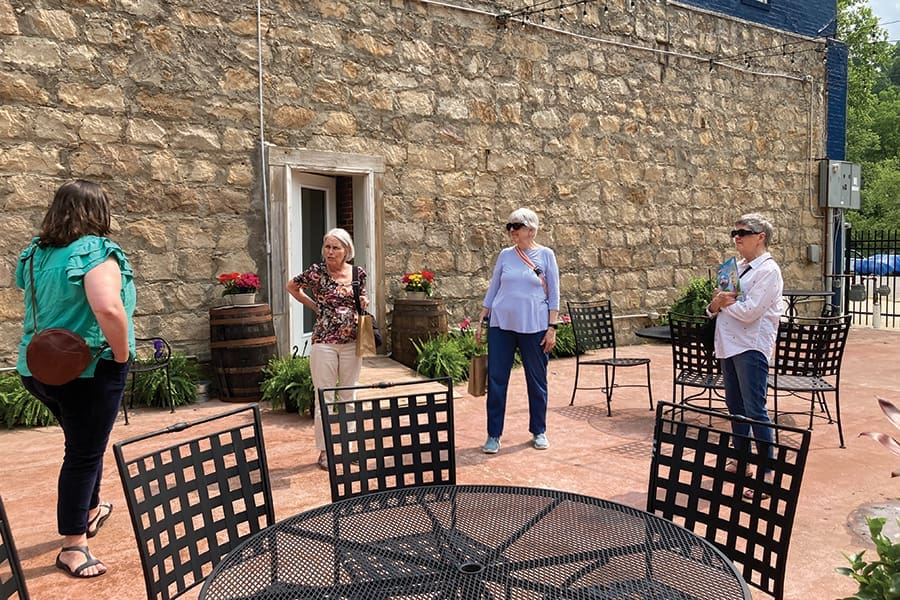
We drove into Harlan, had lunch and walked the downtown with Cole Raines, executive director of One Harlan County. The son of a Bell County coal miner, Rains came back to Kentucky after graduating from Harvard with a major in government and a minor in economics to be part of rebuilding Kentucky coalfield towns.
“It’s deeply personal to me,” he said. “It’s good to be back in the mountains.”

We saw graves of early Harlan settlers, which had been uncovered when the Ford Motor dealership was demolished to open up a space for hotel construction. We spent some time at the Harlan County Coal Miner Memorial, listing the names of more than 1,300 miners killed in the mines. We saw the soon-to-be-opened History of Harlan Museum and heard about plans to restore some of the historic Main Street buildings.
It was clear to us that Harlan was in good hands, with grant-savvy and committed young development staff at the helm.
The last morning of our reunion was spent under Black Mountain in Lynch’s Portal 31 coal mine. Our tour guide was a former miner who spoke with great skill about both the social history of Lynch (a “Cadillac town” built by a US Steel subsidiary US Coal and Coke) and the intricate balancing involved in mining. We learned about canaries in the coal mine, the unions, the recruitment of miners at Ellis Island and the structural details of supporting a mine built deep under a mountain. (The best questions on the tour came from my college roommate, Leslie, who’d been a math and Latin double major and saw the angles and arcs in the mine as problems to be solved.) We heard about accidents and union negotiations, about company stores and scrip. And two hours later, we stepped into the sunlight with a new understanding of what it means to live most of your daylight hours in darkness and uncertainty.
Just before we left Lynch to head north, we stopped at the coffee shop across from Portal 31, packed with Transylvania University students on a field trip with their philosophy professors. One of the young women looked at us and asked why we’d done the tour. We happily told our reunion story, telling her we’d been friends for over 50 years.
“A girl group! Very cool! I hope I can keep my girl group going that long,” she said.

And so. Four girl-group friends had four days and 800 miles on the road in southwest Virginia and eastern Kentucky. We’d been beneath and on top of the highest mountain in Kentucky, met some energetic change makers and history keepers, slept in a 100-year-old schoolhouse/hotel, eaten a lot of fried green tomatoes and ice cream and had a fine time doing it. When you hold a reunion in a place as beautiful, determined and welcoming as these mountains, it’s bound to be a success.
Maybe Leslie summed up this reunion best:
The beauty and peace of the Appalachian Mountains is a wonder.
Laughing and learning with dear friends is a marvelous gift.
The story above first appeared in our November / December 2023 issue.