Skip to content


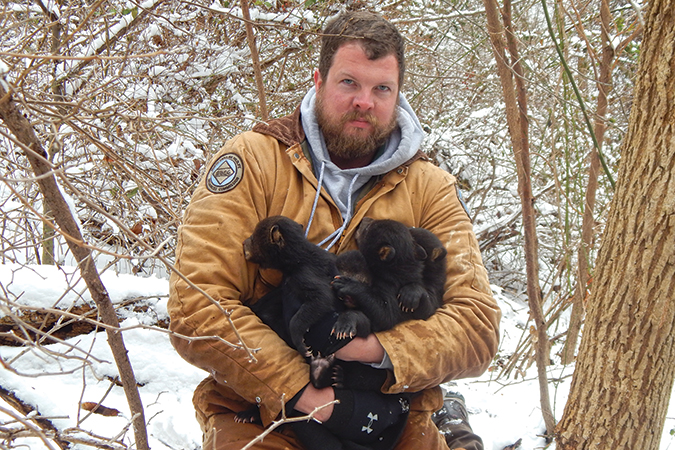
Wildlife biologist Justin McVey loves working with critters—the larger, the better.
Photo Above: Justin McVey, here at work with cubs as part of an N.C. State/N.C. Wildlife Commission project, talks about bears: “They’re super-adaptable and really smart. If there’s a bear in a habitat with a lot of people, it learns where the food sources are and how to get into a trash can readily.”
Photos Courtesy of Justin McVey.
Unsure of the direction his career should take but thinking he might make a good animal keeper, new college graduate Justin McVey began applying for jobs. Two facilities—the Dallas Zoo and the Kangaroo Conservation Center, a wildlife refuge for Australian critters in Dawsonville, Georgia—called him for face-to-face interviews.

After meeting with the owners at the Kangaroo Conservation Center, they asked if he wanted to help catch some joeys (baby kangaroos).
“I was gung-ho and thought that was super cool,” recalls McVey, 41, a wildlife biologist at the North Carolina Wildlife Resources Commission near Asheville. “I was really supposed to stand in this one place and kind of corral the joeys to go toward one of the other keepers. And I jokingly asked, ‘What do I do if the thing comes toward me?’ And they said, ‘Grab it by the tail.’
“None of us thought that would ever happen, but sure enough, a joey is coming right at me, I dive out, grab it by the tail. I got grass stains all over my pants and I came up with this joey,” he says, laughing. “And I’m thinking, ‘I better get this job. I just showed you I can catch a kangaroo.’”
Growing up in King, North Carolina, just north of Winston-Salem, McVey took to the woods—and all types of animals. He was still in high school when he got his foot in the door at a local veterinary office, first as the janitor and later in the kennel, taking the dogs’ temperatures, administering vaccines and performing other tasks.
“I was just trying to make a name for myself,” he says. “For an 18-year-old kid to have that dedication was something else, but it paid off.”
When it was time for college, McVey asked his mentors at the vet clinic for advice about a major. Their suggestion—zoology, which could lead to many different careers—turned out to be the right one.
After graduating from N.C. State in Raleigh, McVey briefly labored as a machinist before moving to north Georgia in early 2001 for his new job with the Kangaroo Conservation Center in the Blue Ridge foothills, where he did everything from preparing the marsupials’ meals to maintaining the buildings and leading public tours. He especially enjoyed interacting with the ‘roos, feeding them peanut butter sandwiches with vitamins and medicines tucked inside.
“Who can resist when you have a newborn joey that for some reason we had to hand-raise?” he says. “Bottle feeding those few critters was always cool.”
But his most rewarding experience, he says, involved caring for a young joey with a back injury. The vet wasn’t sure it would ever walk again; it might even be paralyzed. For several months, twice a week, McVey drove the baby ‘roo to a Cummings, Georgia, facility a half-hour away for acupuncture and massage. Back at the center, he became a sort of physical therapist, helping the joey learn how to move again and take a few steps. It completely recovered and was able to walk on its own.
A year and a half later, McVey and his new bride Ashley, a teacher, packed up and moved back to Raleigh.
“Being out there at the Kangaroo Center, with the other keepers, they taught me a lot about wildlife and introduced me to [the teachings of] Aldo Leopold (considered the father of wildlife ecology),” he says. “And I just really got interested in wildlife as opposed to regular animals.”
A good place to pursue that type of career, he realized, was at his alma mater. Thanks to his prior experience with both large and small animals, he landed a job at the N.C. State College of Veterinary Medicine, where for two years he cared for mice, horses and everything in between.
What he really wanted was a permanent position with the N.C. Wildlife Commission, but first he would have to work his way up the ladder. When a temporary job finally opened up, he became a captive cervid (deer) biologist before moving up to a technician post, managing Butner Falls Lake Game Lands north of Raleigh.
“That was really, really important for my wildlife career because it showed me how to do the actual on-the-ground habitat management, how to do prescribed burns, how to do plantings,” he says.
A permanent job with the Commission was still out of reach, though, so McVey talked his boss into authorizing tuition reimbursement so he could get a master’s degree in fisheries, wildlife and conservation biology. The father of two young boys, McVey thought he could be a stay-at-home dad while writing his thesis comparing the diets of coyotes and red wolves.
“But my newborn just wouldn’t nap long enough or at the right times,” he admits. Day care, although expensive, made it all work, and in July 2012, McVey finally got his dream job with the N.C. Wildlife Commission in District 9. He and his family moved to Horse Shoe, a small unincorporated mountain community in the western part of the state.
3 Things Justin McVey Wants You to Know About Bears
THEY’RE NOT OUT TO GET YOU. “Bears don’t really want to have anything to do with us. They’re kind of a more solitary animal.”
YOUR FOOD IS TEMPTING. “They’re super-adaptable and really smart. They learn really quickly so if there’s a bear in a habitat with a lot of people, it learns where the food sources are and how to get into a trash can readily.”
THEY NEED THEIR SPACE. “Don’t be afraid of bears, but respect them as a wild animal. Never feed them. Never get too close. Observe them from a distance. There’s no reason we can’t coexist with bears.”
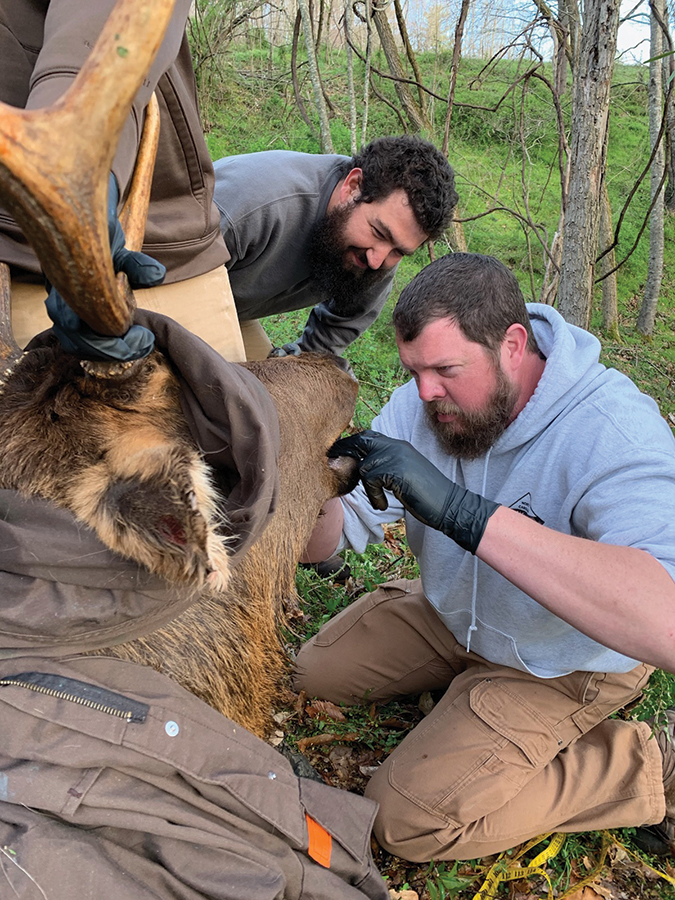
Working out of his home office, the burly, bearded biologist primarily assists land owners concerned about wildlife issues. If someone wants to attract more, or fewer, deer to his property, McVey can show him how to do it. Because many area residents worry about bears, McVey spends much of his time helping them separate fact from fiction, speaking to school groups, and making appearances at community meetings. He also manages the district’s wild elk herd, attaching collars and tracking the animals’ movements to see how far they roam.
A positive, glass-half-full kind of person with a passion for what he does, McVey loves knowing that his conservation efforts are going to help different species survive, “so that years down the road, my children’s children will have an opportunity to see elk on the landscapes, something that before 2001, hadn’t been around for 20 years.”
In his spare time, he hikes and tries to keep up with his athletic sons Braeden, 13, and Finn, 9, whose names are derived from characters in an Irish folktale called The Legend of Finn McCool.
Over the years, McVey concedes, the animals he protects have gotten bigger and bigger.
“I had a woman ask me one time if the animals that we worked with were based on our body size,” he says. “I’m a big guy, so I work with big animals. I do like that large, charismatic megafauna and working with those kinds of critters.”
The story above appears in our January/February 2020 issue.