Skip to content


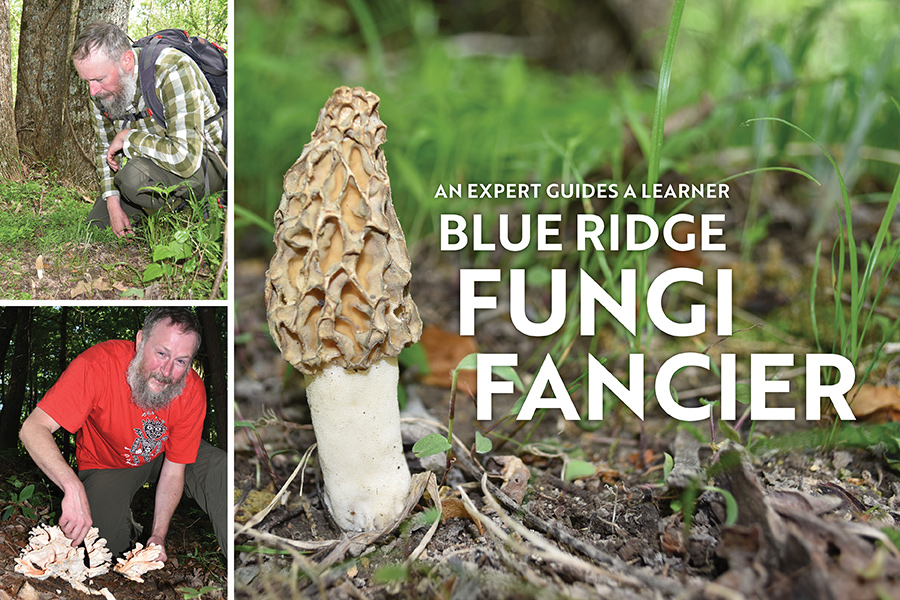
RIGHT: A yellow morel grows on a Botetourt County, Virginia mountainside. TOP LEFT: Roanoke, Virginia’s Jeff Huffman finds a yellow morel in a poplar glade. Note the three poplars growing together behind the mushroom. BOTTOM LEFT: Use a knife to remove an edible mushroom from its base. Doing so often enables the fungi to reproduce from the same spot. Courtesy: Bruce Ingram
Jeff Huffman has taken the time to learn what needs to be known about the wondrous world of mushrooms in the forest.

It’s early May, and Roanoke, Virginia’s Jeff Huffman and I are walking through a stand of tulip poplars on a Botetourt County mountainside.
“Look for two or three poplars growing close together or for a poplar that’s dead or dying and has cavities in it,” he says. “For some reason, those kinds of places give you a better chance of finding them. We should find some—the conditions are good. It rained two nights ago, and the soil temperature is in the mid-50s.”
A short time later, we find one of them—a yellow morel growing among some Christmas ferns and chickweed and just a few feet from a trio of poplars.
“You want it?” Huffman asks. Of course I do, as yellow morels rank as choice mushroom edibles and perform exquisitely in any egg or meat entree and in soups and salads.
Huffman, a receiver for Food Lion, is my mushroom mentor, and I’ve gone afield with him in places as diverse as a downtown Roanoke park and the Jefferson National Forest. Huffman himself has gathered mushrooms in the mountains of the two Virginias and in North Carolina and Tennessee. What caused him to become a fan of fungi?
“I’m an avid hiker, and I kept seeing all these mushrooms and wondering if they were edible,” Huffman says. “About that time I found out about the New River Valley Mushroom Club and went on one of their forays. Learning about mushrooms on your own is possible, but it’s much quicker—and safer—to go with a club and have mentors teach you what’s edible and what’s not.”
Now, he continues, he strives to learn more about all the mushroom species he encounters: what’s edible and what’s not, what’s poisonous and what’s deadly, and what might have medicinal properties.
“Many people don’t understand that most mushrooms won’t kill or hurt you, but their texture or flavor makes them inedible,” Huffman says. “But there are a lot of great eating mushrooms besides the black and yellow morels.
Huffman says that Appalachian cultures (both Native Americans and European settlers) used mushrooms for food and their medicinal properties. For example, lion’s mane is reputed to lessen stomach problems and help with memory issues. Turkey tail may aid respiratory health and be an antioxidant. The oyster mushroom, which rates as a choice edible, may promote cardiovascular health. The fungi fancier says he would welcome more research on the vitamins and minerals mushrooms provide as well as their medicinal potential.
Nearly two months later, Huffman’s and my next excursion is to a Roanoke City park. On that outing, his two major objectives are to find chicken of the woods and smooth chanterelles.
“Morels are my favorite wild mushrooms to eat, followed by chicken of the woods, and then any of the chanterelles,” he says. “I keep notes of when, where, and in what type of habitat I find mushrooms one year and then search for them in those places—and in similar places—the next year and following years.”
We walk for several hundred yards, then Huffman stops, consults his notes, leaves the path, and walks about 15 yards to a mature scarlet oak. Among the forest duff grows a chicken of the woods, probably a foot or so wide and long and a half-foot tall—the creamy white and yellowish/orange hues giving the fungi a distinct appearance. Huffman deftly severs the mushroom at its base, so that the fungi will have something to regenerate from in a month or two or a year later.
“Sometimes chickens grow on the side of dead or dying trees,” he says. “And sometimes, like this one probably is doing, they gain nourishment from that tree’s roots.”
Again we walk several hundred yards and stop where we see smooth chanterelles just barely poking up through the substrate.
“It’s been too dry for them to get any bigger, might as well harvest them,” Huffman explains. “It’s really too dry to look for anything else. Want to call me in a month or so and I’ll show you how to find boletes?”
It’s an offer I plan to accept.
Resources
- Appalachian Mushrooms: A Field Guide by Walter E. Sturgeon
- National Audubon Society Field Guide to North American Mushrooms by Gary H. Lincoff
- Asheville Mushroom Club: ashevillemushroomclub.org
- New River Valley Mushroom Club: sites.google.com/site/newrivervalleymushroomclub/home
- The West Virginia Mushroom Club: wvmushroomclub.net
Be Careful Out There
Fungi fancier Jeff Huffman offers this advice for gathering mushrooms.
- Don’t consume a mushroom new to you until an expert identifies it.
- Even then, only consume small quantities as even choice edibles can cause intestinal problems in some people.
- Also, save part of “new mushrooms” in case problems happen later.
- Never consume raw wild mushrooms because of potential stomach distress. Stir frying is a good option.
- Beware members of the Amanita family, which can cause hallucinations and even death. The aptly named destroying angel is one of the most dangerous mushrooms in our region. Amanita species often feature white gills, rings or veils around their stems, red spots on their caps, and cup-like structures at their bases.
- I once found what I thought might be smooth chanterelles, but they didn’t look quite right. I texted a photo to Huffman who instructed me to immediately cut open the stem and see if it was orange inside. I did so and saw the orange flesh which Jeff said proved the mushroom was the poisonous jack o’lantern.
The story above first appeared in our May / June 2022 issue.