Skip to content

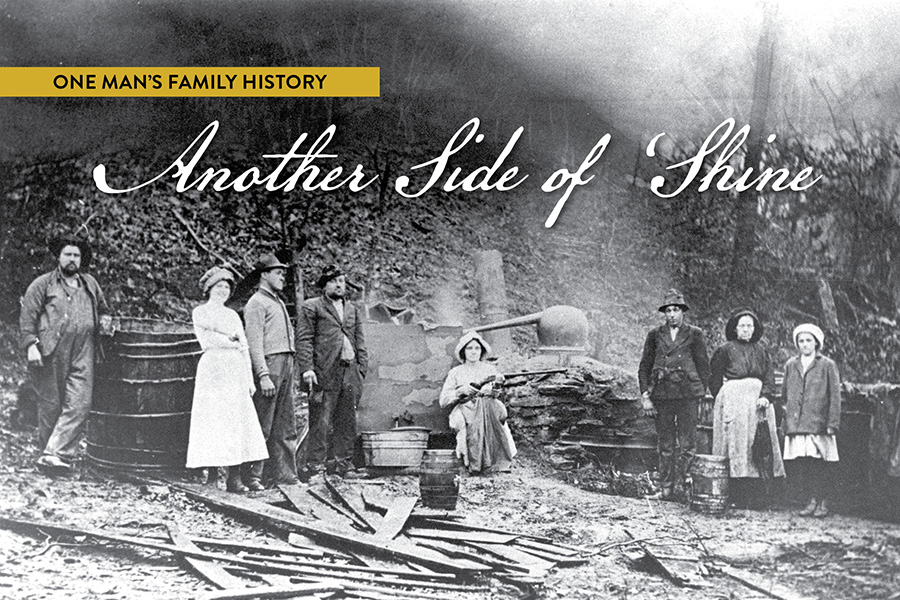
The caption that circulates with this photo reads: “Eight members of the Ingram family with their turnip-style moonshine still. Ida Ingram Nunley is the woman sitting and holding a shotgun.”
How difficult must it be to become the first male in your family for many generations back to make a living at something other than illegal liquor.

Franklin County, Virginia’s tourism slogan—“Moonshine Capital of the World”—has served the county well over the years, but has always struck a personal note with me.
But it was a concern I largely ignored over the years, until recently seeing once again a circa 1930s Internet-circulating picture (above) of Ingram family members involved in making moonshine. I cannot postively identify any of the people in the photo, but they are identified as my ancestors and they have faces that carry features of faces I know well.
The picture portrays a shotgun-packing woman and sundry, serious-looking, sullen men and women guarding a still and various barrels.
As the first male Ingram born in the Blue Ridge Region (our branch of the family) not to be involved in the moonshine business, I know that moonshine wrecked my mother and father’s families for generations back, and created a heritage uninterrupted until I grew up and became a teacher, author and conservationist rather than a moonshiner.
And while I in no way begrudge Franklin County and other destinations’ use of the “romance” of ‘shine—the fast cars, the encounters with the law, the wooded hide-outs and more—the surviving male of one of the primary families of that undertaking can find nothing to celebrate about the all-too-common dark side of this pastime—one that has led to death, alcoholism, hidden secrets, wife- and child-beating and ongoing trouble with the law.
The first death I know of involved my maternal Grandpa Everett in the early 1940s. Everett had tasked two of his sons, Eerie and Vernon, to do the hard labor at the still while he watched the logging road leading to the mountaintop creek where the still lay hidden. If Grandpa spotted Revenuers, he was to run up the mountain, meanwhile blowing on a whistle which was the sign for the sons to skedaddle. Mom’s side of the family was known for their weak hearts, and apparently the steep, quick climb was too much for Everett as he died face-down on the tote road, whistle still in his mouth.
Family lore had always given out that Grandpa died cutting timber on the mountain—the Revenuer escapade conveniently left out. As was the fact that he was a chronic alcoholic who beat both his wife and children, facts I learned while talking to Eerie’s wife, Pauline, in 2004.
In 1962 when I was age 10, my family attended a reunion at Grandma Maude’s Franklin County home. Grandma, who never remarried after losing Everett, was holding forth on some topic when I returned from a morning ramble up the creek and announced that I had found a still. Grandma immediately hushed me, then brusquely scolded that no still existed on the mountain. I was then ordered to leave the room, which I did. Later, listening through the door, I heard a family member say that “if a 10-year-old boy can find our still, we’ve got to move it.”
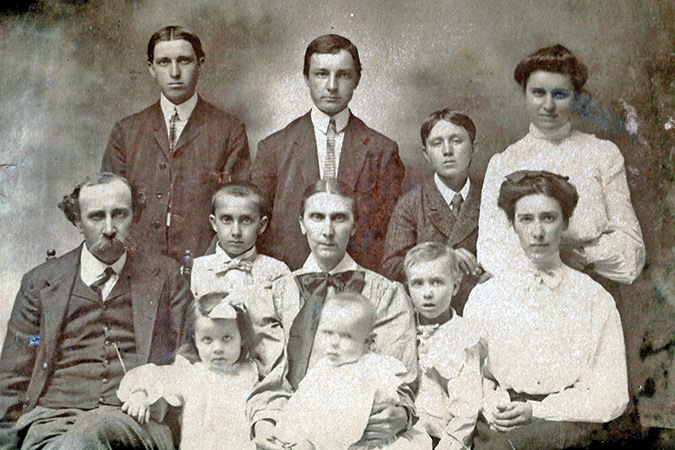
My father’s side was no better. My grandfather, Willie, who was more interested in drinking moonshine than making it, suffered from alcoholism from the 1920s until I was born in 1952. At his death in 1995, I learned that he only quit drinking because he “never wanted Bruce to see him like that.”
My father Roy was generally known as the “wild one” of the family, drinking heavily, running corn on twisting, mountaintop roads (with truck headlamps off) on ebony, moonless nights during the wee hours. He and my Uncle Vernon took me on one of their nighttime Franklin County prowls one summer night in 1964.
Dad, who could drive with one hand better than most folks could with two, effortlessly navigated a Ford pickup (lights off, of course) up the mountain while Vernon, head and shotgun hanging out the front passenger side window, shot snakes that had slithered onto the pavement. How Dad could see to steer and Vernon see to shoot, I’ll never know as I feared the entire night we were going to skid off the mountain into a steep hollow. We never did, however, and my father and uncle were thrilled to bag three snakes during their hunting trip. Just how many laws did we break that night?
Dad wasn’t running moonshine then because he had been arrested, along with some other men, for operating a chop shop for stolen cars in the late 1950s. Dad and his buddies had apparently found the stolen-car angle more lucrative and less dangerous than the corn whisky avocation.
As Dad grew older, he mellowed out some and contented himself with the occasional shady car purchase and selling stolen programs at NASCAR races. To Dad’s credit and especially to my Mom’s, he quit drinking because she told him he had to. Mom who had witnessed first-hand the ravages of moonshine, hammered into me my entire adolescent life that I was never to even try one drop of alcohol. Out of respect for my mother and my fear of becoming an alcoholic like many generations before me, I never have drunk any kind of alcohol.
Again, I wish Franklin County and all the other counties in our region much success with their various moonshine-themed festivals. Tourism is a major economic driver in the Blue Ridge, and I support any effort to help locally owned businesses to thrive. But I am too familiar with the dark side of corn to attend any of those gatherings and have lived a life that leaves me with no capacity to romanticize the lifestyle that existed in those bygone days.
The story above first appeared in our March/April 2021 issue.