Skip to content

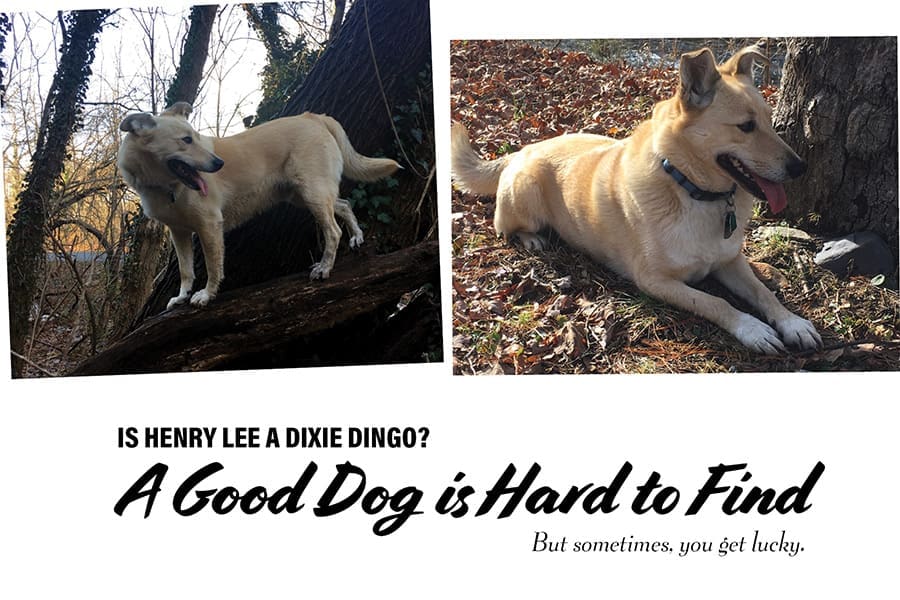
A good dog is hard to find. (But sometimes, you get lucky.)
This is a story about the right dog at the right time in the right place. A dog found wandering the roads in southwest Virginia, who made his way north to make his home with me. The hero? He came with the name of Joe. But now, he has the right name for a Dixie Dingo (aka Carolina dog): Henry Lee.

The office of Valley View Rescue in Alleghany County, Virginia, where I live, is a fine place to be on a cold day: warm and light-filled and animal-fragrant. Owner Amy Bennett Washburn has made a name throughout the region as a champion of abandoned pets, ranging from dogs and cats to ferrets and ponies.
“Tell me what you’re looking for,” she asks, pen in hand.
“A youngish dog. (I couldn’t handle putting another dog down any time soon.)
“But not a puppy.” (The thought of housetraining wasn’t a happy one.)
“Oh—and I want a big dog. A smart dog.” (My previous dog had been a Great Pyrenees mix who weighed not much less than I do, and despite his pie-stealing ways and the fact that he’d been responsible for tossing me into the street and breaking my pelvis, I’d loved his beautiful, philosopher presence.)
The next day, she called. “I don’t know if he’ll work for you…he may be too small. But I have a shepherd-Collie mix coming up from Wise County [Virginia] tomorrow—want to come meet him?”
Forty-five pounds of tan fur. With black-outlined almond eyes that looked like they belonged to an Egyptian queen. A light-colored patch spreading across his shoulders like wings, and a fishhook tail that spun in full circles when he saw me. (Okay, maybe it was the dog treat in my hand that made his tail spin.) He was mine.
Here are a few things I learned about Henry in his first months with me:
- He does not bark. Instead, he whine-moans and howls—very much like a coyote.
- He stares at anything that moves, his gaze unbreakable.
- He chews every bone and rawhide I give him…and then he buries it.
- And later, he roots it out with his snout for another round.
- He works hard to cover his trail, scratching dirt and grass on top of his scat.
- He runs up mountains like a deer (and once, was chased down a mountain by same).
- He walks across fallen trees over streams like a tightrope walker, never looking down.
- He hates small dogs that look too much like squirrels or groundhogs—and loves everything and everyone else.
- He can kill groundhogs without a sound, leaving them for my thanks by the garden fence.
- More people know his name than mine—in fact, he got a few write-in votes in the last local election.
Who was this dog/coyote/acrobat/murderer/joyhound? I had to know.
Confession. Although I have never done my own ancestry search, I sent away for a DNA test kit.
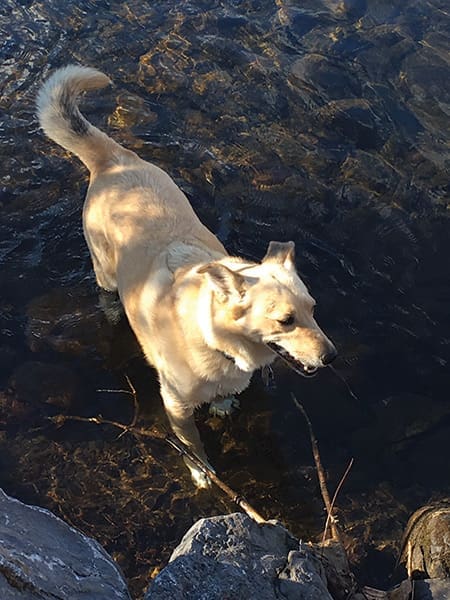
The results came back from WisdomPanel with no exotic surprises. Henry was, they reported, 25% Siberian Husky, 12.5% Beagle, 12.5% Collie, 12.5% Great Pyrenees, 12.5% Labrador Retriever, and 25% Mixed Breed Group. In a word, a mutt. A beautiful, talented, mysterious mutt.
More months passed, Henry and I walking three miles every morning in the woods, rain or shine. He had a fine time pretending that soon—very soon—one of those dozens of squirrels he treed would fall into his waiting jaws. Hope springs eternal in a good dog.
And then, scanning an issue of the wonderful online journal The Bitter Southerner, I saw a picture. Of Henry. Or Henry’s twin.
Written by Cy Brown, the article was a paean to his dog, Penny. And what I learned about her and her probable breed, the Carolina Dog, made all the pieces of Henry join together into a beautiful completed jigsaw puzzle.
Dr. Lehr Brisbin is the Godfather of the Carolina Dog breed (now recognized by the United Kennel Club). It was Brisbin who determined that Carolina Dogs (found wandering wild in the swamps of the South Carolina/Georgia line) were the only American dog with no European roots. The wild Carolina dogs are, Brisbin believes, descended from Asian dogs who followed humans across the Bering Land Bridge into North America 14,000 years ago. Where, in places with few inhabitants—like the Carolina/Georgia swamps—they remained their own breed.
There is, I learned from Brown’s story, a Carolina Dog Society of America, as well as a Carolina Dog History, Education, Research and Conservation group, both with their own Facebook pages. And log on to YouTube for good tutorials about Dixie Dingoes (which, Brisbane assures you, are not dingoes—just good, old-fashioned canis lupus familiaris).
I emailed WisdomPanel to ask if they tested for Dixie Dingoes/Carolina Dogs—they don’t, given that they’re so recently recognized, and not by the American Kennel Club.
Is Henry a bonafide Dixie Dingo? Who knows? He’s found his home, I’ve found my dog, and we live together in the mountains happily. I give him a warm bed, good food and lots of running; he gives me gnawed bones and dead groundhogs and unending adoration. Fair trade.
Call them what you want to: yaller dogs, porch dogs, American or Dixie Dingos, Carolina Dogs. You’ll know them by their habits, their appearance, their loyalty.
Sometimes, walking, Henry raises his nose into the wind, his Cleopatra eyes nearly closed, and you know he’s finding something from a long time ago—something from Asia, or the Carolina swamps and rivers, or the mountains of Wise County.
And then—every time—he turns back to look at me, and on we go.
The story above appears in our May/June, 2020 issue. For more subscribe today or log in to the digital edition with your active BRC+ subscription. Thank you for your support!