Skip to content



Summer is winding down.
By John Goss
Some of its splashy stars are arcing overhead, while others are descending in the west. Replacing them are more subtle luminaries rising in the east and southeast, heralding a quieter time of year with cooler weather and earlier sunsets.

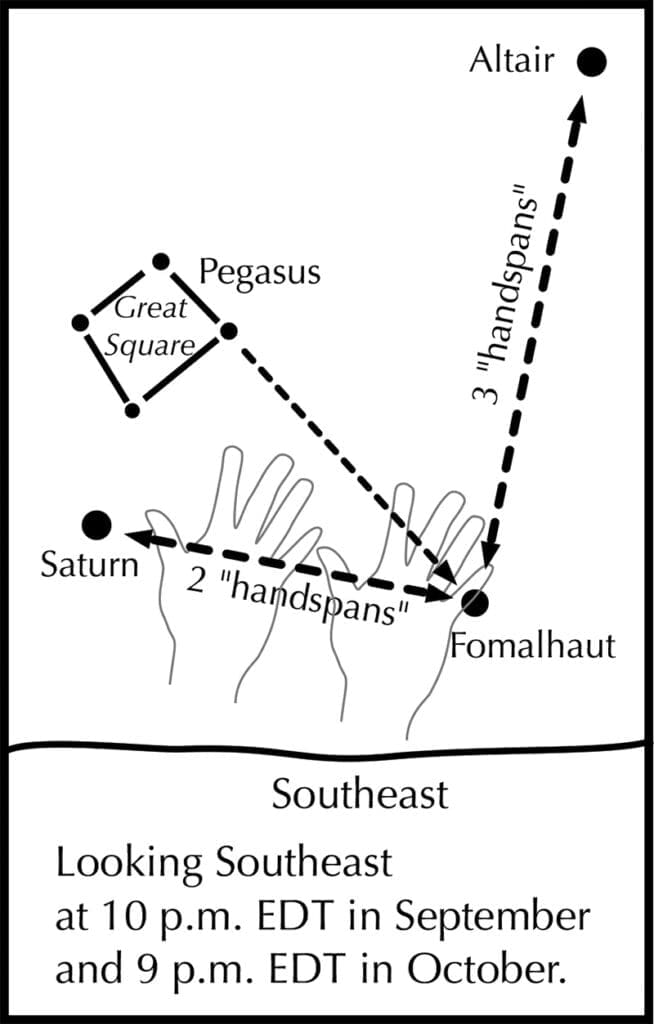
Low in the southeast shines what seems to be a solitary star: the 25-light-year-distant Fomalhaut. But it is not the brightest object in this area of the sky. Northeast of it shines not a star, but the planet Saturn.
How far apart are they? Stargazers would say that they are “two handspans,” meaning that they are the same angular separation as two handspans seen on an outstretched arm.
The next bright object from Fomalhaut is the 17-light-year-distant star Altair, the southern member of the Summer Triangle. It lies about three handspans north-northwest of Fomalhaut.
Visit a state park or a dark overlook along the Blue Ridge Parkway to see the calm sky in the southeast. Try out your handspans!
The story above first appeared in our September/October 2026 issue.