Skip to content



Advocates for the rare yellow-spotted woodland species fight to list it as endangered.
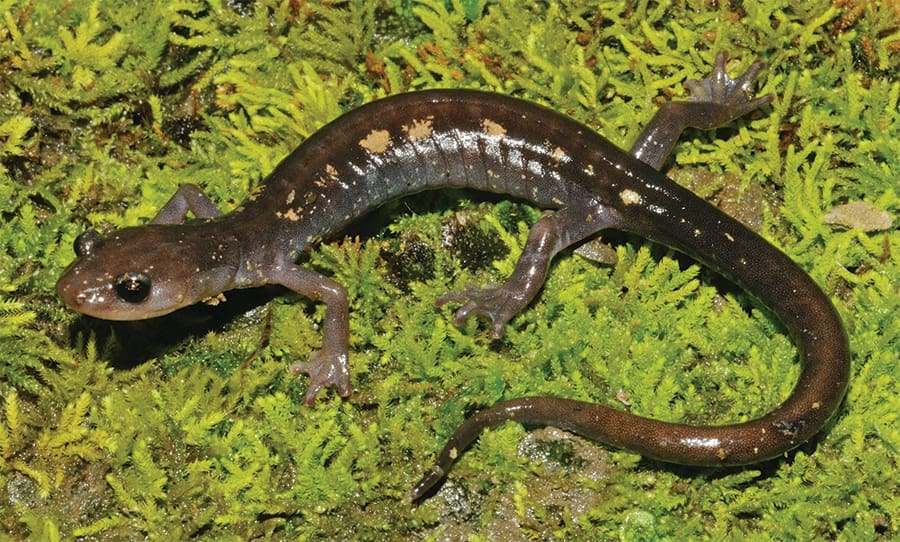
Photo Above Courtesy of Frank Gebhard.
Will Harlan sounds not just appreciative, but downright reverent as he describes the yellow-spotted woodland salamander. “They are gorgeous, beautiful salamanders,” he says. “They’re kind of a dark purple color, with really bright yellow spots that run along its back, and usually in two rows. They’re also slender and thin.”

Harlan is just as protective of the amphibian’s whereabouts. Although he confirms that it’s found primarily in West Virginia and eastern Kentucky, with a few in Tennessee, he declines to identify the sites, or even the towns where it’s been found. By most estimates, only 200 to 400 remain in the wild, and only 65 have actually been seen in 21 small outcrops scattered throughout Appalachia.
“Unfortunately, they’re targeted by poachers,” says Harlan, “because they’re so rare and so beautiful.”
Unlike the similarly named, and much more common, spotted salamander that lives in vernal pools in the eastern U.S., the lungless, yellow-spotted woodland species thrives in shale and sandstone outcroppings.
“That’s why this salamander is so imperiled,” Harlan says. “If you cut down the forests or blow up the shale and sandstone outcrops where they live, they get exposed to a lot more sun. Even if you don’t destroy their rock home, if you cut down the forests around that rock home and expose them to a lot of sun, they’re going to dry out and desiccate and die.”
This unusual species has adapted to an environment that no other salamander can live in, Harlan points out. There used to be a lot more of them because their habitat was abundant across southern and central Appalachia.
“Mountaintop removal mining, and surface mining more generally, targets shale and sandstone specifically,” Harlan says. “It has blown up more than 500 mountains across the Appalachians to get coal and almost certainly has blown up a lot of yellow-spotted woodland salamander habitat. So now it’s down to only a handful of locations.”
Some imperiled species have responded well to captive breeding, and scientists have been able to reintroduce them in certain areas. The yellow-spotted woodland salamander isn’t one of them. Even if they’re successfully reared in a zoo or other conservation facility, they can’t survive without their beloved mountain outcrops.
“And if we don’t take urgent action to protect those 21 outcrops, this salamander will go extinct,” Harlan says. In February, the U.S. Fish and Wildlife Service favorably responded to a petition to list it as an endangered species, and the year-long review process is now underway. Much of the land where yellow-spotted woodland salamanders live is privately owned, and state or federal financial incentives could be forthcoming.
Mountaintop removal mining has destroyed 1.4 million acres of forest in the Blue Ridge region, according to Harlan. And hard-to-find salamanders aren’t the only ones who rely on that habitat.
“They’re also the forests that we humans depend on for our recreation, for our drinking water. By protecting these salamanders, we’re protecting our own health, the health of our communities, the health of our drinking water, and the long-term health of this region.
“This tiny salamander is not going to stop coal mining by any means, but it could keep coal mining away from these last two dozen or so sites where it currently resides and maybe help protect a few more so that it can grow its population into the future.”
What You Can Do
Even if you don’t live in a part of Appalachia where the imperiled yellow-spotted woodland salamander is found, you can help protect the amphibian and its cousins, says Will Harlan, Southeast director and senior scientist at the Center for Biological Diversity in Asheville, North Carolina. It’s as simple as exploring the woods for salamanders—any kind. “They’re completely harmless. They don’t bite. They’re not any kind of threat at all to humans.”
Adds Harlan, “There are probably a dozen other rare, imperiled and even federally listed salamanders in our region. Just connecting to salamanders, recognizing them in the wild, appreciating the fact that we live in the Salamander Capital of the World—I think if we could elevate salamanders and take pride in them in our region, that would go a long way to giving them the protections they need to hang on a while longer.”
The story above first appeared in our July / August 2024 issue.