Skip to content

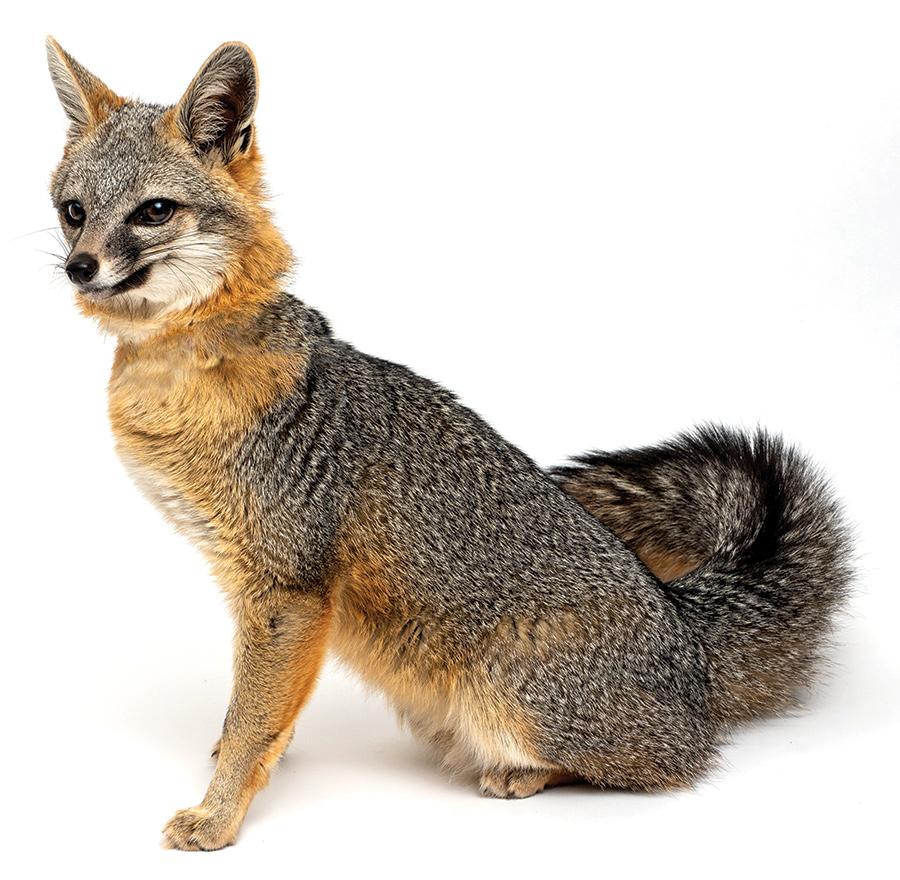
Courtesy: Jim Beasley
Increasing coyote populations in the southeastern U.S. may be having an impact on gray fox populations

For decades, wildlife biologists had been seeing fewer gray foxes, which were once abundant in the Southeast. But no one knew why. A few years ago, researchers like Jim Beasley set out to unravel the mystery.
“It could be habitat-related. It could be related to competitors like coyotes. It could be other things that we haven’t accounted for, like disease. So even if coyotes aren’t directly competing with diet, there can be some disease transfer,” says Beasley, an associate professor at the University of Georgia’s Warnell School of Forestry and Natural Resources’ Savannah River Ecology Lab, based in Aiken, South Carolina. “I don’t think anyone’s quite pinpointed exactly the driver, but my guess is it’s probably a combination of a number of these factors.”
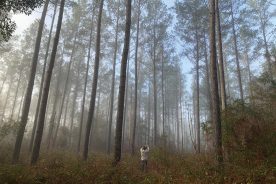
Unlike red foxes, which generally live along the edges of fields, the grays can actually climb trees and are typically found in forests. “They’re a charismatic species,” Beasley notes. “You may not see them very often, but they’re a very neat species to see. And they play a very important role in ecosystems.”
When he started his study, Beasley expected to find more use of natural “partitioning,” which allows different types of animals to share similar food sources without conflict. Gray foxes were probably co-existing just fine with the growing numbers of coyotes, at least in some areas of the Blue Ridge states, he thought.
But the research revealed little neighborly sharing among the two groups.
“In the plains area, which was the other area where we did this comparison, those species have been living together for centuries,” Beasley says. “So they’ve had the advantage of time to kind of work out how to share a space, how to utilize resources to their advantage without being negatively impacted by one another. In terms of historical timelines, coyotes haven’t been in the Southeastern area all that long, so not a lot of time has played out for [gray foxes] to be able to adapt. They just haven’t possibly had enough time to partition things out between themselves.”
This might explain why gray foxes are being spotted more often on suburban properties with trees; they’re simply avoiding the coyote competitors.
“Maybe that’s the more immediate response that we’re seeing, to kind of get along with the new neighbors, if you will,” says Beasley, whose co-authored study was published in the Journal of Mammalogy in 2021.
Regardless of what further research will disclose about the big picture of the gray fox-coyote feud, he adds, “It’s clear coyotes are not going anywhere. If we want to understand how the expansion of this new predator into this area is impacting other species in the food web, this is an important place to start.”
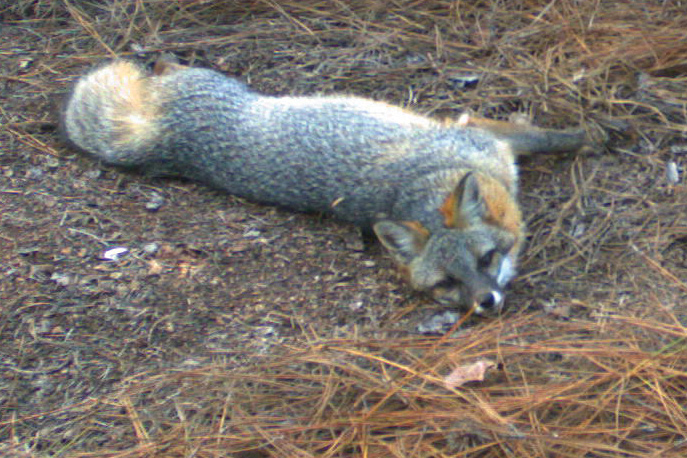
As scientists work to understand the scope of the decline and the reasons behind it, future plans to stabilize the gray fox populations, perhaps through habitat conservation, are “a little far down the road,” Beasley says. In the meantime, Blue Ridge residents can get involved by joining citizen science groups that collect information about wildlife in their backyards, often with cameras that sense movement at night and capture shots of the secretive, nocturnal species.
“Those are easy things people can do,” Beasley says. “And the nice thing is it can offer some pretty widespread monitoring that just isn’t possible with most resources that are available in a lot of research projects.”
The story above first appeared in our September / October 2022 issue.