Skip to content


Usually our Mountain Q & A asks multiple questions. For this 35th anniversary issue we’ve asked our founder and publisher just one: Would you tell us about the background, conception and realization of Blue Ridge Country?
Photo Courtesy of Richard Wells
One fertile seed of Blue Ridge Country magazine goes back to the late ‘60s, when the high elevations of the Southern Appalachians—particularly the area between the Great Smokies and the North Carolina High Country around Boone—suddenly became the epicenter for ski development south of the Mason Dixon Line. Small ski operations sprang up in Gatlinburg, Maggie Valley and Blowing Rock, and by the end of the decade Dr. Tom Brigham had spearheaded two “major” ski areas in Banner Elk, North Carolina, first at Beech Mountain and five years later at Sugar Mountain.

Soon those formative rope tows and t-bar areas gave way to Tyrolian villages, gondolas and the claim as the highest skiing in Eastern America.
Overnight, Mercedes and Porsches were buzzing around Atlanta with ski racks. Miami and Atlanta boasted two of the largest ski clubs in the country. Developers began building ski chalets and condos around these new winter resorts.
Newspapers didn’t quite know how to handle this new thing. Skiing was an Olympic sport, so the editors were inclined to assign coverage to the sports department. But in the South, if it wasn’t something you kicked, shot or hit, then it really wasn’t a sport.
That’s where I came in.
In 1970, while holding down my real job at The Assheville Citizen, I started freelancing for Ziff-Davis, publishers of SKIING magazine. I soon became their Southern correspondent (I think I elevated myself to Southern Editor) for their three ski-related journals, in the same way I had become the resident expert on skiing at The Asheville Citizen.
By default! Guy who doesn’t even work in the sports department, gets to cover this new “ski scene” because there’s nobody else to do it. And he wants to.
Realizing that a similar scenario was playing out at newspapers across the South, I reached out to editors at metro dailies in the region offering them a series of features on the Southern skiing phenomenon. The late Barton Morris, executive editor of The Roanoke Times, had himself caught the ski bug at The Homestead and was one of half a dozen newspapers that published my columns the next winter.
A year later I accepted a job at The Roanoke Times. The move northward along the spine of the Blue Ridge exposed me to new ski-focused developments in the mountains of Virginia and West Virginia and new opportunities.
As a result, in 1972, I published the first issue of SKI SOUTH, a 50,000 controlled circulation “Guide to Southern Skiing,” covering areas from Sky Valley, Georgia, to Deep Creek Lake, Maryland.
From that beginning our small publishing company added city magazines in Roanoke and Greensboro in the mid ’70s and a number of smaller titles during the ‘80s.
Pair that with the additional seed of my roots in the North Carolina mountains and the germination of Blue Ridge Country begins. I had grown up on a farm, filled with memories of church picnics on the Blue Ridge Parkway and day trips into the Great Smokies and Cherokee.
And in college at Mars Hill, I was lucky to have as my history professor Dr. Harley Jolley, author and foremost authority on the Blue Ridge Parkway.
Add those things up, and by the mid ’80s, I found my thoughts and hopes returning more and more often to the mountains.
Through skiing I had glimpsed the unique natural beauty of the Southern Appalachians. I had also seen some of the region’s premier resorts, wonderful old hotels built for the “carriage trade” from a bygone era—The Homestead, The Greenbrier, Grove Park Inn. At the same time, entirely new resort communities like Wintergreen and Massanutten in Virginia, and Snowshoe in West Virginia, were bursting onto the scene. The mountains were becoming more than a place to travel for a picnic or a summer weekend. They were evolving into places where you could see yourself having a wonderful second home, the ultimate retirement home or simply a great vacation.
Besides, my most trusted editor, Kurt Rheinheimer and his wife, Gail, were the most prolific hikers and outdoor lovers I knew. They had hiked and camped and skied all over the region.
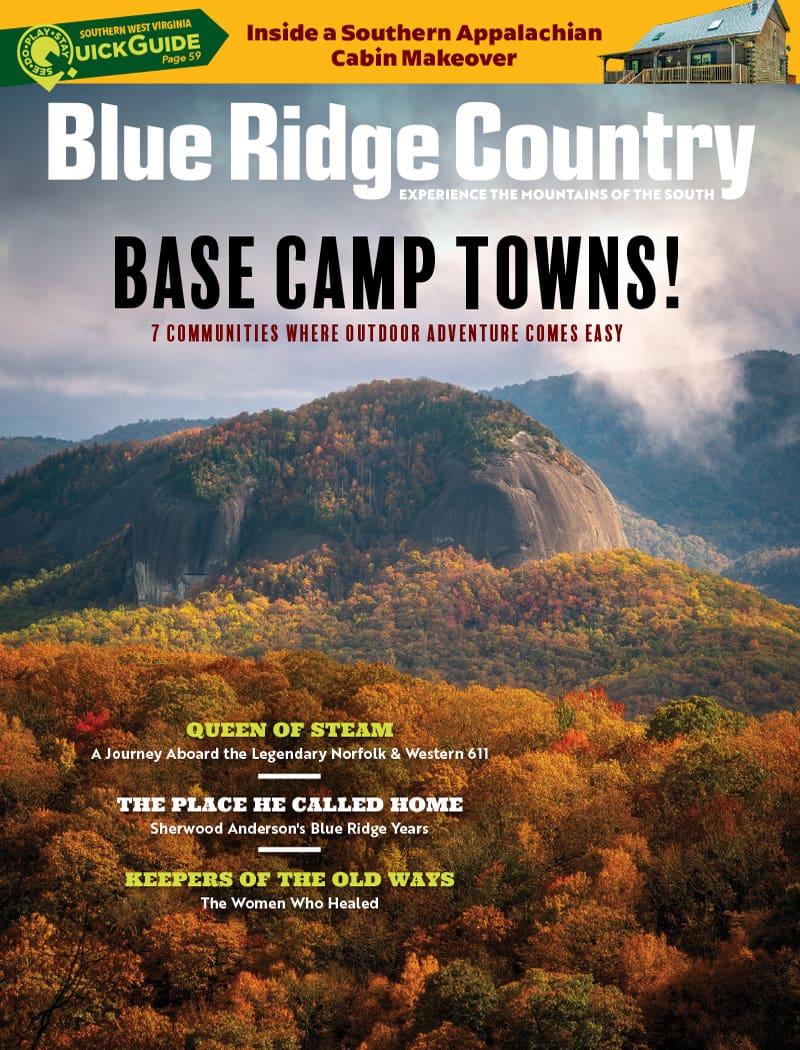
And so, with the support of a wonderful young staff, Blue Ridge Country launched in the summer of 1988 and was immediately embraced by the region and beyond. Our second issue carried a dozen congratulatory letters, and a national publishing group awarded Blue Ridge Country the Best New Regional Magazine of 1988.
Over the next few years, readership grew to over 300,000—through subscribers and newsstand sales throughout the Mountain South. We soon became a member of the International Regional Magazine Association, where we consistently outpaced older and bigger magazines for writing awards. Significant among those were the late Elizabeth Hunter’s “From the Farm” columns, which through the ‘90s and ‘00s were consistently judged the best in the international regional magazine realm.
Elizabeth’s columns and features led the way, but were not the only signature pieces we presented. Emblematic of those was Joan Vannorsdall’s 1991 visit to Sneedville, Tennessee, to generate a piece on the Melungeons.
That cover story served to both bring the magazine to full recognition in the region, and to deliver consciousness of his heritage to the late Brent Kennedy, who followed up with his own heartfelt piece in the magazine, the founding of the Melungeon Heritage Association and his book “Melungeons: The Resurrection of A Proud People.” As a result, thousands of people came to understand a heritage they had not known about or had been denied in family histories.
The contributions of so many other writers are too numerous to mention here, but see Kurt’s column at the front of the book for details on many of them.
Among those are many stories that contributed to the magazine’s role in environmental advocacy—including pieces on the plight of the red spruce on Grandfather Mountain from acid rain, the decline of the fraser fir from the same cause and the demise of the eastern hemlock due to the invasive hemlock woolly adelgid.
Those stories and others helped point me toward support and leadership of Friends of the Blue Ridge Parkway. Through Friends, where I was honored to serve as president from 1999 to 2012, thousands of trees were planted along the Blue Ridge Parkway corridor to buffer the scenic highway from encroaching development, especially around Asheville, Blowing Rock and Roanoke. We also helped cut invasive trees that were blocking the views from many of the parkway’s iconic overlooks.
That time with Friends and more directly these three and a half decades of Blue Ridge Country have been the richest and most gratifying years of my life. To be able to present and help protect the mountains where I grew up and have lived all my life is both a privilege and a responsibility that sends a wave of humility through me each time I think about it.
You, our readers and advertisers, are the reason for one man’s deep personal, professional and preservational realization. Thank you so very much.
The story above first appeared in our July / August 2023 issue.