Skip to content

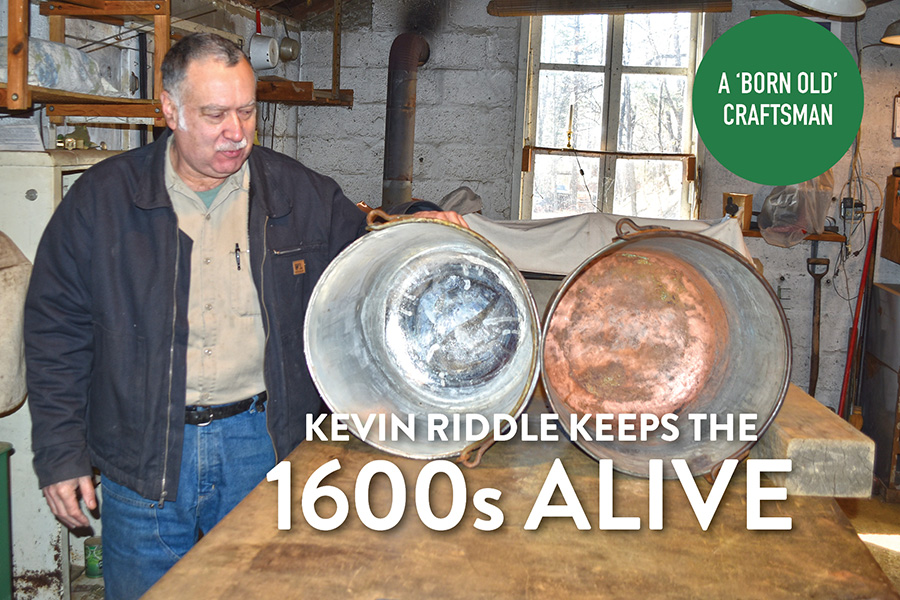
Back in a hollow of the Virginia mountains, Riddle is one of only a few people in the nation to still practice the art of tinsmithing.
Photo Above: Kevin Riddle displays two reproduction copper pots from Virginia’s Jamestown Settlement. He has mostly restored the pot on the left; the one on the right has not been re-tinned yet.
Photos Courtesy of Bruce Ingram.
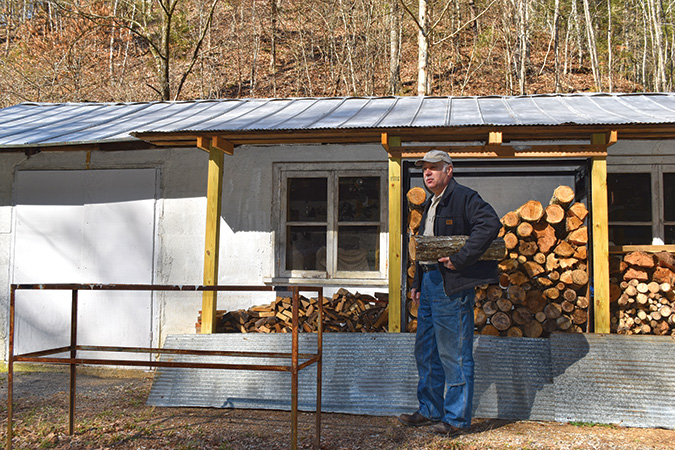
To reach his workshop, coppersmith Kevin Riddle told me I’d have to drive past a dirt road off a tertiary road, go over a hump, look for an orange traffic cone he always puts out when visitors are coming, then turn right into a hollow.

That’s how directions often work in our mountains when folks live in the “suburbs” of tiny mountain communities—in this case Eagle Rock (population 2,037 or thereabouts) in Botetourt County, Virginia.
Riddle’s family has owned the 100-or-so-acre spread since the early 1930s when H.M. Vise, his great-grandfather, purchased it. Riddle is the type of Blue Ridge mountain craftsman one might well expect to live at the backend of a hollow.
“I’m 60, so technically I’m a Baby Boomer, but I don’t consider myself one,” Riddle says, the disdain evident in his voice for the generation of which he is a member. “Some Boomers seem to think they discovered old-fashioned craftsmanship, but I was brought up by family members who practiced this lifestyle.”
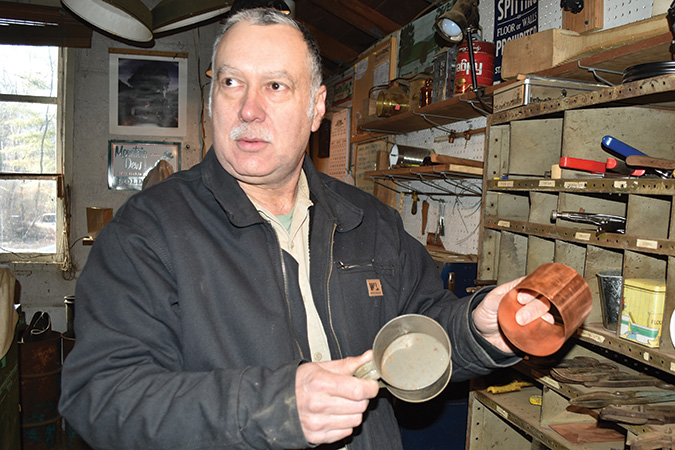
Riddle is one of those individuals that mountain folks describe as being “born old.” So it’s not surprising that on the day of my visit, he is re-tinning a 15-gallon copper pot that he originally helped make for the Jamestown Settlement some 15 to 20 years ago.
“The Jamestown interpreters want authentic copper pots like those that were at the settlement in the early 1600s,” Riddle says. “Those kinds of pots wear out at a certain point and have to be re-tinned. It’s a messy, smelly business to re-tin them. It’s best done outside and upwind from where you’re standing.”
Although Riddle is an accomplished woodworker and blacksmith, his specialty is as a coppersmith. In fact, the Virginian believes he is one of only four or five people in the United States to practice the art of tinsmithing for his copper creations. For example, the Jamestown Settlement employees, who play the roles of 17th century settlers, don’t use the fragile original copper pots during their daily interpretative presentations to tourists. They cook on the authentically made reproductions craftsmen like Riddle have made for them. And those pots eventually show wear just like any cookware will. That’s where Riddle’s tinsmithing ability enters.
“After a thorough cleaning, a pot is heated over a propane burner, and then I add tin, in stick form, to coat the pot with a protective layer,” he explains.
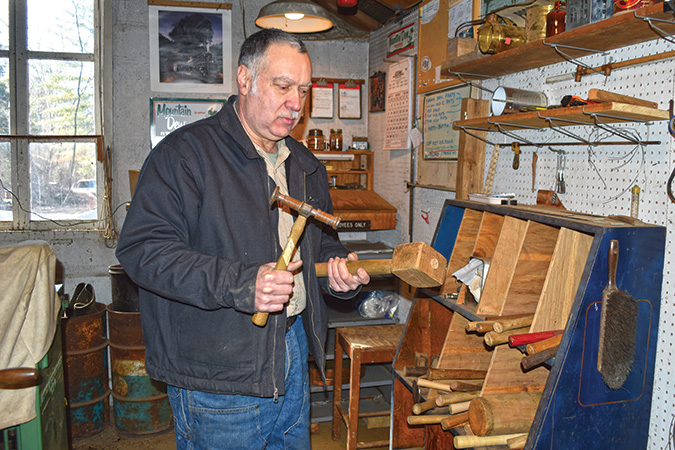
Although Riddle employs a modern propane burner for work such as this, many of his tools are handmade or are of early 1800s’ designs. He shows me a homemade mallet (which can be used to shape kettle bottoms) and a sheet metal hammer (used to seal copper seams, for example).
“It’s not that these old tools are so much better than their newer counterparts,” Riddle says. “It’s just that the way that many of these tools were designed was perfected about 200 years ago. Really, the only difference between many modern tools and their older versions is that the modern ones have rubber or plastic handles. It’s like once you’ve invented the wheel, you can’t make it any rounder.”
Next, the craftsman shows me a thin sheet of copper, several feet long and wide. This piece of metal will become future pans, washtubs and apple butter kettles—some of his primary creations. Riddle tells me the metal came from Revere Copper, a company Paul Revere started in the 1700s.
“It may take me a full five-day week to turn a sheet of copper into, say, a kettle or washtub,” he says. “This is a manual operation where I have to be super-efficient and have an A-B-C-D-type procedure. To help me, I use books which were written 100 years ago, that contain patterns which were created 50 years before that.”
Riddle says one of his biggest challenges is how to make a decent living by practicing “the old ways in a new economy.” He adds that he has almost found that niche where he can compete. The future?
“I figure I’ve got another 10 to 15 years where I can still turn out high-quality work,” he says. “Then I’d like to be able to pass on this knowledge to someone who would continue this way of life.”
The story above appears in our November / December 2020 issue.