Curios: The Cakewalk – Sad Past, Glorious Present

The present-day cakewalk at Fries, Virginia, involves live music, a small donation and gleeful participants.

A storied American custom built of pain lives on with joy.

Photo Above: The present-day cakewalk at Fries, Virginia, involves live music, a small donation and gleeful participants. Courtesy of Kevin Combs.

It apparently started before the Civil War, with this piece of heart-rending history: Black slaves would dress up in their finery — eventually, silken top hats and tails for men, lacy ruffles for women — and strut in an exaggerated, straight-backed way to mock their white owners. These competitive performances were sometimes called prize walks, with the winning dancers awarded a cake.  

With the end of slavery, the cakewalk dance style became ever more elaborate, featured in minstrel shows and migrating to the dance halls of Paris. Some were memorialized in early moving pictures. 

Since then, the racial aspect has faded and cakewalks have become local fundraisers, like a low-tech GoFundMe. Several organizations in West Virginia host them, and Southwest Virginia Cultural Center & Marketplace now holds a cakewalk the first Thursday of every month; and  the Lays Hardware Center for the Arts in Coeburn, Virginia, has also started a Friday cakewalk at their jam.
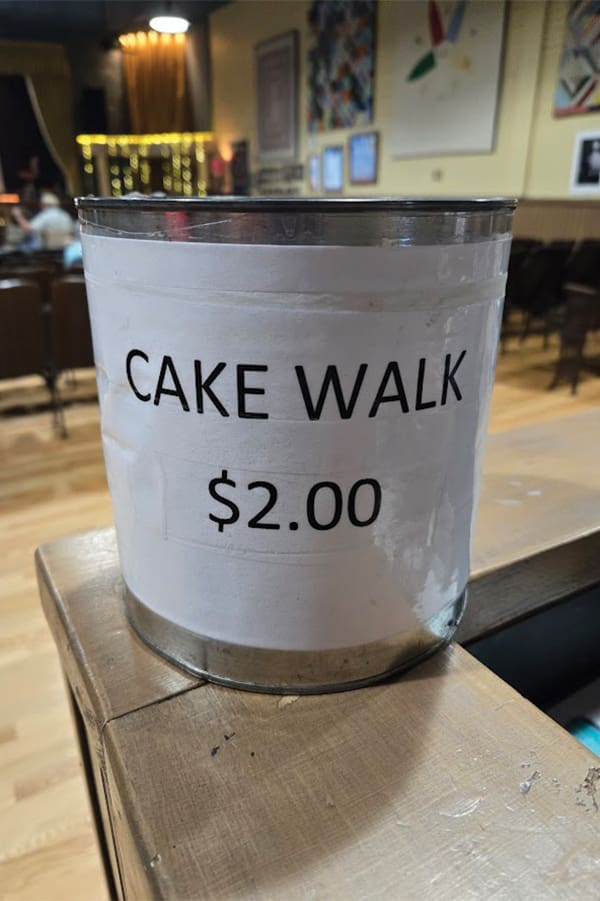
Photo Courtesy of Nan Chase

At the Fries (pronounced “Freeze”), Virginia, old-time music jam every Thursday night, the cakewalk during intermission operates like musical chairs, minus the chairs but with a numbered square on the floor for each person who pays $2. It’s not unusual for 50 or 60 walkers to vie for a dozen cakes and other baked goodies that neighbors bring, or fresh vegetables, flowers and farm eggs in season. The record cakewalk numbered 72 people, snaking through the lobby. 

“When they win you’d think they were winning a million dollars,” muses Yvonne Burr, the director of the Historic Fries Theatre, home to the jam and cakewalk.  

Admission to the jam is free, so the cakewalk acts as a painless fundraiser to keep the lights on. During the jam’s first hour, up to 40 musicians gather to make sweet music as couples waltz around the perimeter or stay in place to flat-foot. There might be a dozen each of fiddles, banjos and guitars, plus a few bass fiddles, dulcimers, mandolins, autoharps and even a washboard. Local fiddler and National Heritage Fellow Eddie Bond calls the tunes and adds vocals. 

Photo Courtesy of Kevin Combs

Before the intermission, Burr circulates with a tin can collecting money. “A lot of people give more than $2, and say keep the change,” she says. “Or they say, ‘I don’t want to walk’ and throw the money in anyway.” 

 In 2025 alone, the Fries jam attracted visitors from as far away as Texas, Hawaii, Ireland and Germany, and there’s definitely visitor karma. During one recent cakewalk three couples traveling together from North Carolina won three cakes among them.


The story above first appeared in our January / February 2026 issue.

You Might Also Like:

A Virginia Historical Marker stands at the entrance to Green Pastures.

Green Pastures’ picnic area was build by the Civilian Conservation Corps in the late 1930s.

Green Pastures Reborn

When it officially opened in 1940 — in the depths of the Jim Crow era — Green Pastures was likely the first U.S. Forest Service recreation area in the nation constructed for African Americans.
Chimney Tops Trail in Great Smoky Mountains National Park rewards a steep climb with exceptional mountain views.

Inset: Gatlinburg, Tennessee’s Chimneys Picnic Area sits beside the West Prong of the Little Pigeon RIver.

11 Picnics with a View

These bucket-list destinations are perfect spots to kick back, enjoy a delightful meal and take in the great outdoors.
Vernon and Toni Wright turn grains grown on their family farm into freshly distilled spirits.

Virginia Century Farm Home to New Distillery

For nearly 200 years, Vernon and Toni Wright’s family has raised corn, cattle and quarter horses at Hill High.
Spring wildflowers bloom early in the New River Gorge of West Virginia. From the photographer: “Bloodroot is one of the first to blossom, fittingly coming in around the first day of spring. The reddish sap that exudes from all parts of the plant — especially the root — when cut is what gives bloodroot its common name.”

Scenes of Spring: A Photo Essay

Our contributing photographers reveal the fresh sights and subtle joys of the season.
At Hayfields State Park in Highland County, Virginia, easy-to-moderate trails wind through quiet forests and past historic structures.

Greening the Blue Ridge Region

New Parks, Healthier Creeks, Solar Power, Protected Lands and More.
John Scrivani bags female flowers from atop a 40-plus-foot-tall chestnut.

The Good Steward

Veteran forester John Scrivani dedicated his career to restoring American chestnut trees — and helped lay the groundwork for the effort’s next generation.
The pond next to the visitor center entrance is easily accessible and a beautiful spot for a selfie or an afternoon of plein air painting.

How to Make a State Park

The opening of Virginia’s newest state park marked the culmination of a community dream carefully nurtured for more than a decade.
Daybreak at Elakala Falls in West Virginia’s Blackwater Falls State Park on a perfect winter morning.

Quiet Beauty of Mountain Winter: A Photo Essay

Our contributing photographers braved the chill to capture the calm of the cold months.
The original Academy burned in 1911.

Curios: When Lynchburg, Virginia, Was King

With the likes of Douglas Fairbanks, Duke Ellington and Louis Armstrong performing live, the little city with the highest per capita income in the U.S. was a national hotspot for entertainment.
Hendersonville, North Carolina, offers a walkable downtown.

Slow Travel in 7 States

It's perfect for the mountains!

CALENDAR OF EVENTS