Skip to content


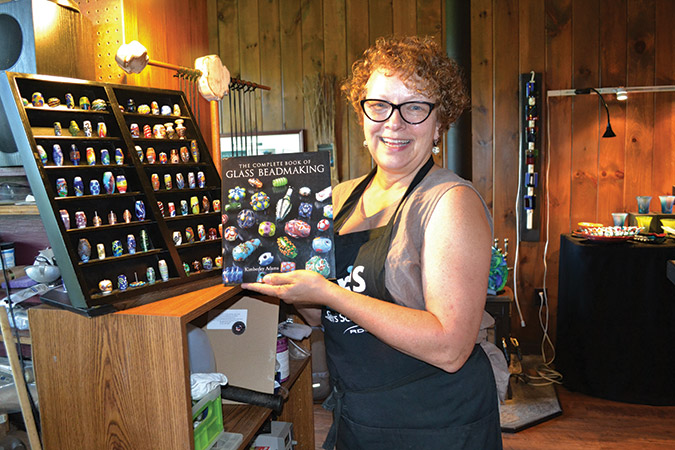
Kimberley Adams – Glass artist (Tiger, Georgia)
Artists can often trace their interests back to an earlier time in life. From there, the road to following that dream can twist and turn, come to abrupt stops, or perhaps not be mapped until decades later. For Kimberley Adams of Tiger, Georgia, a career as a glass artist began when she was 28 and starting her family.

“I distinctly remember analyzing the stained glass in church when I was a child. I’d look at the details of leaves, figures, colors, shapes, and particularly the transparencies that changed as the light shifted through the seasons. That was probably the beginning of my fascination with glass,” she says. “It just took me two decades and a lampwork bead class to get started!”
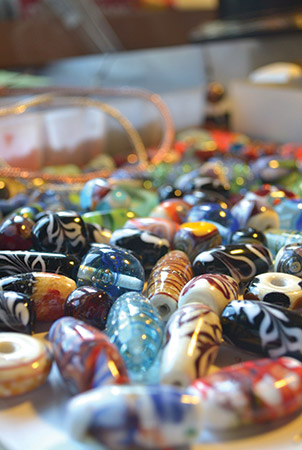
The lampwork process requires tending the movement of melting glass under a torch’s intense flame. A delicate dance with gravity and surface tension forms the balls of molten glass around a mandrel (steel rod), which ultimately become one-of-a-kind beads. With a new workshop in the basement at that time, Adams says glasswork was her third child.
“I was so taken with it, the kids would have to call me to supper several times,” she laughs. “Eventually, my husband at the time quit his job, and we took our art on the road. That became what mommy did for a living to my kids,” she says.
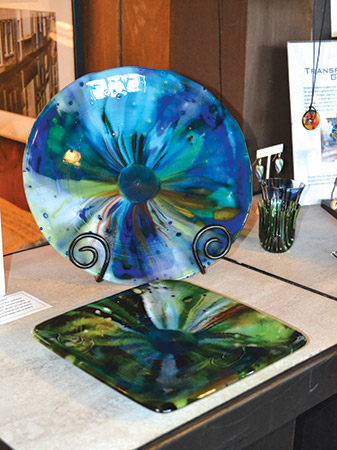
Through the years, Adams has taken many classes and created thousands of hand-made glass beads that became all manner of jewelry items. Ten years ago she started working with sheet glass and creating kiln-formed pieces, such as platters, bowls, cups and other functional items. This is a completely different process that begins with creating a blank by arranging strips and bits of glass into a pattern.
“There are an infinite number of ways to design the blank,” she explains. “Keeping in mind that glass wants to be a particular thickness to behave right, the first firing in the kiln will fuse the pieces into one. For smooth surfaces, the glass will be heated to a molten temperature; and for texture, lower temperatures achieve a tack fuse. Also, certain colors under really high temperatures can create new colors; and sometimes colors interact with each other. To encourage some of this, adjustments in the kiln, like oxygen levels, can pull different metals in the glass to the surface – changing the colors.”
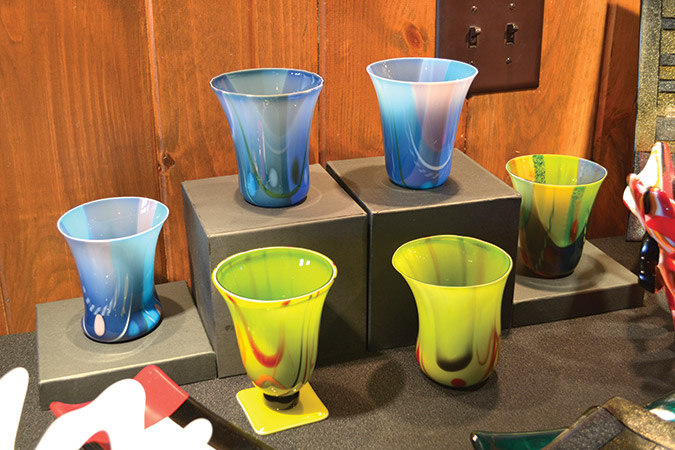
Once the blank has cooled, shaping can begin. “The piece is put over a form (to either sink into or lay over), and the second firing gives it dimension. It’s just enough heat, which I call the ‘slumping temperature,’ that allows the glass to slowly move around or into the mold. You can never be completely sure what you’ll get. You can’t go back and change it. So you have to enjoy surprises,” Adams says with a smile. “Glass firing is a very careful process of heating up and controlled cooling (annealing). Too quickly and you end up with stressed glass.
“The cold working (techniques that happen after pieces are cold) can take up to two hours to complete.” Adams says, “This is where you get the opportunity to set yourself apart as an artist. It takes patience and time; and some people find that this part is quite ‘Zen.’”
When she’s not in the workshop (in a horse barn with her veterinarian husband atop a north Georgia mountain with views for miles), this glass artist is participating in art fairs, shows, and teaching a program she created for a girls’ summer camp. “We have a lampwork and fusion studio where sixth grade through high school girls can learn glasswork. Several have come for years. They have such a connection with it that some of these girls do absolutely magical things. I very often hear the students say, ‘Did you see what that glass did?!’ Their joy is my biggest reward as an artist.”
Adams is available for teaching at her workshop.
Looking ahead: “I’m very excited to learn screen printing on glass at the John C. Campbell Folk School” (where Adams has taught on a fairly regular basis). “I’ve always taken pictures of patterns, like when we go scuba diving and when our horse Gypsy was out in the rain—she had the sweetest curly hair. And, I think this technique will be perfect for using those patterns.”
Breaking news! Adams is working on a new wholesale line of kiln-formed pieces that will be available in gift shops and galleries.
Kimberleyadams.com | “The Complete Book of Glass Beadmaking” by Kimberley Adams | Northeast Georgia Arts Tour – artstour.org | North Georgia Arts Guild – northgeorgiaartsguild.com
Starter Kit/Inside Tips from Kimberly Adams
“There’s something incredibly valuable about watching people work glass in person. So take a class from someone with experience who enjoys teaching. Do NOT learn this from online videos!”
Get books for references.
For lampwork, the costs to start will be around $500 for a torch, tools, regulator, glass, safety wear, and so forth. An inexpensive basic kiln is recommended for proper annealing (cooling).
For fusion (kiln-formed), there are kits available with all the basics to start including a kiln.
“Figuring out the cause when things go wrong with kiln-formed glass is the most challenging.”
For fusing glass, you must have extremely even heat “coming down on the glass” in the kiln.
Take a business class. Learn about spreadsheets, costs, margins and all the other business knowledge if you want to make a career of this. “Then you’ll be able to eat!”
The story above is from our November/December 2019 issue.