Named after Revolutionary War hero General Andrew Pickens and chartered in 1868, the small Upstate city of Pickens is blooming.
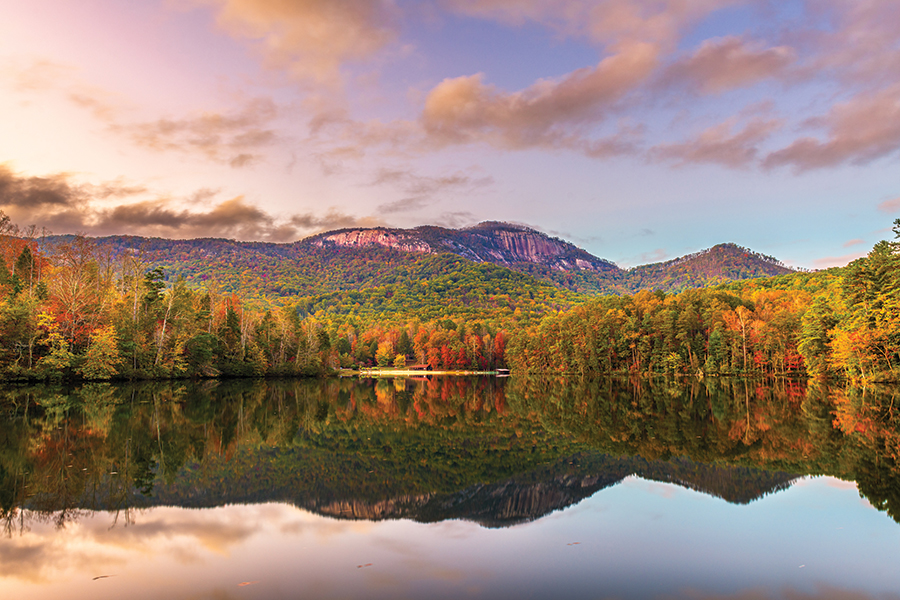
Photo Above: Table Rock Mountain rises high above Table Rock Lake.
A few days before I arrived in Pickens, the 40th annual Azalea Festival brought thousands to the city for two days of good food and music, cruise-in cars and arts and crafts, a pie contest and carnival rides.

So things were pretty quiet in Pickens when I walked Main Street . . . the perfect time to look and listen and learn the essence of this little city of 3,374.
City Administrator Tim O’Briant brings both economic development and journalism skills to the town he now calls home.

“The mountains drew us here,” he says. “Pickens is an oasis in Pickens County—it sits right at the foot of the state parks. It’s only 60 miles from Asheville, just 20 miles from Greenville and Clemson. Easley is 15 minutes up the road.”
O’Briant is determined that his new home will maintain its character. “We don’t want long highways with subdivisions. We want to maintain the feel and appearance of a beautiful small town. We want the right kind of growth and development to fit our character. The growth around Pickens has gone crazy—but Pickens has not. We have the gracious gift of having time to appreciate what we have.”
So I set off to learn the character of Pickens, the little city with big dreams. What I found was in turn surprising (a downtown with a century-old hardware store as well as a thriving creperie and the Bee Well Honey Natural Market); fascinating (a 1902 jail turned into an art and history museum); surprising (three massive flea markets milling with eager shoppers); historically illuminating (the Hagood Mill and Hagood-Mauldin House); and beautiful (Table Rock State Park and the Blue Ridge Escarpment).
I may have missed the Azalea Festival, but being in Pickens on Wednesdays is an astonishment. The Bargain Exchange and the Pickens County Flea Markets sit side by side on Walhalla Highway, booths spreading across acres of fields and under pavilions. Hundreds of cars. Hundreds of vendors. Thousands of customers. It seems safe to say that anything you can imagine is for sale at one of the booths. Both markets are open only on Wednesdays; both open at dawn and close early in the afternoon. The scope and spectacle are worth stopping for…and if you’re lucky, there will be a bluegrass jam session happening in the shade.
Across town is a third boundless yard sale, The Market at the Mill. Housed in a former cottonseed oil mill, The Market is home to budding entrepreneurs.
©Pickens SC
“We have a number of Main Street businesses who started out at Market at the Mill, realized they had something going, and moved into a full-fledged storefront on Main Street,” says Lisa Turnick of the Pickens Chamber of Commerce.
Pickens historian Wayne Kelley has a good take on his town’s flea market identity. “The flea markets? It’s economic and social, too. We’re trendsetting—people all over the country are buying used now, right?” he says with a smile.
Kelley is a Pickens County native who left home for southern California to work in the record and film industries and returned after he retired. “My ancestors came here after the Cherokee Territory opened up for white settlement in 1782 or so…I’m related to hundreds of people here. It’s colorful to figure out how we are all interconnected.”
Kelley believes that maintaining the identity of Pickens will draw people, pointing to the Hagood-Mauldin House as a prime example of its story. Undergoing historic restoration and filled with antique furnishings, the house was donated to the Pickens Historical Society by its last owner, collector Irma Morris. Tours are given the third Saturday of the month, April through October.
Down the street and around the corner, the Pickens County Museum of Art and History is in the restored 1902 jail building. Home to two annual art shows and filled with well-displayed historical items, it’s a fascinating place to wander.
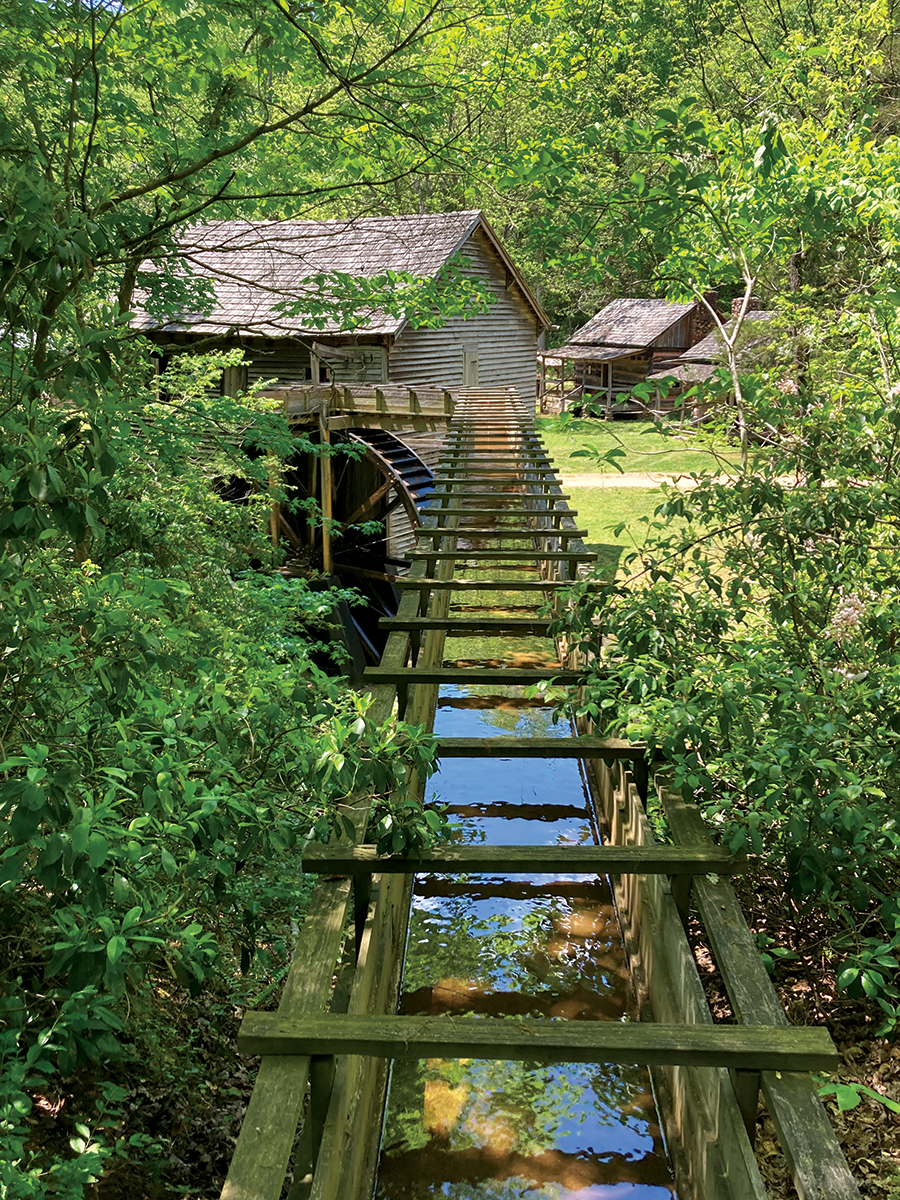
As is the Hagood Mill Historic Site and Folklife Center a little ways outside of town, where walking trails wind through reconstructed log cabins and past a blacksmith shop, a moonshine still and a still-operating 1845 water-powered gristmill that produces milled flour, cornmeal and grits sold onsite. There’s also a building filled with Native American petroglyphs. Nothing here feels engineered or staged. It’s a lovely place where Upcountry South Carolina history shows itself quietly and beautifully.
This is, it seems, what Pickens does best. With the support of its strong historical society, the jail-turned-history-and-art museum, a winding walk/bike trail connecting two cooperating towns, the biggest flea markets I’ve ever seen and new businesses up and down Main Street, Pickens seems well on the way to doing what City Administrator O’Briant hopes for: “We want to tell the story again.”
Remembering Frank Kilgore
Six years and 35 towns ago, I started writing “Our Blue Ridge Towns.” I’ve driven thousands of miles in our mountains and met many skilled movers and shakers, devoted to their towns in creative, progressive ways.

But it was my time in tiny St. Paul, Virginia, (population 829) with lawyer and writer Frank Kilgore in 2019 that showed me first-hand what it meant to be a rock-solid supporter of a place and its people.
Kilgore was the son and grandson of coalminers, and read the law to pass the Virginia bar. He knew the deep history of his region and shared it well—his law office included a 2,000-square-foot museum of Appalachian items he’d collected over the years.
Frank wasn’t afraid to use his knowledge and writing skill to champion his place, writing numerous op-eds challenging the Appalachian stereotypes that run rampant. He put his efforts into building high-achieving coalfield public schools, as well as the Appalachian School of Law and the Appalachian College of Pharmacy. His love of the outdoors and determination to increase tourism resulted in the Mendota Trail, Clinch River State Park, and Channels Recreation Area.
Post-COVID, Frank focused on bringing new residents into Wise and Russell counties. “The mayor said I was repopulating our community one Yankee at a time! Hey, we need their energy and new ideas,” he emailed recently.
Frank Kilgore died at 72 in mid-July. He will be missed. May he be remembered with gratitude for his generous gifts and true grit.
The story above first appeared in our September / October 2024 issue.