Skip to content


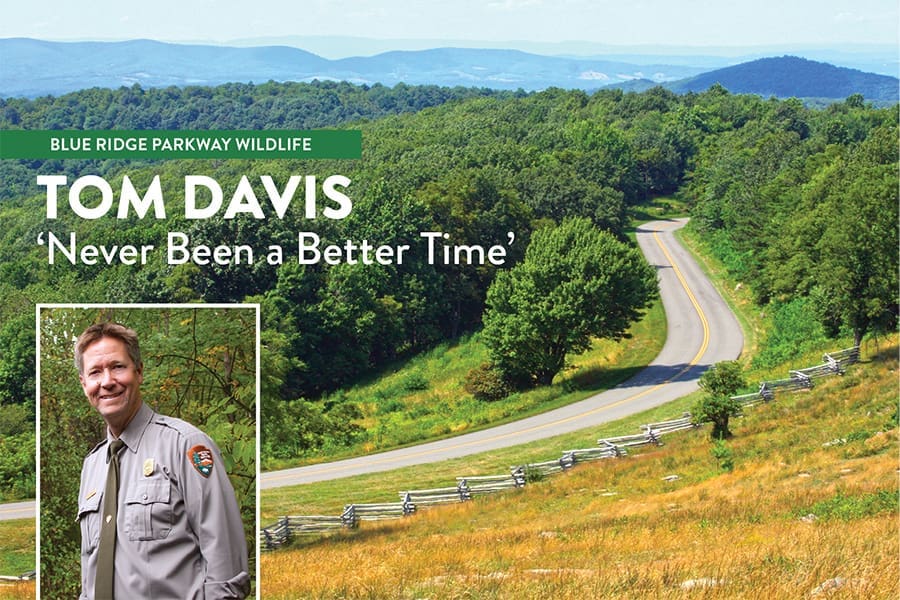
The Blue Ridge Parkway’s easy-flowing 469 miles offer a variety of habitats. INSET: Tom Davis says he’s been drawn to nature for as long as he can remember. His earning of an environmental science degree coincided with the park service’s push to tally plant and animal species, and a career was born. Tom Davis
The 30-year veteran of inventorying wildlife along the Blue Ridge Parkway says the springtime presence of more than 250 bird species along the roadway is just one example of why he wakes up blessed.

Pioneering wildlife biologist Tom Davis knows the habitats, overlooks and critters of the Blue Ridge Parkway better than just about anyone. That’s because he’s spent nearly 30 years tallying plant and animal species, and working to improve land management practices throughout the 469-mile corridor.
“It’s definitely a dream job,” confides Davis, who lives in Blacksburg, Virginia, with his wife, Kathy. The National Park Service hired him in 1994 to help with the Parkway’s first comprehensive wildlife survey. He’s since reconnoitered most of its 93,390 acres.
“I worked hard and paid my dues to get to where I am,” says Davis, “but it’s a rare occasion that I don’t wake up in the morning feeling blessed to be doing what I’m doing.”
Monday may find him wading knee-deep through rare, high-elevation wetlands searching for endangered bog turtles. Tuesday, listening for northern saw-whet owls in an isolated old-growth forest by moonlight. Wednesday, working with farmers to tweak early-summer mowing schedules and boost breeding success among grassland birds. The list goes on.
Here, we talk with Davis about what it’s like to spend so much time in one of America’s most beloved national treasures, about 30 years of changes, pandemic closures—and why he thinks there’s never been a better time to visit the Parkway.
How did you come to work on the Blue Ridge Parkway?
I’ve been drawn to nature and the outdoors for as long as I remember. But that kicked into high-gear when I was 10, when my parents bought 20 acres of undeveloped land in the eastern panhandle of West Virginia. We started camping there on most weekends, and my brother and I spent all of our time exploring nearby woods, streams and fields.
Those experiences inspired me to pursue a career in conservation. I started working at Great Falls National Park with the Youth Conservation Corps and wound up getting a bachelor’s degree in environmental science from Shepherd University.
I was lucky because, when I graduated, the National Park Service was going through a kind of renaissance. There was a big push to tally plant and animal species, and [use the data to] develop better land management plans. I was able to get jobs in places like Shenandoah National Park helping with things like surveying brook trout and exotic plant populations. I hopped around doing surveys and other things for various parks for about four years, then got hired by the parkway as a district biologist.

From a conservation standpoint, how did things look when you started working for the BRP?
Back then, nobody really knew [how many different species of plants and animals were] living here, much less how they were distributed. So, land management approaches were often sort of just shooting in the dark.
And there was no comprehensive strategy at all. In one district, the lead ranger might be interested in migratory songbirds. In another, reptiles. Well, they’d focus on related species and habitats, and leave the rest alone. Districts didn’t collaborate, so it was all pretty disjointed.
Fast-forward to the mid-’90s. The forests—much of which had been replanted when the park was formed and various adjacent lands were protected in the 1930s—were starting to mature. Plants and animals that’d been pushed out by logging and deforestation were returning. Meanwhile, NPS was acquiring lots of new land from retiring farmers. Four other biologists and I were hired to come in and basically usher in a new era at the park.
They wanted to be able to do things like target threatened species like peregrine falcons, or rare habitats like southern Appalachian high-elevation bogs, and figure out how to increase their distribution. That started with us getting out there and scouring the park, figuring out what was here, where it was, and in what abundance. Once compiled, that information revolutionized how land was managed in the park and ultimately led to major changes and successes.
Can you tell us about some of the biggest changes and successes you’ve seen so far?

One of the most obvious is black bears. When I started, I’d see one or two a year, tops—and those were almost exclusively in southwest Virginia. Now, because of reforestation and adapted management approaches, their numbers have increased dramatically. I deal with them on an almost daily basis.
Similarly, it wasn’t long ago that raptors like bald eagles, golden eagles and peregrine falcons had all but disappeared. All three are once again nesting in the park. In fact, we’re currently using trail-cameras to try and pinpoint areas where golden eagles are feeding, with an ultimate goal of bolstering their numbers.
Then, in far southwest Virginia and North Carolina, you have elk that’ve spilled over from reintroduction efforts in the Smokies. The species was hunted to extinction in North Carolina by the late-1700s. Now there’s a herd of about 200 roaming around. Seeing them grazing in a high, grassy meadow around sunset? Man, that’s incredible.
Something that’s less obvious is habitat restoration, particularly for birds. We’ve done a lot of work in that department. During spring migration, there could be upward of 250 species in the park at any given moment. I’ve personally documented more than 112 in the Rocky Knob Recreation Area alone (Milepost 167)—including [prized sightings like] hooded, golden-winged and prothonotary warblers, golden-crowned kinglet, blue-gray gnatcatcher, red-eyed vireo and yellow-billed cuckoo.
I’m particularly proud of efforts around high-elevation grassland birds. The past decades have revealed most of these species are experiencing serious population declines. Accordingly, we’ve been doing things like restoring habitats and altering mowing schedules to boost breeding activity. And it’s working. We’ve been seeing a lot more of the rarer birds like bobolinks, eastern meadowlark and Savannah sparrows, to name a few.
You say there’s never been a better time to visit the Parkway. Why?
When I first started, I saw this job as a springboard for getting a position out West. But the more time I spent along the ridgeline, the more I fell in love. It didn’t take long to realize I wanted to stick around. Most people know that the parkway is the nation’s longest linear park, but few understand what that means in terms of ecological diversity. There are countless overlooks, for sure. But being able to explore so many different habitats in one park? That’s utterly unique.
I’ve been here almost 30 years and, honestly, I feel I’m always discovering something new. There are just so many great, hidden spots to explore. For instance, last summer, I did a bunch of hiking in the Smart View Recreation Area near mile-marker 154. It has this amazing old-growth forest full of huge, gnarly oaks, which also happens to offer fantastic birding opportunities—most notably, a breeding population of cerulean warbler. You can hike around in there, see beautiful birds, then picnic in a meadow with 2,500-foot views of the piedmont. To me, it doesn’t get much better than that.
The story above first appeared in our May/June 2021 issue.